

Spoiler Warning: This article discusses major plot revelations from Twin Peaks, Twin Peaks: Fire Walk with Me, and Twin Peaks: The Return, including the identity of Laura Palmer’s killer and the ending of the 2017 season.
Noir is often associated with crowded cities, crooked cops, dangerous women, desperate criminals, smoky rooms and people whose pasts refuse to stay buried. Yet some of the genre’s most unsettling stories take place far from the city, where the promise of a quieter life and a respectable community can hide just as much corruption. Twin Peaks understands that contrast better than almost any other television series. It turns an idyllic logging town into a place where the familiar becomes frightening and the search for the truth leads somewhere far more disturbing than anyone expects.
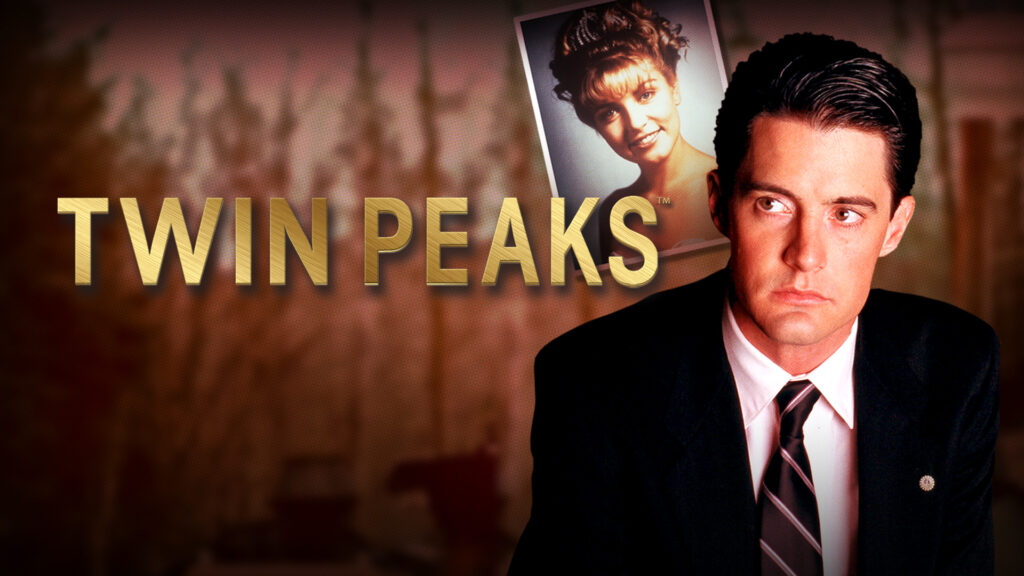
Created by David Lynch and Mark Frost, Twin Peaks debuted on ABC in 1990 and begins with the discovery of Laura Palmer, a popular high school student whose body is found wrapped in plastic on the shore. Her murder brings FBI Special Agent Dale Cooper to the town, where the case quickly points to something larger than a single crime. What he finds is a community of secret affairs, criminal enterprises, fractured families and hidden identities, all of it far removed from the wholesome image Twin Peaks presents to outsiders.
That contrast is what makes Twin Peaks such a compelling piece of noir. The genre has always been interested in the gap between what people pretend to be and what they actually are, and Lynch and Frost take that idea somewhere colder. The town’s innocence is part of the deception. Beneath the diners, friendly neighbours, beautiful scenery and comforting routines, the darkness surrounding Laura’s death cannot be separated from the web of secrets and personal tragedies that existed long before the investigation began.
Dale Cooper is an unusual figure in the tradition of noir detectives. Rather than being cynical and emotionally detached, he is remarkably enthusiastic about life. He loves good coffee, cherry pie, the Pacific Northwest scenery and the people he meets, even when they baffle him. His curiosity is genuine, his instincts are formidable, and he treats the people of Twin Peaks with a kindness that stands out against the town’s secrets. Cooper arrives believing the truth can be found, even if the road to it runs through dreams, intuition and a Tibetan-inspired method as much as conventional police work.
He is not untouched by darkness, though. His own past carries the kind of wound noir loves. Cooper and his partner and mentor, Windom Earle, were assigned to protect Earle’s wife, Caroline, a witness to a federal crime. Cooper and Caroline eventually fell in love, but he let his guard down during their assignment, and both were attacked. Caroline was stabbed to death, while Cooper survived his injuries. Cooper suspected Earle was responsible, and the tragedy destroyed their partnership. Earle was eventually institutionalized before escaping and following Cooper to Twin Peaks, obsessed with revenge. In The Return, Cooper’s own shadow takes a more literal form, making him a stranger and more interesting noir hero than he first appears.
Cooper’s investigation shows how easily noir can exist outside its traditional urban surroundings. Twin Peaks is surrounded by forests, mountains and wilderness, but that isolation only makes the menace feel more pervasive. There is nowhere to escape the town’s secrets, and the corruption Cooper uncovers is not the work of a few bad individuals. It is woven into the community itself, reaching into the homes, relationships and private lives of people who otherwise seem perfectly ordinary. The picturesque scenery becomes almost a cruel joke, offering the appearance of safety while concealing something deeply wrong.
The show’s roots in classic noir are not subtle, either. Laura Palmer’s name comes from Otto Preminger’s 1944 noir Laura, which follows a detective who falls for the woman he believes has been murdered. Cooper, like that detective, comes to know Laura largely through the people who remember her, gradually piecing together an image of someone who may have been very different from the person they thought they knew.
The series also draws on melodrama, soap opera, horror and surrealism, which lets its mysteries unfold in ways that rarely follow the expected rules. Peyton Place, the 1957 small-town drama that Lynch and Frost cited as a primary influence, helps explain the affairs and scandals simmering under the town’s surface. Meanwhile, the cast supplies familiar noir archetypes. Josie Packard and Catherine Martell bring elements of the femme fatale tradition, while Audrey Horne plays with manipulation, desire and danger in ways that make her far more complicated than a straightforward archetype. Ben Horne’s business dealings and One Eyed Jacks, the criminal establishment across the Canadian border, supply the town’s connection to a more conventional underworld.
Then there is everything noir never planned for: the strange behaviour of certain characters, the unsettling dream sequences, figures like the Giant and BOB, and the growing sense that the town exists alongside something far more sinister in the Black Lodge. Noir has always been concerned with uncertainty, but Twin Peaks takes that uncertainty beyond crime and human behaviour. Sometimes the mystery is not simply what happened, but whether the world itself can be understood.
Laura’s importance becomes clearer as the story moves past the original murder investigation. For much of the series, she exists through the memories, assumptions and revelations of those who knew her: the town’s beloved homecoming queen, a troubled young woman, and someone whose private life was far more complicated than anyone wanted to acknowledge. The series eventually reveals that her father, Leland Palmer, was responsible for her murder while under the influence of BOB, the malevolent entity that had taken hold of him.
Twin Peaks: Fire Walk with Me transforms that understanding. Released in 1992 as a prequel, the film drew a hostile response from critics and audiences at the time, but it has since been widely reappraised. Rather than treating Laura primarily as the victim whose death drives an investigation, it follows her final days, her suffering, and the abuse behind her death, placing her at the centre of her own story. It is a devastating shift in perspective, and it makes the original mystery feel far more tragic.
That brings Twin Peaks closer to some of noir’s most enduring concerns. The genre has repeatedly explored exploitation, abuse, power, and the ways vulnerable people become trapped by circumstances beyond their control. In Fire Walk with Me, the darkness is no longer something the audience discovers through clues and interviews. It becomes an experience that is difficult to escape. The mystery may have drawn audiences into Twin Peaks, but Laura’s story is what gives the franchise much of its emotional weight.
By the time Twin Peaks: The Return arrived on Showtime in 2017, twenty-five years after the original story, the series had become even harder to categorize. It does not simply offer nostalgia or try to recreate the original show. Much of it takes place far from the town itself, in Las Vegas, New York, South Dakota and Texas, while Cooper is split between a lost, blank version of himself living as Dougie Jones and Mr. C, his malevolent doppelgänger. The world around them grows fractured, unpredictable and often deeply disturbing.
This is where Twin Peaks becomes especially fascinating as noir. Noir detectives are often caught in systems they cannot control, chasing answers that reveal how little power they have. Cooper begins as the exception, a man who seems able to move through the corruption around him without losing his humanity, but the franchise gradually challenges even that optimism. In the final two parts, his attempt to undo Laura’s death does not restore anything. It leads to a different, stranger world, and the story ends with Cooper asking a question he cannot answer: “What year is this?” Laura, now living as Carrie Page, responds with a scream. The moment leaves the fate of Laura and the reality Cooper has entered just as uncertain as ever. Knowledge does not bring peace, justice does not always restore what has been lost, and confronting evil does not guarantee that evil can be defeated.
There is something fitting about Twin Peaks ending up in such an uncertain place. Its world has always held kindness and cruelty, humour and horror, beauty and ugliness side by side. A cup of coffee, a familiar face or a quiet conversation can offer comfort, but that comfort is never entirely secure. Evil does not always announce itself, and it does not necessarily disappear once someone recognizes it.
Twin Peaks may begin with a murder investigation, but its greatest achievement is turning the conventions of noir into something far more expansive. It understands that the most frightening secrets are not always hidden in distant cities or criminal underworlds. Sometimes they exist in the places people call home, behind the faces they trust, and within the communities they believe they understand. Twin Peaks looks like the kind of town where nothing terrible could happen, and that illusion is exactly what makes it such a compelling noir nightmare.


