

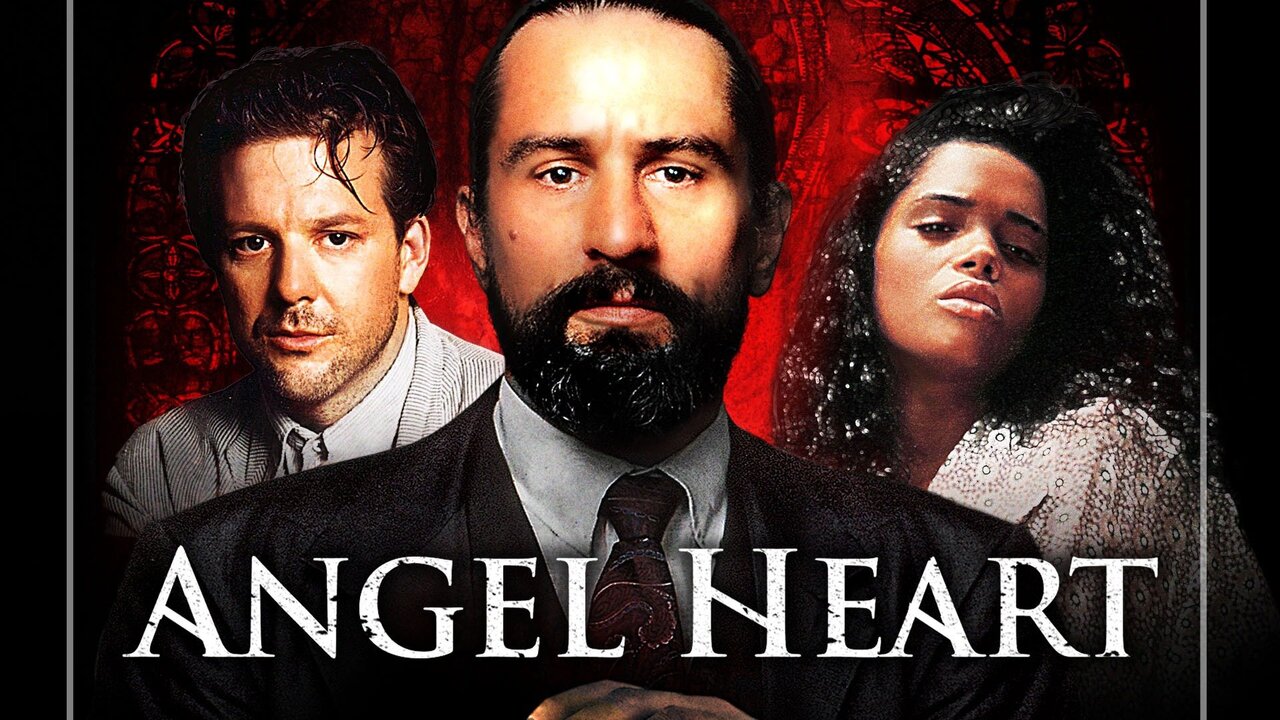
Not every detective story ends with the satisfaction of solving a mystery, and some answers are far more disturbing than the questions that led us to them. Angel Heart (1987), written and directed by Alan Parker, opens with the familiar ingredients of a private-eye story and slowly turns them into something far more sinister. It is best remembered as a supernatural horror film, but a strong noir identity runs through it, which makes it an especially fascinating entry for Noirvember. (Spoiler note: This piece avoids the film’s major twist, but it does discuss the setup and themes.)
Adapted from William Hjortsberg’s 1978 novel Falling Angel, the film is set in 1955. Mickey Rourke stars as Harry Angel, a small-time New York private investigator hired by the mysterious Louis Cyphre (Robert De Niro) to find Johnny Favorite, a once-famous crooner who disappeared after the Second World War. Cyphre says Favorite owes him, and he wants to collect. What looks like a routine missing-persons case soon turns grim, as the people Harry tracks down begin meeting gruesome ends. The search takes him from New York to New Orleans and into a world of voodoo, secrets, violence, and unsettling discoveries. Charlotte Rampling and Lisa Bonet play two of the women caught up in the case, Margaret Krusemark and Epiphany Proudfoot, respectively.
Harry feels like the kind of detective who belongs in a much more conventional noir. He is rough around the edges, cynical, and unpolished, and he hardly inspires confidence in the people around him. There is nothing glamorous about him, and Rourke plays him with a weariness that makes him feel lived-in, as though he has spent far too long dealing with dishonest and dangerous people. Of course, he is also a little scrappier and twitchier than the trench-coat archetype, but the noir bones are all there. Harry doesn’t feel like a detective who wandered into a horror movie. He feels like one whose world was always heading in this direction.
The film’s atmosphere is arguably its greatest strength. Parker, cinematographer Michael Seresin, and production designer Brian Morris create a world of shadows, rundown interiors, and cramped, sweaty rooms, while Trevor Jones’s score keeps the audience uneasy even during quieter scenes. Parker originally wanted to shoot the film in black and white. Instead, he and his designers stripped primary colours from the sets and costumes, giving the finished colour film a largely monochromatic appearance. Even when Harry is simply following a lead, something feels terribly wrong. The film doesn’t need to remind us that it is a horror story, because its visual language already feels threatening. Every new discovery drags Harry further into a place he should never have entered.
That is where Angel Heart earns its place as a neo-noir. Noir has always been comfortable with people who make questionable choices, get caught in circumstances beyond their control, and discover that the truth is uglier than they imagined. Here, Harry believes he is just doing his job. The further he goes, the more the case seems to take on a life of its own. The people he meets aren’t just withholding information. They seem connected to something much larger than he understands. The familiar noir touches are all present: a client who is hiding more than he says, women whose connections to the missing singer are not immediately clear, and detectives Sterne (Eliott Keener) and Deimos (Pruitt Taylor Vince), whose involvement adds to the pressure surrounding Harry’s increasingly dangerous investigation.
The shift from detective thriller to supernatural horror is what makes the film so effective. Rather than abandoning its noir foundations, Angel Heart builds on them. The mystery grows more disturbing, the danger more personal, and the fatalism harder to escape. The answers Harry finds offer none of the reassurance a solved case normally provides. The investigation starts to feel less like a search for the truth and more like a descent.
Louis Cyphre is a big part of why it works. His name itself offers a rather unsubtle clue for attentive viewers, and De Niro plays him with a quiet, composed confidence. He never raises his voice or needs to threaten Harry to establish authority. That calm contrasts sharply with the grotesque events surrounding the case, and every conversation with him feels uncomfortable, especially as we begin to suspect that Harry’s assignment is far more complicated than he was led to believe.
New Orleans also sets the film apart from more traditional detective stories. The move from New York’s grey streets to New Orleans brings Harry into an environment where Parker emphasizes religious imagery, voodoo rituals, blues music, and violence. Blues legend Brownie McGhee appears as Toots Sweet, and the music gives the city a rhythm that feels bound up with the mystery itself. Parker treats the location as an extension of the investigation rather than just another stop on Harry’s route, a place where the rules Harry has relied on seem increasingly irrelevant.
What ultimately makes Angel Heart such a compelling horror noir is its relationship with fate. Detectives are supposed to uncover the truth through observation and persistence, but the film asks what happens when uncovering it gives you no control at all. It takes the fatalism so often associated with noir and pushes it into supernatural territory, turning the idea of a doomed protagonist into something literal.
That said, Angel Heart is not a comfortable watch, and it was controversial from the start. The Motion Picture Association of America initially assigned it an X rating, and Parker removed approximately ten seconds from the sexual encounter between Rourke and Bonet to secure an R rating. The original footage was subsequently restored for an unrated home-video release. Beyond that scene, its imagery can be grotesque, its mood is relentlessly unpleasant, and its story is deliberately disorienting. Those qualities are exactly what give it such a distinctive identity. It is a detective story in which the investigation itself becomes the source of horror.
For Noirvember, Angel Heart is a reminder that noir doesn’t have to stay in the world of gangsters, corrupt officials, and cynical private eyes. Its darkness can take other forms, including the supernatural. Parker’s film takes the pessimism, moral uncertainty, and fatalism that have long defined the genre and pushes them somewhere far more terrifying. Sometimes the greatest danger in a detective story isn’t failing to solve the mystery. It’s finding out that the answer was waiting for you all along.