

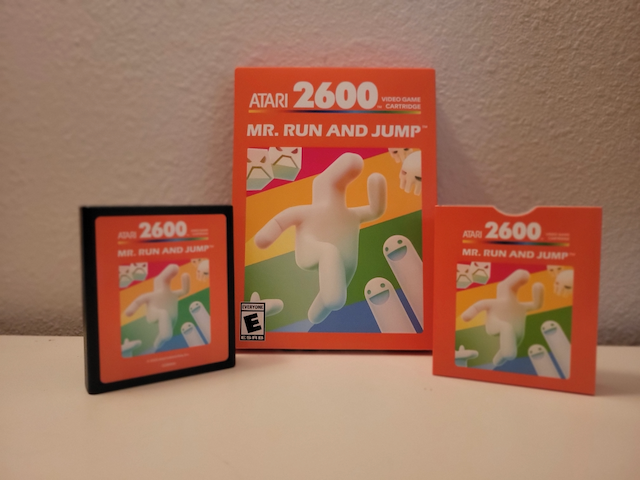
The objective of Mr. Run and Jump is a bold, almost defiant one: to deliver a fluid, high-speed, precision platforming experience but on the severely limited Atari 2600 hardware. The player’s goal is simple yet ruthless: guide the perpetually moving protagonist, Mr. Run, and his companion, Jump, through visually dense (by Atari 2600 standards), collect power orbs and escape the Void.

The gameplay of Mr. Run and Jump is a masterclass in modern design constraints applied to archaic hardware. The perpetual movement isn’t with the level itself or the character but that of trying to out run the score at the bottom of the screen. From the moment you start playing, the score at the bottom of the screen counts down. Once it reaches zero, the game is over, unless you happen to reach the end of the game. The port’s technical achievement lies in its near-flawless frame rate and low input latency. On a console notorious for sluggishness and choppy movement, Mr. Run and Jump maintains a level of fluid motion that feels completely alien to the Atari 2600.
However, the game’s difficulty is punishing. Levels demand complex and precise jumps, which translates into failure being a frequent occurrence. The challenge is not rooted in inconsistent controls, but in the game’s expectation of perfection. The greatest functional critique is that the required precision, while possible due to the low latency, can be easily undermined by the typical stiff control of the Atari Joystick. If you’re hit once, you lose your life and are placed back at the start of the level, no matter how many screens you’ve cleared up to that point.

Visually, Mr. Run and Jump is a testament to clever optimization. The game utilizes the Atari 2600’s TIA video chip with surgical precision to produce vibrant, distinct color palettes. This is a significant achievement considering the system’s propensity for visual noise. The presentation is remarkably clean: the environment and collectible orbs stand out clearly against the backgrounds, essential for a game requiring the need for quick decision making.
The most important graphical feature is the stability of the sprites and background. While the visuals are, by necessity, blocky and minimalist, the development team has almost entirely mitigated the infamous sprite flicker common to all complex 2600 titles. This flicker mitigation ensures that vital platforms and enemies don’t disappear mid jump, preserving the integrity of the high speed platforming Though there is some flickering with some of the enemies, but it’s more of a shimmer than a flicker. This is deceptively genius and looks amazing when playing the game.

The sound design is dictated entirely by the 2600’s basic audio hardware (the TIA sound registers), meaning the audio is strictly functional chiptune. The music in the game is repetitive due to the limitations of the Atari 2600 but still sounds good. Sound effects in the game work well with the sounds of Mr Run and his dog jump and the occasional sound of orb collecting.
This audio choice serves as a means to be the least distracting as possible while allowing the player to focus on the brutal precision platforming that this game throws at you.
Mr. Run and Jump on the Atari 2600 is less a retro game and more a technical manifesto. It succeeds wildly in its objective, delivering an unexpectedly fluid, challenging, and fast-paced platformer on a system that should not be able to handle it. Its strengths are its low input latency, stable visuals, and demanding, yet fair, design. While the game is brutally difficult and suffers slightly from the inherent imprecision of the original Atari joystick, the sheer accomplishment of its performance makes it an essential purchase. This is a game that honors the history of the 2600 by proving that its hardware limitations can still be overcome with clever, modern design.

In addition to writing articles, Ryan Byers also creates content for his YouTube channel called "Obscure Games and Consoles", collects video games, and dabbles in video game development.