

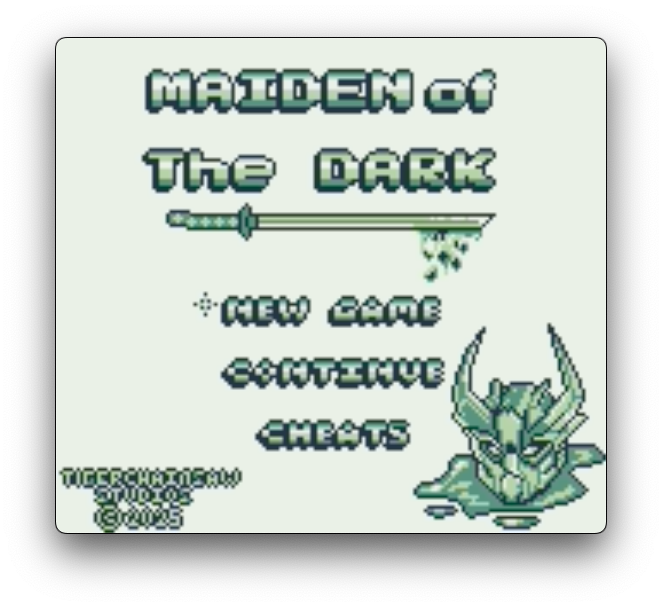
The narrative follows a desperate village in rural Japan that has been crushed under the heel of the ruthless warlord Zankoku. In a final act of defiance, the villagers use ancient magic to summon the Maiden of the Dark, a powerful spirit warrior whose existence is tethered to the night. You are given exactly ten hours—cleverly represented by the game’s ten stages—to dismantle Zankoku’s army and defeat his shoguns before the rising sun erases your power. It’s a classic, high-stakes premise that provides a clear motivation for the relentless forward momentum, further deepened by the inclusion of a mysterious figure named Teixeira, who hints at a hidden reward tied to the theme of love.

In terms of mechanics, Maiden of the Dark is a fast-paced action-platformer that wears its inspirations, such as Ninja Gaiden and Shadow of the Ninja, on its sleeve. Armed with a deadly katana, you must navigate 10 perilous stages ranging from fiery villages to spiked caverns and raging rivers. The difficulty is unapologetically high; success requires precision timing and the mastery of enemy patterns. Boss encounters, particularly the defensive strategist Yoroi and the swift Shiruku, act as intense skill checks that force you to utilize every inch of the screen. The controls are tight and responsive, ensuring that every death feels like a learning experience rather than a failure of the hardware.

Visually, the game is a masterclass in what the original Game Boy hardware (DMG) can still achieve. The pixel art, handled by PixelChunga, makes excellent use of the system’s limited four-color palette to create moody, atmospheric environments that never feel cluttered. Despite the density of enemies and projectiles, the performance is remarkably fluid. There is almost no slowdown or sprite flickering, even during the more chaotic boss fights, which is a testament to the modern optimization techniques used by the developers. The Maiden herself is beautifully animated, with her katana strikes and jump cycles feeling weightless yet impactful.
What Maiden of the Dark manages to achieve on the original Game Boy is very impressive, but I would have liked to have seen either an enhanced color palette when played on a Game Boy Color, or at the very least color palette options.Neither of these are present in this game.

The soundtrack is arguably the game’s standout feature. Composed by Ryan “OGM” Scotson, the score is a heavy-metal inspired tour de force that pushes the Game Boy’s sound chip to its absolute limits. Each stage features a unique, high-energy track that perfectly complements the frantic combat, moving away from what would typically be found in early 90s games on the Game Boy in favor of something much more aggressive and driving.
The sound effects in Maiden of the Dark are pretty good, though also standard for an action platformer. I feel like the sound effects kind of took a backseat to the music in this game, which really is fine. While it’s nothing really special, what’s here isn’t something that’s repetitive or annoying but rather compliments the music quite well. I would much rather have sound effects that compliment the music rather than something repetitious and aggravating.

Maiden of the Dark is a triumph of retro-modern design, proving that the Game Boy remains a viable platform for high-quality, challenging experiences. TigerChainsaw Studios has delivered a debut title that honors the “tough-as-nails” legacy of the 8-bit era while providing the polish expected by contemporary players.
While I would have liked to have seen a full color palette offered or at the very least color palette integration when playing on a Game Boy Color, it still looks spectacular when played on original hardware. What Maiden of the Dark offers here is a focused, atmospheric, and mechanically sound journey that is essential for any handheld enthusiast. If you’re looking for a reason to dust off your original hardware or fire up an emulator, this dark, katana-wielding sprint against the sunrise is it!
We were provided with a review unit. Those interested can check out the game here.

In addition to writing articles, Ryan Byers also creates content for his YouTube channel called "Obscure Games and Consoles", collects video games, and dabbles in video game development.