

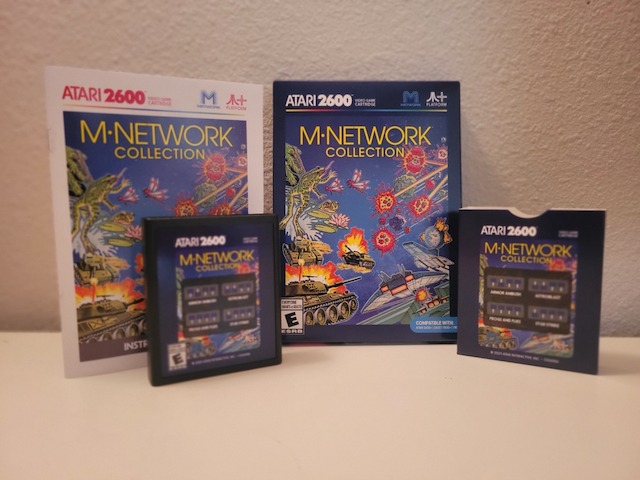
The M-Network are a set of games that were originally on the Mattel Intellivision, or ports there of. This collection is rather unique because these games were originally designed for the graphically superior Intellivion and were ported to the Atari 2600. The Intellivision boasted a 16-direction control disc and a 12-button numeric keypad, enabling complex sports and strategy games. Translating these controls to the rudimentary four-way digital joystick and single fire button of the Atari 2600 is technically impressive.
When it comes to gameplay, there are four different games included in this collection that all are neat and really rather impressive in their own right. The four games included on this cartridge are Armor Ambush, Astroblast, Frogs and Flies, and Star Strike.
Armor Ambush:

This game feels like it was Mattel’s take on the Atari Combat game. The game feels similar yet different. So in Armor Ambush, you have a team of tanks and you must maneuver them into position and take out the enemy team’s tanks. What is cool about this title is that not only is the game really detailed, but you have to compensate for recoil of your tank cannon. The first team to take out the other team wins and scores points. Pretty straight forward but also a fun game. Much more fun than Combat was on the Atari 2600 and I am glad this game was included in this collection.
AstroBlast

While not as detailed as the previous game in this collection, AstroBlast is a neat title. The game feels like a combination of Asteroids and Missile Command. You have a base that is equipped with a laser cannon. You move your base left to right and blast asteroids and other hazards out of the sky as they are hurled towards you. The mechanics of the game are simple yet addicting for those looking to chase high scores.
Frogs and Flies

Frogs and Flies is Mattel’s attempt to bring the game Frog Bog to the Atari 2600. What we got with this release is a game that has you competing to eat the most flies while avoiding ending up in the pond. This can be played against another player or by the computer controlled opponent.
This game is one of those that will have you chasing high scores and trying to one up your opponent. I feel like this game was added for nostalgic sake and is the least fun when it comes to the games offered on this cartridge.
StarStrike

StarStrike is a pretty impressive title and offers a lot, especially for an Atari 2600 title. With the game being originally made for the Intellivision, the game had to sacrifice graphics but what it lacks in graphics it makes up for in mechanics. In this game, you pilot a ship that needs to bomb eight missile siloes before the aliens launch a missile that will take out the planet Earth. If an alien ship hits you with a laser, it will cause your ship to fly lower and lower which makes it harder to complete your objective.

Though if you are hit, your ship will fly lower automatically for a short time before you can resume control. The more you’re hit, the lower your ship goes, which may result in your ship crash landing on the alien space station. Should an alien hit you with a missile, your controls will temporarily be scrambled. So while the graphics aren’t as good as one would find on the Intellivision port, the game retains all of the logic and is a real fun game to play. I am glad it was included in this collection.

Visually, the M-Network games are often striking examples of the 2600’s graphical maximums, prioritizing color and large, distinct sprites over the fine lined detail of the Intellivision. The presentation is typically bold and colorful, using the 2600’s limited palette effectively to create visually separated play fields. However, this is where the hardware limitations become most apparent. To render the more complex, numerous objects required by the original Intellivision game logic, the result is significant sprite flicker. For example, in fast-paced screens, entire objects or large portions of the protagonist’s sprite may momentarily disappear or “flicker” as the TIA chip struggles to process and redraw the high number of on screen elements. This constant visual stutter, while a technical necessity, detracts from the smooth flow of the gameplay. Despite this, the graphics are usually successful in communicating the core action clearly. They are also still fun to play even if there is flickering involved while playing.

The audio experience of the M-Network Collection on the 2600 represents the most noticeable technical degradation compared to the Intellivision, which had a sophisticated 3 channel sound chip. The Atari 2600’s sound capabilities are rudimentary, often relying on simple, single-channel beeps, boops, and tone shifts. The sound design in these 2600 games (some being ports of those found on the Intellivision) is functional: explosions have a loud thump, and firing a weapon emits a distinct pew. The primary role of the audio is to serve as essential gameplay feedback rather than atmosphere. While the audio fidelity is clean, the lack of complexity is a stark reminder of the technical constraints of the Atari 2600 platform.

The M-Netowrk Collection of games offered on this cart are some pretty great games. With StarStrike and Armor Ambush being the most impressive of the collection on this cart. While the games took a hit on graphics due to the platform they are on, they are still a lot of fun to play. If you’re an Intellivision fan or even if you never got the chance to own or play an Intellivision; you have the opportunity to play some pretty great games. I would recommend picking up this collection as it’s a nice set of games for the Atari 2600.
Disclaimer: A review unit was provided

In addition to writing articles, Ryan Byers also creates content for his YouTube channel called "Obscure Games and Consoles", collects video games, and dabbles in video game development.