

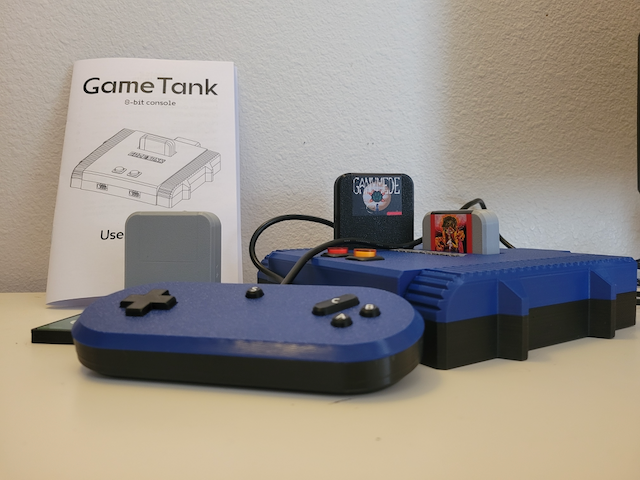
The GameTank is a fascinating anomaly in the modern gaming landscape. It’s described as a “fantasy console” brought to life as physical, open-source hardware. Instead of the modern trend of using FPGAs to mimic old chips, it uses actual, discrete components. Here is a breakdown of how this 8-bit underdog performs.
Under the hood, the GameTank is a love letter to the MOS 6502 architecture, featuring not one, but two WDC W65C02S processors. The main CPU runs at a respectable 3.5 MHz, while a co-processor dedicated 6502 is clocked at a blistering 14 MHz purely for audio. The system is built entirely from modern components, making it a “maker” console that you can actually solder and build yourself. With 32KB of banked system RAM and a dedicated 512KB for graphics memory, it’s a powerhouse compared to the 8-bit legends it takes inspiration from.

When it comes to games for the console, they come in the form of cartridges. These cartridges are satisfyingly “chunky,” utilizing a custom 36-pin edge connector format. While the system can support smaller 8KB EEPROMs, the standard retail-grade cartridges pack 2MB of NOR Flash memory. This memory is banked in 16KB increments, giving developers plenty of room for high-quality assets and expansive game worlds that would have been unthinkable on a standard NES or Atari 2600. The physical design even includes a notched shell to prevent you from jamming it in backward.

Playing on the GameTank feels like visiting an alternate dimension where 8-bit gaming never died but instead evolved into a sleek, efficient “indie” form. The gameplay experience is defined by its library of original homebrew titles like Accursed Fiend, which showcase a level of fluid movement and complexity usually reserved for early 16-bit systems. Because the console is physical-first, there’s a tactile immediacy to the experience; there is no OS lag or firmware bloat. You just insert the game, and the game just starts right up!
When it comes to the games themselves, we were provided Accursed Fiend and the demo for Ganymede. For the sake of this review, I will cover Accursed Fiend. Ganymede will be covered once the game is finished, as it’s currently in a demo format.

Accursed Fiend, doesn’t have much in the way of a story. But rather is more so a game about atmosphere. The game is played from a slightly top-down perspective. The game focuses on being a hack-and-slash roguelite that emphasizes movement and timing. Each of the six dungeon floors is procedurally generated, ensuring that no two runs feel exactly the same. Combat is snappy; you’ll spend most of your time managing crowds of enemies and hunting for the stairs to the next level. While it starts as a standard crawler, the difficulty spikes significantly as you approach the climactic boss fight, requiring genuine strategy to emerge victorious.

Visually, Accursed Fiend is a technical marvel for the 8-bit era it emulates. It was famously the first game for the GameTank to feature smooth, full-screen scrolling. This is something that many original 8-bit systems struggled with. Thanks to the system’s dedicated “Blitter” hardware, the performance remains fluid even when multiple sprites are on screen, avoiding the flickering or slowdown often found in the classic games that inspired it.

The audio design takes full advantage of the GameTank’s dedicated sound coprocessor. The soundtrack is a moody, lo-fi collection of tracks that heighten the tension of the dungeon that the player finds themselves traversing. Rather than the upbeat “bloop-and-bleep” melodies of the early 80s, the music here is atmospheric and slightly discordant, perfectly fitting the “Accursed” theme.

Accursed Fiend is more than just a dungeon crawler; it’s a proof-of-concept that the GameTank is a legitimate platform for “next-generation” 8-bit gaming. It balances its retro limitations with modern design sensibilities like procedural generation and high-performance scrolling. Whether you are playing it via the web emulator or on a physical 2MB cartridge, it is an essential experience for anyone interested in the homebrew scene.

Visually, the GameTank delivers a unique aesthetic with its 128×128 resolution and a fixed 200-color palette. While the resolution might sound small (matching the PICO-8), the performance is bolstered by a custom DMA “Blitter” engine. This hardware-accelerated circuit can move graphics into the dual framebuffers at 3.5 megapixels per second, allowing for silky-smooth parallax scrolling and massive sprites without the flickering found to be common in older hardware. It outputs via a standard NTSC composite RCA jack, providing that authentic retro feel.

The audio is where the GameTank truly flexes its dual-core muscles. With its dedicated 14 MHz audio coprocessor, the system isn’t limited to the simple bleeps and bloops of its ancestors. It uses a high-speed DAC and 4KB of shared RAM to handle anything from complex wave synthesis to PCM sample looping. At a default sample rate of 14 kHz, the sound has a crisp, lo-fi charm that is remarkably configurable, allowing developers to push the “chip-tune” aesthetic into much more textured, orchestral territory.


For the developers and the “DIY” crowd, the Cartridge Flasher is an essential accessory. It functions as an Arduino Mega 2560 shield that connects to your PC or Mac via USB, allowing you to flash your own ROMs onto blank cartridges in seconds. Using the GTFO (GameTank Flashing Overhauled) client program, the process is streamlined and remarkably fast—flashing a 2MB cart takes significantly less time than traditional EEPROM burners. It turns the console into a live development environment, bridging the gap between coding on a PC and seeing your work run on real hardware. For those that don’t feel like coding your own games, you can pick up a flasher and a flash cart

The GameTank is a brilliant, niche masterpiece for those who find “software emulation” a bit too cold. It occupies a space between a hobbyist project and a professional retro revival, offering a level of transparency and “hackability” that modern consoles have long since abandoned. While its $300 price point and composite-only output might be a hurdle for casual players, for the homebrew developer or the hardcore 8-bit enthusiast, it is an unparalleled playground of pure, unadulterated logic gates and creative freedom.
The game.tank is easily the best modern take on 8-bit gaming to be made available. This is one of if not the only platform that gives you the option of purchasing a console, building a console, or just emulating the games that are made for the console. The emulator and the games themselves are made freely available. You can play the games right in a web browser, download an emulator and the ROMS to play offline on your computer, or you can dive into the world of building and using the console on your TV in your living room.
With so many ways to enjoy some of these amazing games made available for the game.tank, there is no reason to not get into the platform. Though I must say the best way to play these titles is to either purchase a console or build one. It’s a must have for your game collection!
Disclaimer: A review unit was provided

In addition to writing articles, Ryan Byers also creates content for his YouTube channel called "Obscure Games and Consoles", collects video games, and dabbles in video game development.