

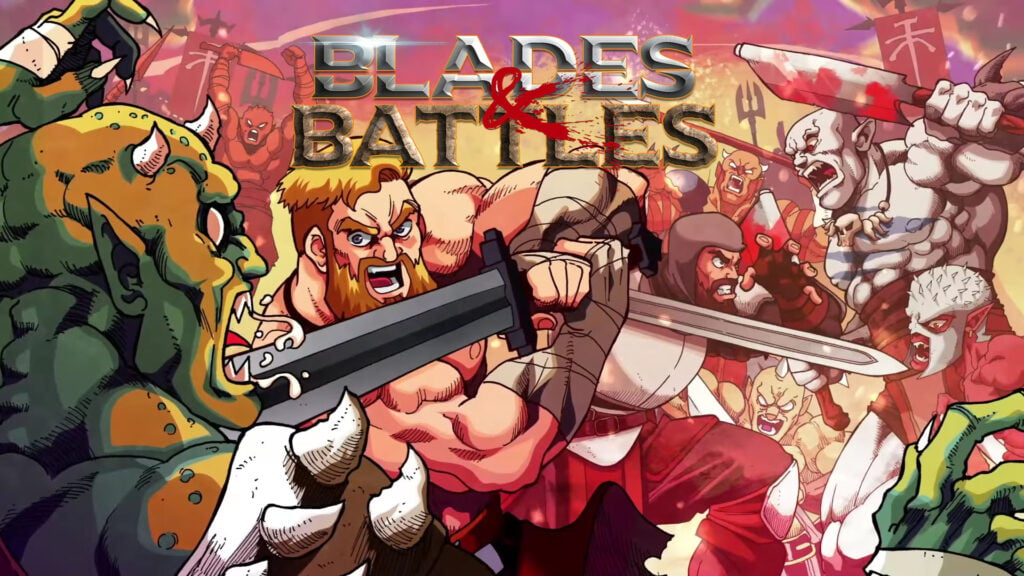
QuByte Interactive knows exactly which era it wants to revisit with Blades & Battles, and it wears that intention proudly. The 2.5D side-scrolling beat ’em up leans hard into Golden Axe as its clearest influence, but there is also a bit of Gauntlet and Rastan Saga baked into how the whole thing moves. The setting is a bright, storybook take on Arthurian fantasy, and the plot has King Arthur and Lancelot venturing out to rescue Merlin after Morgana the sorceress makes off with him. That is really all there is to the story, and Blades & Battles does not pretend otherwise. This is a game built to put a weapon in your hands and get out of the way, and for the most part, it succeeds at that goal.
Arthur and Lancelot are simple to understand on paper, but the gap between them ends up mattering more than I expected going in. Arthur hits like a truck and is built for crowd control, sending groups of enemies flying with wide, heavy swings. Lancelot trades that power for speed, with quicker attacks, longer combo strings and a dash that makes him far better at closing distance or bailing out of a bad spot. That contrast becomes especially useful in local co-op, since the two characters naturally cover for each other. Arthur can hold a crowd in place while Lancelot picks off stragglers, and having two very different tools on hand gives co-op a bit more shape than just two people mashing buttons at whatever happens to be closest.

The combat itself is easy to pick up, but there is more going on under the hood than simple button mashing. Both knights get access to combos, mana-fuelled special attacks and an ultimate that can wipe out a crowded room when things get out of hand. There is also a desperation move that lets you recover from being launched into the air while dishing out damage on the way down, which is a nice safety valve when you are surrounded. Enemies can be juggled and kept airborne, and once you start stringing hits together, Blades & Battles produces some genuinely satisfying old-school spectacle. It is at its best when a whole group gets kept off the ground long enough that a routine encounter turns into an extended combo.
That said, the combat is not always as precise as it needs to be. The 2.5D perspective makes positioning trickier than it should be, particularly once several enemies are spread across different depths of the screen. I ran into more than a few moments where an attack looked like it should have connected but whiffed, while enemy hits occasionally landed despite appearing to fall short. None of this makes Blades & Battles unplayable, but it does get frustrating when a missed swing or a questionable hitbox leaves you boxed in. The enemy AI does not help matters either, since it can get aggressive fast once multiple opponents are involved. That aggression gives the game some welcome bite, but it can also feel like the enemies are the ones benefiting from the same imprecision that works against you.

On Switch specifically, Blades & Battles is at its best treated as a pick-up-and-play brawler rather than something you sit down with for hours. The stages are short, which suits handheld sessions well, and the straightforward structure means you can play in bursts without committing to a lengthy RPG-style progression system. The tutorial gets you up to speed quickly enough, though the movement retains a bit of the stiffness you would expect from the games that inspired it. Running requires a double tap in a direction rather than a dedicated button, and the dodge, while functional, never feels quite as dependable as the combat itself. Playing handheld makes these quirks more noticeable too, since the smaller screen makes busy encounters harder to read, especially once the pixelation filter gets cranked up.
That filter is genuinely one of the more interesting design choices here. Blades & Battles lets you pick between a cleaner stylised 3D look and increasingly pixelated presentations, topping out at a heavily filtered 16-bit style. The retro filter fits the game’s ambitions well, and there is something charming about watching its fantasy world get transformed into something that looks pulled from a much older console. On Switch, though, I found myself sticking with the cleaner presentation during actual combat, since the heaviest pixelation makes enemies and environmental details harder to pick out once the screen fills up. It looks the part, but it is not always the most practical option when you need to track everything happening around Arthur or Lancelot at once.

There is still a decent amount of visual variety on display regardless of which filter you land on. The journey takes you through ruined villages, forests, castles and underground chambers, and areas like Bone Castle do a good job of setting a grimmer tone for the later stretch of the campaign. The mix of undead, monsters and other fantasy enemies keeps each area feeling distinct enough, and the colourful presentation helps stop things from becoming visually monotonous. The soundtrack leans into the same retro inspiration with chiptune-influenced music that shifts comfortably between dramatic and more sombre pieces, and the sound effects give real weight to sword swings and impacts. They do repeat a fair bit over a full playthrough, but they suit the arcade presentation Blades & Battles is going for.
Where things get shakier is once you have actually learned everything the game has to teach you. Arthur and Lancelot start the campaign with their full kit already unlocked, and there are no new weapons, skills or meaningful upgrades waiting further in. There is something almost refreshing about that old-fashioned approach, since Blades & Battles is asking you to get better with the tools you already have rather than constantly dangling new gear in front of you. Of course, that also means there is little mechanical incentive to keep playing once the novelty wears off, and by the time you clear the first few stages, you have already seen most of what the combat system is capable of.

This becomes harder to ignore given how short the campaign actually is, with a full run clocking in at roughly three hours. The difficulty settings add some extra challenge, and playing alongside another person makes repeat runs more fun, but the limited progression only makes the lack of additional content more noticeable. More playable characters, hidden stages, unlockable moves or some kind of bonus arcade mode could have given Blades & Battles a stronger reason to pull players back in. As it stands, the whole package feels closer to a compact arcade experience than a substantial adventure.
The boss fights help break up the pacing somewhat, demanding more attention to positioning and timing than the regular enemy waves. Some bosses stick with you more than others, and not every fight feels as mechanically distinct as it could, but they still offer a welcome change of pace once the standard enemy groups start blurring together. The treasure chests scattered through the stages add a small arcade-style incentive to explore, handing out gold, mana refills or the occasional giant cooked chicken to restore health. These touches reinforce the sense that Blades & Battles is deliberately reaching back toward an older style of action game rather than trying to reinvent itself as a modern, progression-heavy brawler.

That, ultimately, is both the strength and the ceiling of Blades & Battles. The game understands the appeal of the classic fantasy beat ’em up and does a respectable job recreating it without drowning the experience in unnecessary systems. Arthur and Lancelot feel meaningfully different from one another, the combat becomes genuinely entertaining once you start juggling enemies, and local co-op is easily the best way to experience the campaign. On Switch, the short stages and simple structure suit handheld play nicely, even if the occasionally imprecise hit detection and crowded combat can work against the experience at times.
At around $14.99, Blades & Battles delivers exactly what its premise promises and not much more. It does not reinvent the beat ’em up, and it does not offer enough content or progression to feel like a substantial modern revival of the genre. What it does offer is a colourful, uncomplicated throwback that understands why games like Golden Axe still hold up decades later. This being said, the Switch version is easy to pick up for a quick session, and having a second player alongside you makes the modest campaign considerably more worthwhile. Blades & Battles may not have the depth to become a new genre classic, but for anyone after a short sword-and-sorcery brawler with an honest retro arcade spirit, it gets the job done.
Disclaimer: A review key was provided