

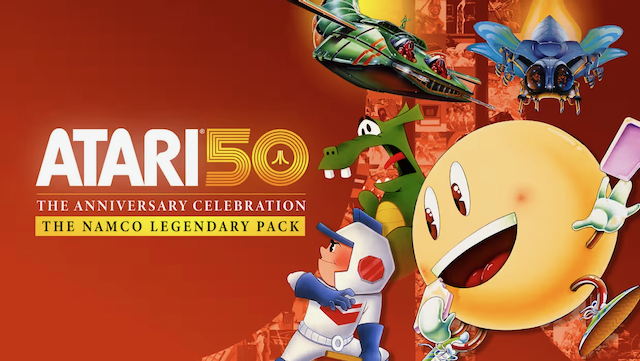
Digital Eclipse’s Atari 50: The Anniversary Celebration was already a landmark in retro game preservation. It offers a playable, interactive documentary along with an amazing set of games. The Namco Legendary Pack DLC is not just an add-on; it’s a vital, perfectly integrated chapter that chronicles one of the most crucial, yet often complicated, partnerships in early video game history: the bond between Atari and Namco.
This DLC goes beyond simply dropping a few extra classic games into the library. It weaves an entirely new narrative timeline, focusing on the relationship that brought seminal arcade titles like Pac-Man and Dig Dug to Atari’s home consoles and computers. For the price of a singular Arcade Archives entry, you receive a treasure trove of playable titles and, more importantly, a wealth of archival materials that provide deep, insightful context.

The core appeal lies in the archival materials and video interviews. Digital Eclipse has once again sourced stunning high resolution scans of original promotional materials, arcade flyers, box art, and even internal development documents. Seeing the original unused artwork for the Atari VCS version of Pac-Man, for example, is rather amazing.
The centerpiece of the historical feature is the new video content, featuring interviews with key industry legends who were directly involved in these ports. Most notably, the segment detailing the herculean effort by programmer Tod Frye to bring Pac-Man to the technically limited Atari 2600 is captivating. The collection does an excellent job of debunking the “myth” that the Atari 2600 Pac-Man alone caused the video game crash, instead presenting it as a commercially flawed, but technically miraculous, achievement under immense time pressure. The sheer dedication shown in discussing the compromises and hurdles faced in translating complex arcade code onto primitive home systems is where the DLC truly shines.

This DLC covers licensing, technical challenges the teams faced bringing the arcade classics to the Atari home platforms.In addition to licensing and technical challenges, this collection also goes over the commercial hype surrounding the home console releases and the arcade releases as well that are featured in this collection. If all of that history wasn’t enough, this collection also includes things like commercials, advertisements, and documentation used during the heyday of these releases and during the development process.
One of the best aspects of this collection is that while these ports may be considered inferior and some games in general are considered missing, the fact that all of this history is included really does make up for the lack of playable content and some might argue quality of the content.
So I briefly mentioned the games included in this collection, but what are you really getting? Well this DLC comes with a total of twelve playable titles. These twelve titles are across five classic franchises that span many Atari platforms, including the arcade versions of two games. The inclusion of so many platforms, especially when it comes to the arcade releases, gives you a great way to compare the home versions to the arcade and see just what it took to bring these iconic games into your living room.
I will give some information on what franchises are included and a bit about each game offered in their respective franchises. The first franchise we are going to look at is Pac-Man. In this collection we get the Atari 2600, Atari 5200, and the Atari 8-Bit computer version.

Pac-Man (Atari 2600) is arguably the most famous and most historically scrutinized game in the entire collection.The limitations of the VCS (2600) hardware are brutally apparent. The ghosts flicker excessively, maze design is simplified, the sounds are jarring, and the ghosts’ AI is fundamentally different. The infamous “rectangles” for pellets are present.
Despite its technical flaws, it was a massive commercial success, selling millions of copies and proving the demand for arcade translations. The DLC’s historical segments encourage players to view it less as a failure and more as a technical ‘miracle’ given the constraints. Playing it today is an exercise in appreciating history. It’s crude and difficult to control, but its presence is essential for a complete picture of the Atari-Namco partnership.
Pac-Man (Atari 5200) The 5200 version represents a significant step up, leveraging the console’s improved color palette and processing power.The game is far closer to the arcade experience as a result of the updated home console hardware. The maze is more accurate, the color fidelity is better, and the ghosts are mostly flicker-free. Control, while dependent on the 5200’s unique controller (nicely emulated here), is substantially better than the 2600.
While still not an arcade perfect port, this port is genuinely solid and enjoyable. This port showcases what Atari could achieve with more capable hardware. It’s a great example of a home port that was able to meet player expectations of the time.
Pac-Man (Atari 8-bit Computer) Often sharing codebases and capabilities with the 5200, the 8-bit computer version is similarly competent. Providing this version highlights the breadth of Atari’s hardware ecosystem and the developer’s consistency across platforms. For many users of the Atari 800 or 400, this was their definitive home version, and it holds up well.
The second franchise we will take a look at is Dig Dug. The Dig Dug franchise in this collection is composed of the Atari 2600, 5200, Atari Computer, and one of the two arcade games in this DLC collection.
The arcade original of Dig Dug is a timeless classic. The emulation is flawless, presenting the vibrant colors, iconic music, and addictive rock dropping, pooka pumping gameplay with perfect fidelity. As a game initially developed by Namco and distributed in the US by Atari, its inclusion is a key highlight of this collection. What makes this truly special is the fact that this is the first official console re-release of the specific U.S. arcade version of the game.

The Atari 2600 version, like Pac-Man, is a heavily compromised but functional interpretation. The colors are sparse, the enemies are simplified sprites, and the sound is minimal. In contrast, the 5200/Computer versions are surprisingly excellent. They capture the look and feel of the arcade game remarkably well, with good performance and recognizable sprites. The DLC’s feature on Dig Dug is particularly thorough, including vintage commercials that are a fun period piece.
Galaxian is the third franchise we are going to look at as a part of this DLC collection. This franchise offers their Atari 2600 and Atari 5200 ports. Galaxian was a very early space shooter and the first game to use RGB color graphics.
The 2600 port is a strong example of what the console could do well. The gameplay is fast and frantic, and while the color palette is limited, the core mechanics are intact. Some reviews note an unexpected speed boost in this port, which makes it an addicting score-chaser.When it comes to the 5200 version, it provides a much more arcade-accurate visual experience, with more detailed enemies and better colors.

Xevious is the fourth franchise that this DLC pack offers. With this franchise, we get the only other Arcade port, Atari 2600, and Atari 7800 ports. Xevious in the arcade was revolutionary for it’s time. It was the first vertical shooter that introduced the concept of two distinct weapons: an air-to-air shot and a bomb for ground targets. The emulation of the arcade version is fantastic, allowing players to experience the game’s depth, intricate level design, and pioneering ‘Solvalou’ ship with perfect fidelity.
The Atari 2600 port is another technically impressive feat of compromise. It has its limitations and is great to see it running on the platform. The 7800 version, which is the most enjoyable of the home conversions, is a solid port. Its most interesting adaptation is the use of a single fire button for both the air shot and the ground bomb, which requires players to adapt their muscle memory from the arcade twin-button layout.
The fifth and final franchise that this DLC pack offers is Galaga. With this franchise, we get the single port of the Atari 7800 version. Galaga is considered to be the spiritual sequel to Galaxian and plays very well for a home console port of an arcade classic.
It’s a decent rendition, capturing the core mechanics of the challenging waves and the “capture/double fighter” feature. While not arcade-perfect, it’s a respectable and playable home console version, showcasing the 7800’s capabilities compared to its predecessors.

When it comes to the performance overall of the games offered in this collection, Digital Eclipse’s emulation is, as expected, superb. The games run flawlessly on the Nintendo Switch, whether docked or in handheld mode. The inclusion of features like scanlines, cabinet artwork borders (for the arcade titles), and save states maintains the high bar set by the base game. Furthermore, the inclusion of scanned manuals and flyers for every game version adds immense value. Critically, the DLC maintains the high-quality interface and seamless integration into the main Atari 50 structure, making it feel like a natural, essential expansion rather than a tacked-on extra.
In conclusion, the amount of history and everything in this DLC is the true selling point. The Namco Legendary Pack is not just a bundle of emulated ROMs; it’s a masterclass in historical preservation. The dedicated timeline elevates the historical context of these specific ports. By focusing on the direct developer interviews and the struggles behind bringing Pac-Man and other giants to home consoles, it offers a necessary correction to decades of simplified historical narratives (particularly surrounding the 2600 Pac-Man). It transforms a collection of ports into an educational and deeply appreciative look at the roots of console gaming.
While it can be argued that ports are missing, and entire franchises or games within a franchise are missing, this DLC is really about the quality of what’s here rather than the quantity.The Namco Legendary Pack is an essential expansion to Atari 50: The Anniversary Celebration. It is a vital historical document that chronicles a pivotal era in the industry’s birth, providing an unprecedented level of detail into the technical and commercial hurdles faced by Atari in the early 1980s. The quality of the emulation is perfect, and the documentary presentation is peerless.

It may not contain every single Namco title licensed by Atari, but the depth it provides on the games it does feature—especially the fascinating comparison between the various home console ports and the inclusion of the rare U.S. arcade versions of Dig Dug and Xevious—makes it an invaluable purchase. This DLC firmly cements Atari 50 as the gold standard for retro game history.
I would definitely recommend picking up this DLC package as for its historical content and the amazing Namco games that are offered.
Disclaimer: A review key was provided

In addition to writing articles, Ryan Byers also creates content for his YouTube channel called "Obscure Games and Consoles", collects video games, and dabbles in video game development.