

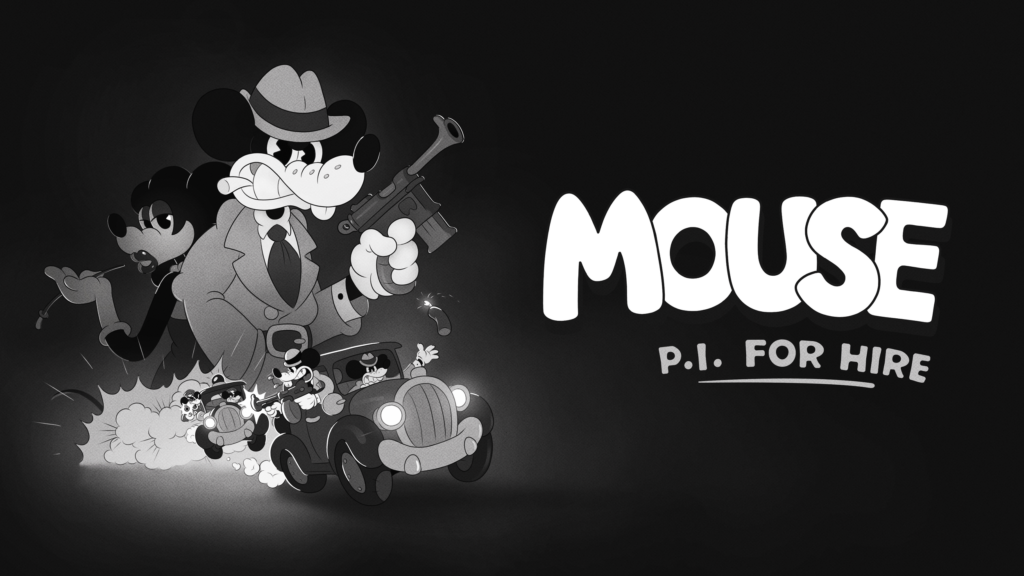
Few pairings sound as unlikely on paper as rubber-hose animation and film noir. One belongs to the bouncy, exaggerated cartoons of the late 1920s and early 1930s, while the other is associated with cynical detectives, rain-slicked streets, and people who rarely turn out to be what they seem. Fumi Games’ MOUSE: P.I. For Hire, released earlier this year, proves they share more DNA than you might expect, making it a natural fit for Noirvember. I covered how it plays in my review, so this time I want to look at what makes it work as noir.
Published by PlaySide and released on April 16, 2026, for PC, PlayStation 5, Xbox Series X|S, and Nintendo Switch 2, the game stars Jack Pepper, a former war hero and police officer turned private investigator, voiced by Troy Baker. Its monochrome presentation and hand-drawn, frame-by-frame animation immediately establish its identity, but the cartoon aesthetic is only the surface. Beneath it is a story built on the traditions of hard-boiled detective fiction.
What begins as an investigation into the death of an actress soon grows into a web of gangs, crooked cops, cults, and conspiracy. There is a journalist in the mix, a mysterious woman who sets things in motion, and a city where almost everyone has something to hide. Mouseburg’s anthropomorphic population also allows the game to explore social tensions and political issues associated with the 1930s, including characters inspired by real historical figures who are largely forgotten today. That gives the cartoon violence something more substantial to push against, and it is a big part of why the tone holds together.

Noir’s roots help explain why the game’s black-and-white presentation feels so appropriate. The hard-boiled private eye took shape in pulp magazines during the 1920s and 1930s, particularly through the work of writers such as Dashiell Hammett and Raymond Chandler. The term “film noir” itself was coined by French critic Nino Frank in 1946, following the Second World War, as critics began examining a particular strain of Hollywood crime cinema. Its visual language drew from several influences, including German Expressionism, with its dramatic shadows, unusual compositions, and distorted perspectives. Jack sits comfortably within that tradition as a world-weary gumshoe navigating a corrupt city, albeit with the cartoon twist that his tail can pick locks and let him hover.
The game also has some notable company. Who Framed Roger Rabbit? is set in 1947 Los Angeles and combines animation with a detective story involving corruption, murder, and a scheme to reshape the city through property development. Its similarities to Chinatown are particularly interesting, although the two approach their respective conspiracies from different directions. The film’s source novel, Who Censored Roger Rabbit?, is also considerably more mature in its approach to detective fiction. Jim Henson’s Dog City, a blend of puppetry and animation, took a similarly playful approach to a world of animal characters, puns, and detective tropes. Cuphead, meanwhile, helped introduce a new generation of players to the visual language of early theatrical animation. MOUSE: P.I. For Hire draws from these traditions while adding something that sets it apart: the player is the one pulling the trigger.

The humour deserves credit for how well it fits the genre. The game is packed with cheese puns and weapons with equally ridiculous names, such as the Mouser standing in for a Mauser and the James Gunn replacing a Tommy Gun. Yet it plays its mystery with a relatively straight face. That balance is something the best noir parodies understand, allowing the humour to coexist with a story that takes its characters and circumstances seriously. The original big-band jazz soundtrack also keeps the atmosphere firmly rooted in the period, complementing the animation and helping bring Mouseburg to life.
Some players have argued that the detective work is lighter than they wanted from a game with such strong noir influences, but that criticism overlooks what makes the genre so enduring. Noir isn’t necessarily about the mechanics of solving a mystery or following a perfectly constructed trail of clues. It is often more interested in what an investigation reveals about the people and institutions surrounding it. The Big Sleep is famous for its tangled plot, with Raymond Chandler reportedly admitting that even he wasn’t entirely sure who had killed the chauffeur, Owen Taylor. The anecdote has become part of the film’s history, but it also illustrates how a noir story can remain compelling even when every detail isn’t neatly resolved. Mood, moral ambiguity, and memorable characters can be just as important as the mystery itself. By those standards, a story about a hard-boiled mouse chasing the truth through a corrupt city fits right in.

MOUSE: P.I. For Hire has since surpassed one million copies sold, with a story expansion also planned. For Noirvember, it is a fun reminder of just how far the genre’s influence has spread, from pulp fiction and Hollywood to comics, animation, and video games. Noir doesn’t need to be confined to shadowy streets, cynical detectives, or even realistic characters to work. Sometimes all it takes is a private investigator, a city full of secrets, and a mouse who knows better than to trust everyone he meets.


