

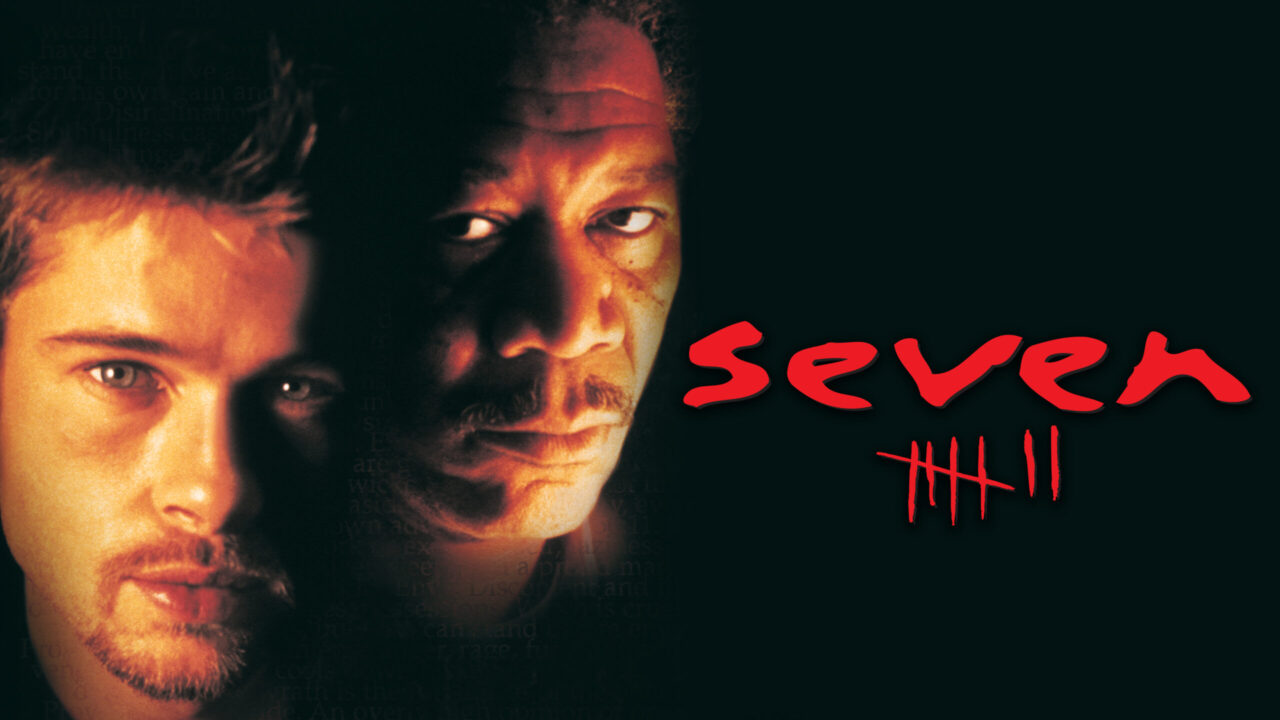
Spoiler warning: this piece discusses the ending of Se7en.
There are few films that capture the oppressive atmosphere of film noir quite like David Fincher’s Se7en. Released in 1995 and written by Andrew Kevin Walker, this crime thriller takes the familiar ingredients of detective fiction and transforms them into something considerably more unsettling. Its unnamed city is a miserable place to inhabit, its inhabitants seem increasingly disconnected from one another, and its detectives are confronted with a case that challenges their understanding of humanity. Although it arrived decades after the classic Hollywood noir period, Se7en is one of the clearest examples of neo-noir, showing just how effectively the genre’s defining characteristics could be adapted for a new generation.
Rather than relying on the glamorous criminals, seductive femme fatales, and shadowy underworlds associated with classic noir, Fincher presents a world that feels almost completely devoid of hope. Rain pours over filthy streets, buildings appear neglected, and even the interiors of apartments and police stations seem to possess an overwhelming sense of claustrophobia. The city is never identified by name, allowing it to become something more than a simple setting. Walker drew inspiration from an unhappy stretch of living in New York, while the film itself was shot in Los Angeles. The result feels like a composite of every grim American metropolis. It is an environment defined by decay, violence, and indifference, where the distinction between ordinary life and the horrors uncovered by the investigation becomes harder and harder to recognise.
This atmosphere is essential to the film’s identity, and it was built deliberately. Cinematographer Darius Khondji and Fincher used a specialised bleach-bypass process during printing, known as Color Contrast Enhancement (CCE), which retained silver in the film prints, deepening the blacks and draining much of the colour from the image. Production designer Arthur Max surrounded the characters with murky, desaturated greens and greys, so that even the walls look as though they are slowly rotting. Traditional noir frequently used urban environments to reflect the moral and psychological deterioration of its characters, and Se7en takes this approach considerably further. There is little visual comfort to be found, and even moments of relative calm carry an uncomfortable sense of impending disaster. Howard Shore’s score and Kyle Cooper’s jittery title sequence add to the feeling that something is wrong before the story has even begun.
The story unfolds over the course of seven days, counting down to the retirement of William Somerset, portrayed by Morgan Freeman. He is a veteran investigator who has become deeply disillusioned with the world around him. His experience has taught him to expect the worst from humanity, and his decision to leave the police force reflects a growing belief that there is little left worth fighting for. He is intelligent, observant, and methodical, but there is also a profound sadness behind his professionalism. Somerset has not simply become tired of his job. He has become tired of the world that makes his job necessary.
His replacement, David Mills, played by Brad Pitt, represents a very different perspective. Younger, impatient, and considerably more impulsive, Mills arrives with the confidence of someone who still believes that he can make a difference. His enthusiasm occasionally borders on recklessness, particularly when contrasted with Somerset’s measured approach to police work. Their relationship initially resembles the familiar pairing of an experienced detective and an inexperienced newcomer, but Fincher uses their differences to explore two competing responses to a world that seems impossible to understand. Somerset has learned to protect himself through detachment, while Mills remains emotionally invested in the possibility of justice.
That investment extends to his wife, Tracy, played by Gwyneth Paltrow. She is one of the film’s few sources of warmth, and she is nothing like the femme fatales of classic noir. Having followed her husband to a city she hates, she confides in Somerset that she is unhappy and pregnant, and the quiet scene they share gives the audience something to lose. Fincher is building the stakes of the ending long before anyone realises it.
The investigation itself takes an increasingly disturbing turn when the detectives discover that their killer is arranging his murders around the seven deadly sins. Gluttony, greed, sloth, lust, pride, envy, and wrath become the framework for an elaborate series of crimes that transforms an ordinary investigation into something resembling a grotesque religious parable. Somerset heads to the library to research Dante and Chaucer, and a trail of borrowed books eventually leads the pair to the killer’s door. The killer, John Doe, is not motivated by the usual criminal ambitions of money, revenge, or personal gratification. Instead, he believes that his actions serve a higher purpose, positioning himself as an instrument of punishment against what he considers the moral failures of society.
Spacey’s performance works so well because of the restraint with which he portrays John Doe. Spacey was omitted from the opening credits, and John Doe’s face is not fully revealed until late in the film, making his arrival all the more jarring. Rather than behaving like a conventional theatrical villain, he presents himself as someone who genuinely believes in the righteousness of his actions. His apparent composure makes the character even more disturbing, especially when contrasted with the desperate detectives pursuing him. There is an uncomfortable parallel between his certainty and Somerset’s pessimism, although the two arrive at radically different conclusions about the nature of humanity. One has become disillusioned with the world, while the other believes himself justified in punishing it.
The film’s relationship with noir becomes especially interesting as the investigation approaches its conclusion. Classic noir is frequently defined by its fatalism, its morally compromised characters, and its refusal to guarantee that doing the right thing will produce a satisfying outcome. Se7en embraces these qualities without offering the audience the familiar comforts of a conventional detective story. The detectives never truly outwit their killer. Doe walks into the police station and surrenders because he has already planned the final act, and the case ends on his terms rather than theirs. The investigation becomes less about restoring order than confronting the possibility that order was never particularly secure in the first place.
This is ultimately what makes the film’s conclusion so devastating. Doe leads the detectives out to an empty stretch of desert, where a delivery arrives that reveals Tracy’s fate. He claims to have envied Mills’ ordinary life, making himself the sin of envy, and he taunts Mills into becoming the final sin, wrath. Somerset pleads with Mills not to shoot, aware that doing so would hand Doe exactly the ending he wants. Mills fires anyway. The scene plays out in harsh daylight rather than rain and shadow, and that choice makes it feel even more exposed and inescapable. It is a brutal expression of the film’s underlying philosophy, suggesting that even the strongest convictions can become liabilities when confronted with someone willing to exploit them.
The closing narration borrows a line from Hemingway: the world is a fine place and worth fighting for. Somerset adds that he agrees with the second part. It is a perfect summary of the gap between the two detectives, and it suggests that Somerset, who had planned to walk away, might stay on and keep fighting after all. That small, bruised flicker of resolve is as close as the film comes to hope.
What makes Se7en such an effective modern noir is that it never feels as though it is simply imitating the films that came before it. Its visual style, disturbing subject matter, and approach to detective fiction reflect a different era, but its underlying concerns remain remarkably familiar. The corrupt city, the disillusioned investigator, the morally compromised antagonist, and the seemingly inescapable consequences of human weakness all belong to a tradition that stretches back through decades of crime cinema, including the original Hollywood noir films and neo-noir classics such as Chinatown.
For Noirvember, Se7en is a worthwhile reminder that film noir is not defined by a specific decade, a collection of visual tricks, or even the presence of a private detective. Its most enduring qualities are found in its understanding of human nature and its willingness to explore what happens when morality, ambition, and desperation collide. Fincher’s film takes those ideas and pushes them into an especially unforgiving environment, producing a crime thriller in which the darkness is not simply something lurking in the shadows. It is something that has become inseparable from the world itself.


