

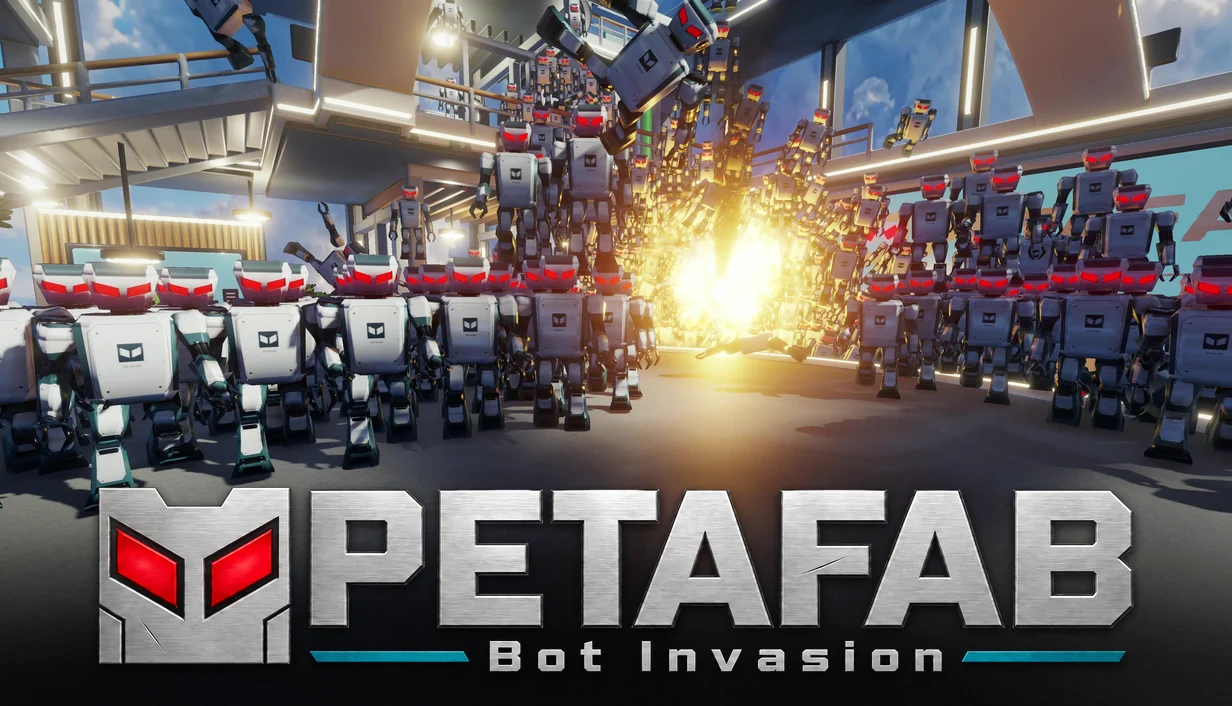
There is something deeply satisfying about a game that lets players tear through enormous groups of enemies with an unreasonable amount of firepower. Whether it is mowing down demons in a classic arena shooter or blasting through waves of enemies in a modern action game, there is a particular appeal to being completely overwhelmed by the chaos on screen and somehow coming out on top. PETAFAB: Bot Invasion understands that appeal, throwing players into a massive robot facility and giving them plenty of explosives with which to make a mess. It is a simple premise, but one that has the potential to deliver some genuinely entertaining action.
Developed by Sebastian Aaltonen, PETAFAB: Bot Invasion is a first-person shooter built around large enemy encounters and fully destructible environments. The setup is suitably ridiculous. PETAFAB is the largest robot manufacturing facility in the world, having expanded over decades through the work of its builder bots until it has grown to the size of a major city. Contact with the artificial intelligence controlling the facility has been lost, and the situation has clearly gotten out of hand. Special forces are sent in with three heroes to deal with the threat, which mostly involves destroying as many robots and as much of the facility as possible.
There is not much of a story here, nor does there need to be. PETAFAB: Bot Invasion is interested in giving players a reason to fight through increasingly dangerous groups of robots, and it gets to that point quickly. The problem is that the game does not always give players enough reasons to return once the initial novelty has worn off.

The basic structure is straightforward. Each stage drops players into an arena where waves of robots begin closing in. Weapons and items are scattered around the environment, and surviving means knowing when to attack, when to reposition and when to get out of the way. Once enough enemies have been dealt with, a much larger boss enters the fight. Defeating it brings the stage to an end, with the boss eventually self-destructing in suitably explosive fashion.
This might sound like a fairly basic formula, but there is more to managing the encounters than simply holding down the trigger and hoping for the best. The number of enemies can become overwhelming, and different threats require players to pay attention to their surroundings rather than stand in one place. Ammunition is limited, and the available weapons encourage a more aggressive approach to combat. There is a constant need to move, find supplies and make the most of whatever opportunities present themselves. The three difficulty settings also provide some flexibility, with higher difficulties increasing both enemy numbers and the damage they deal. Even the shorter stages can become surprisingly dangerous when the robots start piling up.
The combat is at its best when everything comes together. PETAFAB: Bot Invasion is not particularly interested in the conventional arsenal of a military shooter, instead giving players access to explosive weapons such as bazookas and grenades. These are exactly the sorts of tools needed when dozens of robots are bearing down on the player, and watching a well-placed blast send enemies flying is consistently entertaining. The weapons do not always have enough ammunition to make reckless use of them practical, which gives the action a welcome degree of resource management. It is important to keep moving and make every shot count, especially when the robots can bring down a player surprisingly quickly.

There are also three playable character classes, each with its own passive ability and ultimate. The Soldier, for example, has additional health and passive healing, while the Scout moves faster and can jump higher at the cost of being less durable. These differences give players some reason to experiment with the available options, although the variety could be developed further. A game built around surviving enormous enemy waves would benefit from more substantial differences in how each character approaches combat, particularly if there were additional modes designed to encourage repeated play.
The real star of PETAFAB: Bot Invasion, however, is the destruction. Explosions do not simply produce a visual effect before everything returns to normal. The environments themselves can be damaged and torn apart, with the geometry changing as the fighting progresses. Robots are thrown around by explosions, sections of the surrounding structures are destroyed, and the battlefield can become a considerably different place by the time a stage reaches its conclusion. There is a wonderful sense of scale to it all, particularly when large groups of enemies are caught in the same blast.
This is not just a visual gimmick, either. The technology behind the game is a major part of what makes its premise possible. Aaltonen has spent decades working in game development, including time with Frozenbyte, RedLynx, Ubisoft and Unity. PETAFAB: Bot Invasion uses a custom engine called NoGraphicsAPI, which replaces traditional graphics shaders with distance-field ray tracing and mesh shaders. It also builds on the Clayfield simulation technology previously used in Claybook, allowing the environments to be fully destructible. Combining that with large crowds of independently controlled enemies is an ambitious undertaking, and the results are impressive.
There are some issues with how the action plays out, though. Movement can take some getting used to, and while there is a degree of freedom in how players navigate the stages, it does not always feel as fluid as a game built around constant movement should. Jumping and reaching certain surfaces can be awkward, and the momentum does not always feel quite right. Rocket jumping is a particularly enjoyable addition, but the general movement could use some refinement to make traversing the environments feel more natural.

The destruction can also work against the player. With so many robots being destroyed and pieces of the environment scattered around, navigating the battlefield can become more troublesome than it should be. Fallen enemies and debris can obstruct movement, and it is frustrating to find the player caught on something while trying to avoid an incoming attack. This is especially noticeable during the larger encounters, where a moment of hesitation can be enough to end a run. The destruction is one of the game’s greatest strengths, but it needs to be balanced against the practical demands of combat.
The soundtrack is another highlight. Composed by Ari Pulkkinen, whose previous work includes Resogun, Nex Machina and Super Stardust HD, the music is a good fit for the fast-paced action. Those games demonstrated an understanding of how to accompany arcade-style combat, and PETAFAB: Bot Invasion benefits from that same sensibility. The music helps maintain the energy of the encounters without distracting from the constant stream of explosions and incoming enemies. The developer also discloses that Codex was used to help with graphics production.
Where PETAFAB: Bot Invasion runs into its biggest problem is content. There are only three stages in the main game, and they can each be completed in a matter of minutes. The different difficulty settings provide some incentive to revisit them, while the score multiplier and online leaderboards give players a reason to chase better results. Building up a large kill combo and seeing how high a score can go is entertaining, and there is certainly an arcade sensibility to the way the game is structured. However, that approach can only go so far when there are so few environments and encounters to experience.

The lack of additional modes is particularly disappointing. A survival mode would have been an obvious fit, giving players a larger supply of ammunition and an endless stream of robots to fight through for as long as they can survive. It would allow the game’s most appealing elements to shine without being constrained by the short structure of the existing stages. More weapons, additional enemy types and further character options would also help give the experience more staying power. The core combat is enjoyable enough that there is a clear foundation for something much bigger, but the current selection feels limited.
There is at least some encouragement for the future. PETAFAB: Bot Invasion received a free Steam Workshop update that allows players to create and share their own stages. The tools are built around relatively simple text files, with options to shape environments, place objects, add lighting, create enemy spawn points and script waves of robots. There are also tools to help creators work with Blender, along with official example maps to demonstrate what can be done. This is a welcome addition, especially for a game whose main limitation is the amount of content available at launch. Community-created stages could give players more reasons to return, although they are not quite a replacement for additional official modes and content.
PETAFAB: Bot Invasion is an interesting game that gets a lot right. The spectacle of fighting enormous groups of robots while tearing apart the environments around them is genuinely enjoyable, and the custom technology behind it makes for an impressive technical achievement. The combat has enough strategy to keep the action from becoming mindless, while the soundtrack and explosive weapons help make each encounter entertaining. There is a good game here, and the Workshop tools give it some room to grow.

The problem is that the three-stage campaign is simply too limited, and the movement and battlefield clutter can make some encounters more frustrating than they need to be. At $9.99 USD, PETAFAB: Bot Invasion is not an expensive game, but its low price does not change the fact that there is not enough variety to support its strongest ideas. A survival mode, more weapons and additional enemy encounters would go a long way towards making this a much more compelling package. For now, it is an enjoyable burst of destructive arcade action with plenty of potential, but one that still feels like it needs more to become something truly special.
Disclaimer: A review key was provided