

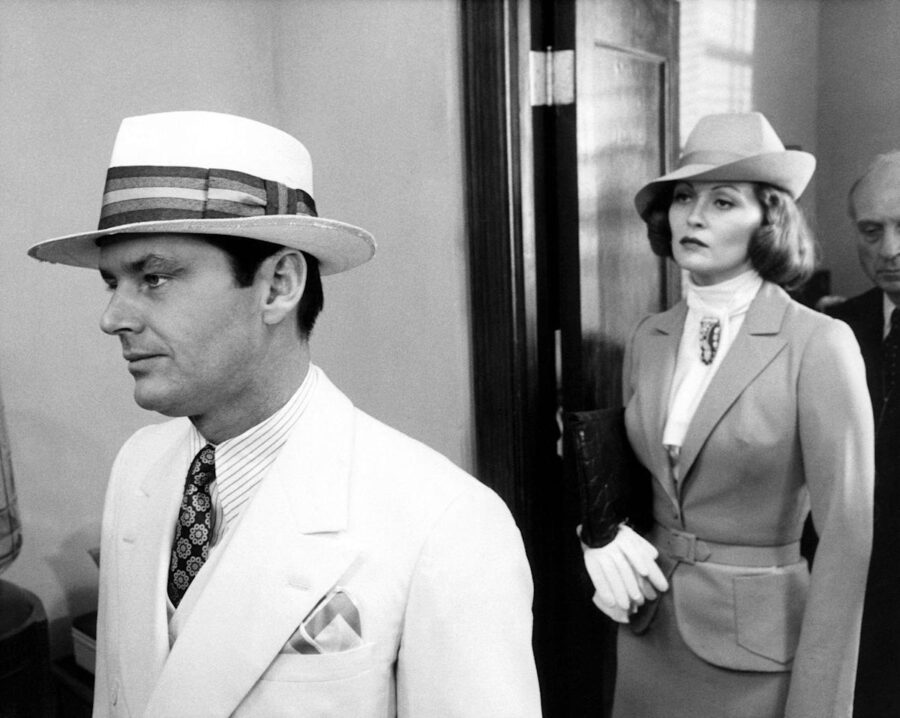
Few films have understood the darker side of the American Dream quite like Chinatown. Roman Polanski’s 1974 neo-noir takes the familiar ingredients of classic detective fiction, including a cynical private investigator, a seemingly straightforward case, a mysterious woman, and a conspiracy involving powerful individuals, before gradually transforming them into something considerably more disturbing. Starring Jack Nicholson as private investigator J.J. “Jake” Gittes, the film initially appears to be a relatively traditional detective story, but its investigation into corruption in 1930s Los Angeles becomes an increasingly unsettling examination of wealth, power, exploitation, and the impossibility of escaping a system designed to protect those at the top.
Gittes is introduced as a successful private investigator who specializes in divorce cases, making a living by exposing the infidelities his clients suspect. His latest assignment comes from a woman claiming to be Evelyn Mulwray, who suspects her husband, Hollis Mulwray, the chief engineer of the city’s Department of Water and Power, of having an affair. What initially seems like another routine investigation quickly becomes considerably more complicated when Gittes discovers that the woman who hired him was not actually Evelyn. The real Evelyn, played by Faye Dunaway, soon becomes involved in the investigation, and the subsequent murder of her husband draws Gittes into a conspiracy surrounding Los Angeles’ water supply, land development, and some of the city’s most influential figures.
Robert Towne’s screenplay is particularly effective at making the investigation feel like an elaborate puzzle without allowing its increasingly complicated revelations to become disconnected from the characters. Each discovery changes Gittes’ understanding of the situation, frequently forcing him to reconsider what he previously believed. The audience is similarly restricted to what Gittes knows, an approach developed through extensive revisions to the screenplay. An early draft included voiceover narration, but Polanski ultimately removed it and reshaped the story to give viewers a more subjective perspective, allowing them to uncover events alongside the detective. The result is a mystery that feels like something being uncovered rather than a collection of secrets waiting to be revealed. Even when the investigation begins to expose the larger conspiracy, the full extent of what is happening remains disturbingly difficult to comprehend. There is always another piece of information, another deception, or another person whose involvement changes the meaning of everything that came before.
Nicholson is perfectly suited to the role, bringing a combination of confidence, cynicism, humour, and underlying vulnerability to Gittes. He is recognizable as a descendant of the private investigators portrayed by Humphrey Bogart in films such as The Maltese Falcon and The Big Sleep, possessing the sharp tongue and professional instincts expected of a noir detective. However, Gittes is also a distinctly different protagonist. He is accustomed to controlling his investigations and manipulating situations to his advantage, but his confidence gradually becomes a liability when he encounters people whose influence extends far beyond anything he can control. Nicholson makes this transformation particularly compelling because Gittes never entirely loses his personality or his willingness to challenge those around him. Instead, he discovers that being clever, observant, and determined does not necessarily make someone capable of changing the outcome.
Dunaway is equally important to the film’s success. Evelyn Mulwray initially appears to occupy the familiar position of the mysterious woman in a noir investigation, someone whose motivations are difficult to understand and whose explanations cannot necessarily be trusted. However, the film gradually complicates this perception, revealing that Gittes’ assumptions have prevented him from understanding the circumstances surrounding her life. Evelyn is not simply another femme fatale manipulating an unsuspecting detective. She is a deeply troubled character attempting to protect someone she loves while living under the influence of a powerful and abusive man. The revelation that Cross sexually abused his own daughter and fathered her child transforms the investigation into something far more horrifying than Gittes initially anticipated. Dunaway gives the character an extraordinary mixture of composure, desperation, and vulnerability, making her increasingly tragic as the investigation progresses.
John Huston’s performance as Noah Cross provides the film with an especially disturbing antagonist. Cross is not presented as some theatrical criminal operating outside respectable society. He is a wealthy businessman whose influence, connections, and apparent respectability allow him to operate with an extraordinary degree of freedom. His conversations with Gittes are particularly unsettling because he rarely needs to raise his voice or openly threaten anyone to demonstrate his authority. He simply assumes that the world belongs to people like him. Huston, who had previously directed The Maltese Falcon, brings an additional historical connection to the film, effectively placing one of the defining figures behind classic Hollywood noir on the opposite side of the detective story.
What makes Chinatown especially interesting as a Noirvember selection, however, is how effectively it reimagines the visual language of film noir. The genre is traditionally associated with shadowy streets, rain-soaked urban environments, cigarette smoke, and the dramatic contrast between light and darkness. Although Polanski certainly understands these conventions, he approaches them from a different direction. Much of the film takes place under the bright California sun, surrounded by dry landscapes, open spaces, and seemingly beautiful architecture. The cinematography by John A. Alonzo uses these environments to create an atmosphere that is every bit as oppressive as the darkest urban settings of classic noir. There is nowhere for the characters to hide, yet the truth remains obscured.
This is particularly appropriate for a story about water, an essential resource being manipulated by those who understand its value and possess the influence to control its distribution. The conspiracy surrounding Los Angeles’ water supply is not simply an elaborate mystery designed to give Gittes something to investigate. It represents the larger conflict between public interests and private greed, with ordinary residents ultimately paying the price for decisions made by wealthy individuals. The film’s depiction of Los Angeles is fictionalized, drawing inspiration from the city’s real history of water development and land speculation, but it takes considerable dramatic liberties with the historical events. Its central conspiracy is not an accurate reconstruction of the Los Angeles water controversies, even though the real disputes surrounding the Owens Valley and the city’s expansion provide an important historical foundation. The American Dream becomes less about opportunity and prosperity than about who has the power to determine who receives either.
There is also an interesting relationship between Chinatown and the political atmosphere of the 1970s. Released during the Watergate era, when public confidence in American political institutions was being severely undermined, the film’s depiction of corruption and powerful individuals operating beyond accountability resonated with contemporary anxieties. Yet its period setting gives these concerns a broader historical dimension. By placing the story in 1937, Towne and Polanski suggest that institutional corruption is not necessarily an isolated failure or a temporary political problem. It is something that can become embedded in the foundations of a city, shaping its development and determining who benefits from its growth.
The film’s treatment of its central mystery also makes it an interesting companion to other classic noir stories. Like The Maltese Falcon, it features a private investigator surrounded by deception, competing interests, and people who rarely reveal their true intentions. Its complicated family relationships and wealthy suspects also invite comparisons with The Big Sleep. However, where those films ultimately preserve some sense of the detective’s ability to navigate their respective conspiracies, Chinatown takes a much more pessimistic approach. Gittes can uncover the truth, but discovering what happened does not mean he has the power to stop it. The film also shares something with Out of the Past, particularly its understanding that the past is not something that can always be escaped, although its tragedy extends beyond the individual decisions of its protagonist.
Jerry Goldsmith’s score further reinforces the film’s atmosphere, with its distinctive trumpet melody providing an unexpectedly romantic quality to an increasingly disturbing story. It is an effective contrast to the surrounding material, capturing both the seductive appeal of the world surrounding Gittes and the loneliness that exists beneath its surface. Combined with Alonzo’s cinematography, the period production design, and the film’s careful pacing, it gives Chinatown a distinctive identity that feels connected to classic noir without simply reproducing its visual conventions.
Of course, the film’s legacy is not entirely uncomplicated. Its use of Chinatown as a metaphor for confusion, helplessness, and a world in which nothing can be resolved has attracted criticism for reducing a real Chinese community and its history to an expression of inscrutability. The film also cannot be discussed entirely separately from Polanski’s criminal history, including his 1977 guilty plea to unlawful sexual intercourse with a 13-year-old girl. He subsequently fled the United States before sentencing. Recognizing the film’s artistic accomplishments does not require overlooking these issues, particularly when its own story is so concerned with the exploitation of vulnerable people and the abuse of power.
Ultimately, what makes Chinatown such an enduring example of neo-noir is its refusal to offer the audience the kind of resolution traditionally associated with detective fiction. That bleakness owes a great deal to Polanski, who insisted on changing the ending over Towne’s objections. In Towne’s original screenplay, Evelyn kills Cross and is ultimately allowed to remain with her daughter, offering a considerably more hopeful resolution. Polanski instead insisted that Evelyn die and Cross escape punishment, transforming the conclusion into something far more devastating. Gittes follows the evidence, challenges powerful people, and eventually uncovers the truth, but none of this guarantees justice. The final moments are devastating precisely because the investigation has not been pointless. Gittes has learned what happened, and the audience understands the full extent of the conspiracy, but knowledge alone cannot undo the damage or protect those who remain vulnerable. The detective has uncovered the truth, yet the world around him continues as though nothing has changed.
That is the real nightmare at the heart of Chinatown. It takes the conventions of classic film noir and strips away the comforting possibility that intelligence, persistence, or even the discovery of the truth can make a difference. Its Los Angeles is a place where corruption is not merely hiding in the shadows but operating openly in the daylight, protected by money, influence, and the institutions that are supposed to serve the public. For a Noirvember project exploring the evolution of the genre, few films offer a more compelling demonstration of how noir’s pessimistic worldview could be carried into a new era. Chinatown is not simply a tribute to the detective films that came before it. It is a devastating reminder of just how little power the detective may have when the people responsible for the crime are the ones who control the world.