

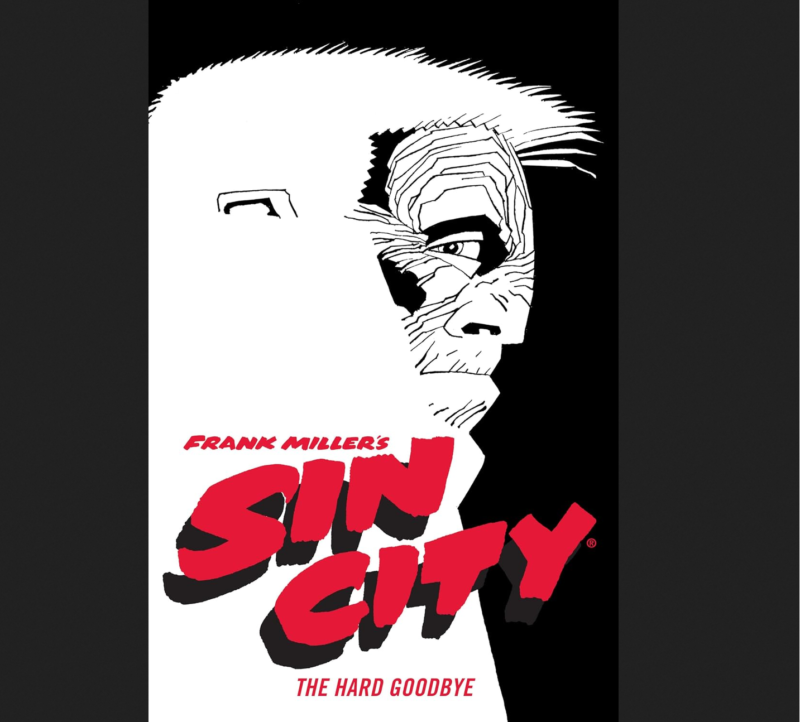
There are few comic book settings as immediately recognizable as Basin City, a place where criminals operate with little fear of consequence, the police are frequently compromised, and violence is often the only language understood by those who inhabit its streets. It is a city populated by killers, prostitutes, corrupt officials, desperate men, and people who have learned that doing the right thing can be considerably more dangerous than doing the wrong thing. This is the world Frank Miller created with Sin City, a series that takes the familiar ingredients of classic film noir and hard-boiled crime fiction and pushes them into an increasingly violent, exaggerated, and visually striking direction.
First appearing in Dark Horse Presents Fifth Anniversary Special in April 1991 before continuing in Dark Horse Presents, Sin City became one of Miller’s most recognizable creator-owned works, eventually developing into a collection of interconnected crime stories set within Basin City. While the series is frequently associated with its distinctive black-and-white artwork, its appeal extends beyond its visual presentation. Miller demonstrates a strong understanding of the conventions that make noir so compelling, from morally compromised protagonists and doomed relationships to criminal conspiracies and the seemingly inescapable corruption of the world around them. Rather than simply reproduce the atmosphere of an old detective movie, however, he creates something that feels considerably more savage.
The opening story, The Hard Goodbye, establishes the series’ identity through Marv, an imposing ex-convict whose nightmare begins when Goldie, a woman with whom he spends the night, is murdered while he sleeps. Marv sets out to find those responsible, embarking on a trail of violence that takes him through the city’s criminal underworld. It is a straightforward premise on the surface, but one that provides an effective introduction to Miller’s particular interpretation of noir. Marv is hardly a conventional hero, and his methods are frequently horrifying, yet there is an unusual sense of personal honour guiding his actions. He is a monster by many conventional standards, but one who has little patience for those who prey upon the vulnerable.
There is something particularly interesting about making such a character the audience’s entry point into Basin City. Marv’s perspective is often brutal and uncomplicated, but the world around him is considerably more sinister. His investigation exposes an organized system of exploitation and murder, revealing just how thoroughly corruption has embedded itself into the city’s institutions. The story embraces the hard-boiled tradition while giving its protagonist an almost mythological quality, turning a relatively simple revenge narrative into an exercise in urban brutality.
A Dame to Kill For approaches the genre from another direction, placing Dwight McCarthy at the centre of a story involving manipulation, obsession, and betrayal. Ava Lord is one of the series’ most recognizable examples of the femme fatale, using her influence over Dwight to draw him into a dangerous situation. The story plays with the familiar noir relationship between desire and self-destruction, where attraction can become a liability and the promise of a better life is frequently nothing more than an elaborate trap. Dwight is a more conventional noir protagonist than Marv, but his willingness to become involved with Ava demonstrates how easily reason can disappear when personal desire takes control.
The series continues to explore different corners of its criminal landscape with The Big Fat Kill, which shifts attention toward the uneasy balance between the city’s criminal factions. Dwight once again becomes involved in a situation that quickly spirals out of control, this time involving a group of prostitutes who have established their own degree of independence within Old Town. The story expands the setting beyond individual revenge and personal obsession, presenting Basin City as a collection of competing territories where violence is always close to the surface. That Yellow Bastard, meanwhile, offers one of the series’ more emotionally grounded stories through John Hartigan, an aging police officer who risks everything to protect a young girl from a powerful and thoroughly depraved individual. His story brings together police corruption, sacrifice, and the familiar noir theme of an individual attempting to do something decent in a fundamentally rotten environment.
The remaining volumes add further dimensions to this world. Family Values returns to Dwight for another crime story steeped in organized violence, while Booze, Broads, & Bullets collects shorter tales that provide glimpses into the lives of Basin City’s many dangerous inhabitants. These stories are particularly useful in demonstrating that the setting is not dependent on a handful of recurring protagonists. There are countless other people living on the margins of this city, each with their own motivations, grudges, and reasons for becoming involved in its criminal underworld. Finally, Hell and Back takes a somewhat different approach through Wallace, a former soldier and aspiring artist whose involvement with a woman draws him into a conspiracy involving manipulation, violence, and powerful interests. Its longer narrative and psychological elements make it an interesting conclusion to the original collection of major stories.

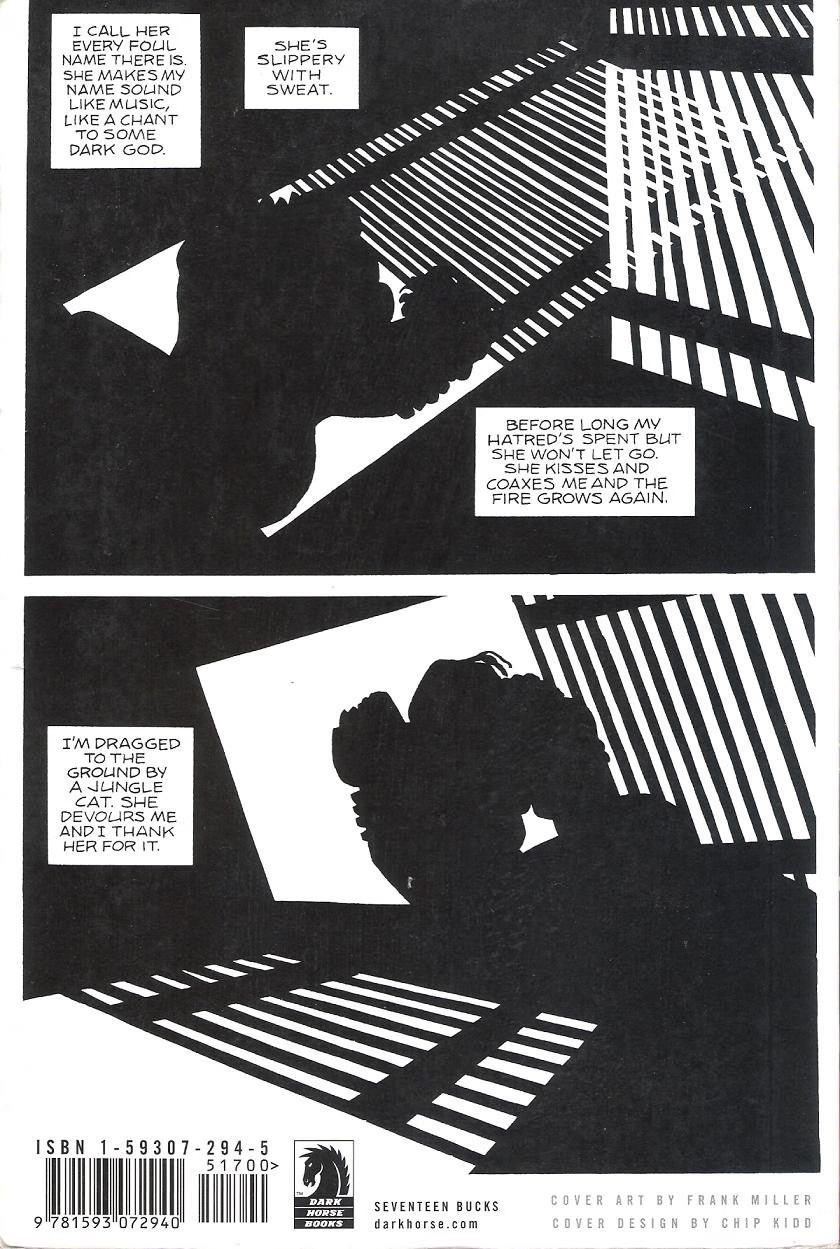
What makes Sin City particularly memorable, however, is how much of its identity comes from Miller’s artwork. His decision to work primarily in black and white is not simply an aesthetic preference or an attempt to imitate the appearance of classic cinema. It fundamentally shapes how the stories are presented. Shadows become physical obstacles, characters disappear into dark backgrounds, and seemingly ordinary environments can become threatening through the placement of a single silhouette. There is very little reliance on conventional shading, with Miller frequently using stark contrasts between solid black and white to establish the composition of a panel.
The effect is often striking. Characters can be reduced to silhouettes, with only their eyes, expressions, or a few defining details visible against the darkness. Other panels use large areas of black to create an almost suffocating atmosphere, making the city feel like a place that is constantly swallowing its inhabitants. The occasional introduction of colour is equally deliberate. Rather than filling the pages with additional visual information, Miller generally uses colour sparingly to emphasize particular characters, objects, or moments, although Hell and Back leans on it far more heavily than the earlier volumes. Its more extensive use of colour, alongside its increasingly surreal imagery, gives the story a visual identity that separates it from the more restrained presentation of the earlier tales. These interruptions become especially effective because the surrounding artwork has trained the reader to expect such an austere visual language.
This approach also gives the series a distinctly cinematic quality without sacrificing what makes comics unique. Miller understands that a comic book does not need to imitate the framing of a film to create a sense of movement or atmosphere. The arrangement of panels, the positioning of characters, and the deliberate withholding of visual information all contribute to the storytelling. Some sequences feel almost like individual frames from an expressionist crime film, while others make particularly effective use of the page itself to communicate violence and movement. The reader is not simply observing the action but actively following the visual rhythm established by the artwork.
Miller’s influences are equally important to understanding the series. The hard-boiled fiction of writers such as Raymond Chandler, Dashiell Hammett, and Mickey Spillane provides an obvious foundation, while the visual language of film noir is present throughout. The cynical protagonists, dangerous women, criminal conspiracies, and morally compromised environments are all familiar elements of the genre. Yet Sin City does not feel like a simple collection of references. Miller takes these conventions and exaggerates them until they become almost larger than life. His characters speak in memorable, often deliberately theatrical narration, while the violence and corruption are pushed to extremes that would feel excessive even in many traditional crime films.

That exaggeration is also one of the series’ more divisive qualities. Miller’s portrayal of women frequently relies on familiar noir archetypes, particularly the seductive femme fatale, and his depiction of sexuality and violence can be uncomfortable in ways that go beyond the intended brutality of the setting. Many of the female characters are capable of considerable agency and influence, but the series often filters their experiences through a particularly masculine perspective. Its treatment of violence can also become repetitive, especially when revenge and physical brutality are used as the primary means of resolving conflicts. These are legitimate shortcomings, and they prevent the series from being quite as nuanced as some of the crime fiction that inspired it.
Nevertheless, these qualities are also part of what makes Sin City such an interesting work to revisit. Miller is not attempting to create a realistic portrait of urban crime or a particularly restrained examination of human morality. Basin City is a heightened fictional environment where almost everyone is operating according to their own personal code, and where the distinction between hero and villain is rarely as clear as it initially appears. Even its most sympathetic characters are capable of terrible things, while those who present themselves as respectable members of society can be considerably more monstrous than the criminals they condemn.
The success of Sin City also demonstrated how effectively the language of film noir could be translated into the comic book medium. Its influence is not limited to its visual style, either. The series helped reinforce the possibilities of creator-owned crime comics, showing that a recognizable artistic identity and a strong understanding of genre could sustain an interconnected body of work outside the traditional superhero framework. Its eventual film adaptation in 2005, co-directed by Miller and Robert Rodriguez, with Quentin Tarantino serving as a special guest director for one scene, further introduced Basin City to audiences beyond the comic book readership. Nevertheless, the original comics remain the most complete expression of Miller’s vision.

Ultimately, Sin City stands as one of the most distinctive interpretations of modern noir in comics. Its stories are often violent, its characters frequently unpleasant, and its approach to crime fiction occasionally more interested in spectacle than subtlety. Yet its visual storytelling, understanding of hard-boiled conventions, and memorable depiction of a city consumed by corruption give it an identity that is difficult to mistake for anything else. Miller takes the shadows, cynicism, and moral uncertainty of classic noir and turns them into something unmistakably his own. Basin City may be an exaggerated nightmare, but it understands something fundamental about the genre that inspired it: sometimes the darkest part of a city is not what hides in its shadows, but what happens in plain sight.