

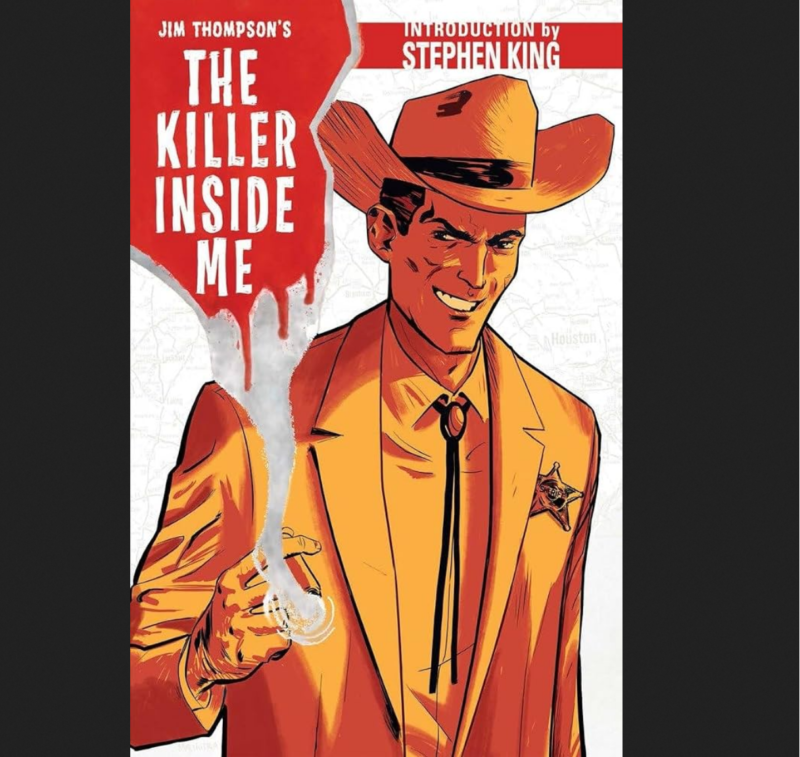
There are few things more unsettling in crime fiction than discovering that the person responsible for maintaining order is also the person most deserving of suspicion. Noir has explored this contradiction in countless ways, frequently placing otherwise ordinary people in circumstances that expose their greed, desperation, and capacity for moral corruption. However, Jim Thompson’s The Killer Inside Me takes this familiar premise somewhere much darker. Rather than following an individual gradually drawn into a life of crime, Thompson introduces readers to someone who has already learned how to conceal the darkness within him, making the distinction between respectable society and its most dangerous inhabitants harder to recognize.
Originally published in 1952 as a paperback original from Lion Books, The Killer Inside Me follows Lou Ford, a deputy sheriff in the small West Texas community of Central City. To the people around him, Ford appears to be an unremarkable but generally pleasant individual. He is friendly, approachable, and seemingly content with his position in the community. His responsibilities place him on the side of law and order, while his public personality makes him someone most residents have little reason to distrust. Unfortunately, this carefully maintained appearance conceals a deeply disturbed man. Ford has been through this before. A crime committed during his youth was covered up by his father, a doctor who has since passed away. Now, the “sickness,” as Ford describes it, has returned, and his increasingly violent behaviour threatens to expose the darkness he has spent years concealing.
What makes Thompson’s approach so effective is the decision to tell the story entirely through Ford’s perspective. Rather than observing a murderer from the outside, readers are forced to experience events through the mind of someone whose understanding of morality is fundamentally corrupted. Ford is not simply an unreliable narrator because he withholds information or deliberately misleads those around him. His entire way of interpreting the world is unsettling, especially when he attempts to explain or rationalise his own behaviour. His casual observations and conversational manner create an uncomfortable contrast with the increasingly horrifying nature of his actions.
This narrative approach also makes the novel far more disturbing than a conventional crime thriller. There is no traditional mystery surrounding the identity of the perpetrator, nor does the novel rely on the familiar process of investigators gradually piecing together evidence. Instead, Thompson places readers in the uncomfortable position of understanding the thoughts and motivations of someone capable of extraordinary cruelty. Ford’s perspective becomes an effective instrument for exploring how violence can coexist with an outward appearance of normality, especially when someone has become adept at manipulating the expectations of everyone around them.
The small-town setting is equally important. Central City is not presented as an obviously dangerous place. On the surface, it is an ordinary community where people have jobs, relationships, reputations, and expectations of one another, although wealth and local influence quietly determine how much power certain people actually hold. Ford’s position as a deputy sheriff makes his behaviour particularly disturbing because his authority depends on the very public trust he is exploiting. He is supposed to represent security, yet his presence undermines the assumptions that allow the community to function. Thompson uses this contradiction to challenge the relationship between respectability and morality, suggesting that the appearance of being a decent person is hardly evidence of what someone might be capable of doing.
There is also something particularly effective about the way Ford’s personality is constructed. He does not resemble the theatrical villains often associated with crime fiction, nor does he spend every moment announcing his intentions through elaborate displays of cruelty. Much of his behaviour is disturbingly mundane. He deliberately needles the people around him with folksy clichés and platitudes, using his seemingly harmless manner to encourage others to underestimate him. His conversations, social interactions, and attempts to maintain his reputation are frequently more revealing than the moments when his violent nature becomes impossible to ignore. The contrast gives the character a psychological dimension that makes him difficult to dismiss as simply another criminal protagonist.
However, The Killer Inside Me is not an easy novel to appreciate, and its treatment of violence deserves close consideration. Thompson’s depiction of brutality, especially violence directed against women, is exceptionally harsh. These moments are not incidental details that can be separated from the novel’s broader examination of human cruelty. They are central to understanding the kind of individual Ford is and the disturbing worldview through which he interprets his actions. There is a difference between depicting horrific behaviour to examine the darkness of a character and presenting that behaviour as something entertaining or admirable. Thompson’s novel deliberately makes that distinction uncomfortable, refusing to offer readers a conventional antihero whose actions can be comfortably excused.
This is also where the novel demonstrates its understanding of noir. The genre has always been interested in people whose weaknesses, desires, and moral compromises eventually lead them toward destruction. In many noir stories, the protagonist becomes trapped by circumstances partly of their own making, discovering too late that there is no easy escape from the consequences of their decisions. Ford represents a particularly disturbing variation on that tradition. He is not someone whose downfall comes from pursuing wealth, romance, or an increasingly dangerous ambition. His darkness is already present, and much of the tension comes from watching him attempt to maintain the illusion that he is an ordinary member of society.
Thompson’s work also stands out within the crime fiction of its period. Published during the early 1950s, The Killer Inside Me arrived as American paperback crime fiction was exploring increasingly bleak and psychologically complex territory. Its decision to place readers inside the mind of a murderous lawman was a particularly uncompromising variation on more conventional crime narratives. The novel would eventually become one of Thompson’s most recognised works, helping establish his reputation as a major voice in American crime fiction. Its inclusion in the Library of America’s Crime Novels: American Noir of the 1950s collection further demonstrates its importance within the literary tradition.
What ultimately makes The Killer Inside Me so memorable is that its horror does not depend on an elaborate criminal conspiracy or an extraordinary set of circumstances. Thompson finds something more unsettling in the ordinary routines of everyday life, particularly when those routines are maintained by someone whose understanding of right and wrong has become profoundly distorted. Lou Ford is frightening not because he looks particularly threatening, but because he understands how little effort is required to convince other people that he is harmless.
Jim Thompson’s novel remains an exceptionally dark example of American noir, pushing the genre’s fascination with deception, psychological corruption, and violence into deeply uncomfortable territory. Its subject matter can be difficult to confront, and its willingness to place readers inside the mind of such a disturbing character will not appeal to everyone. Nevertheless, that discomfort is central to what makes the book so effective. The Killer Inside Me is not simply a story about a criminal hiding behind a badge. It is an examination of the distance between how people present themselves and what they are capable of becoming, securing its place among the more psychologically unsettling works of American noir.
Works referenced:
Library of America: Crime Novels: American Noir of the 1950s
Library of America: Jim Thompson
Library of America: Dime Stores & Bus Stations: Robert Polito on the Savage Art of Jim Thompson
Open Library: The Killer Inside Me (1952 edition)
Open Library: The Killer Inside Me