

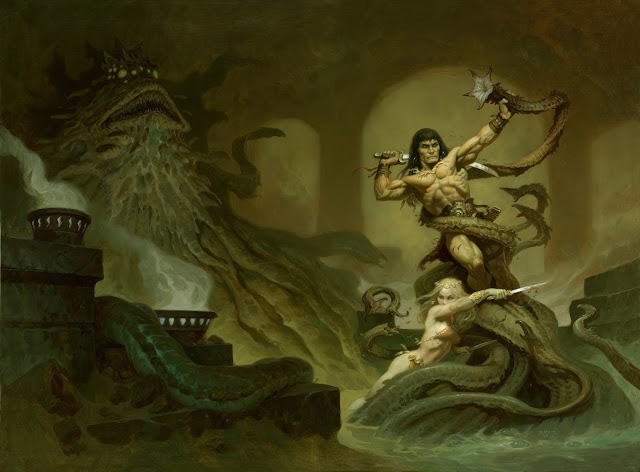
Sword and sorcery is fiction built on lean plots, dangerous magic, and heroes who are far more concerned with staying alive than saving the world. The stakes tend to be personal rather than cosmic. A thief wants a treasure, a warrior wants revenge, or a wanderer simply wants to get out of a cursed city in one piece. Of course, the genre has a long history, and knowing where to begin can be tricky. The genre’s roots are in pulp magazines from the 1930s, but the tradition never went away, and it still shapes modern fantasy novels, tabletop roleplaying games, and video games.
These six works cover the foundations and a few later branches. Each one works as an entry point, and none of them require any prior knowledge of the genre.
Conan the Cimmerian by Robert E. Howard
Every conversation about sword and sorcery starts here. Howard’s Conan debuted in “The Phoenix on the Sword” in Weird Tales in December 1932, and “The Tower of the Elephant” followed in March 1933. Set in the fictional Hyborian Age, the stories follow a barbarian who rises from thief to mercenary to king, and Howard wrote most of them for Weird Tales between 1932 and 1936.
What makes these tales endure is the mix of fast pacing and atmosphere. Conan is often described as a simple brute, but the stories show a sharp mind and a strong sense of survival. “The Tower of the Elephant” is a great place to start, since it features a young Conan breaking into a sorcerer’s tower and running into something far stranger than he expected. Beginners should pick up The Coming of Conan the Cimmerian, which presents the tales in their original form rather than in the heavily edited versions that circulated for decades. Once that collection is finished, The Bloody Crown of Conan and The Conquering Sword of Conan continue the run.
Swords and Deviltry by Fritz Leiber
Fritz Leiber is credited with coining the term “sword and sorcery” in 1961, and his Fafhrd and the Gray Mouser tales show how much fun the genre can be. Swords and Deviltry (1970) collects the early stories chronologically in the series, including “Ill Met in Lankhmar,” which won both the Hugo and Nebula Awards. The series itself goes back to 1939, so Leiber was working in the genre from almost the very beginning.
Where Conan is a force of nature, this duo is a pair of thieves with sharp wits and sharper tongues. Fafhrd is a towering northern barbarian, while the Gray Mouser is a small, quick swordsman with a talent for trickery. Their banter gives the stories a warmth and humor that many readers do not expect from pulp fantasy. That said, the city of Lankhmar might be the real star. It is a crowded, corrupt, and wonderfully strange place in the world of Nehwon, and it has served as a model for countless fantasy cities since. Swords Against Death is the natural follow-up.
“Black God’s Kiss” by C. L. Moore
Published in Weird Tales in October 1934, this story introduced Jirel of Joiry, one of the first female protagonists in the genre. Jirel is a warrior lord who loses her fortress to an invader, and the story sends her into a nightmarish underworld in search of a weapon to get her revenge. The price she pays for it is not what she expects.
It is short enough to read in a single sitting, which makes it a good sampler for anyone unsure about the genre. Moore’s imagery is also stranger and more poetic than what most readers expect from pulp fiction. The story reads like a dark fairy tale, and the atmosphere is far more haunting than most of its peers. Anyone who enjoys it can continue with “Jirel Meets Magic” and the rest of the Jirel stories.
Elric of Melniboné by Michael Moorcock
Elric first appeared in “The Dreaming City” in 1961, and the character was designed as the reverse of Conan. He is a sickly, sorcery-dependent emperor who relies on a soul-drinking sword called Stormbringer. Instead of a triumphant barbarian, readers get a doomed anti-hero whose weapon is as much a curse as a gift.
Moorcock’s stories are dark, tragic, and deeply influential on later fantasy and gaming. The ideas he introduced, such as the eternal struggle between Law and Chaos and the blade with a mind of its own, turned up in tabletop roleplaying games and video games for decades. The 1972 novel Elric of Melniboné is a solid starting point, and it explains how Elric came to lose his throne and take up Stormbringer in the first place. This being said, the tone is far bleaker than Howard or Leiber, so readers who want something lighter may want to save it for later.
The Desert of Souls by Howard Andrew Jones
Published in 2011, The Desert of Souls proves that the classic sword and sorcery formula still works today. The story is set in eighth-century Baghdad and follows Dabir, a scholar, and Asim, a swordsman, as they get pulled into a dangerous hunt filled with sorcery, monsters, and ancient treasure. Jones is well versed in the pulp tradition, and it shows in the pacing. Every chapter moves briskly, and the action never stalls.
This being said, it is not just a change of scenery. The Arabian Nights flavor gives the genre a fresh setting, and the two leads have a great dynamic that will remind readers of Leiber’s duo. Dabir brings the brains, Asim brings the blade, and the friendship between them gives the story its heart. It is also one of the most readable books on this list, so it works well as a first step for anyone who finds older pulp prose a little dense. The Bones of the Old Ones continues their adventures.
Death Angel’s Shadow by Karl Edward Wagner
Karl Edward Wagner’s Kane is an immortal wanderer, part warrior and part sorcerer, and he is one of the grimmest heroes the genre has produced. Death Angel’s Shadow (1973) collects some of the earliest Kane stories and shows how the genre could take on a harder, more cynical edge in the 1970s. Kane is cursed to walk the earth forever, and he treats kings, cults, and gods with equal contempt.
Wagner wrote with a clear love for what came before him, but Kane is very much his own creation. The violence is sharper, the morality is murkier, and the horror elements are stronger than in most of the earlier stories. Readers who enjoy the darker side of Elric will feel right at home here. The novels Bloodstone and Dark Crusade are the next steps for anyone who wants to go further.
Where to Go From Here
Of course, this is only a starting point, and there is plenty more to explore once the basics are covered. Plenty of other authors and stories helped shape the genre, but this lineup gives new readers a strong sense of what sword and sorcery can do.
Featured Image: Conan, art by Gerald Brom