

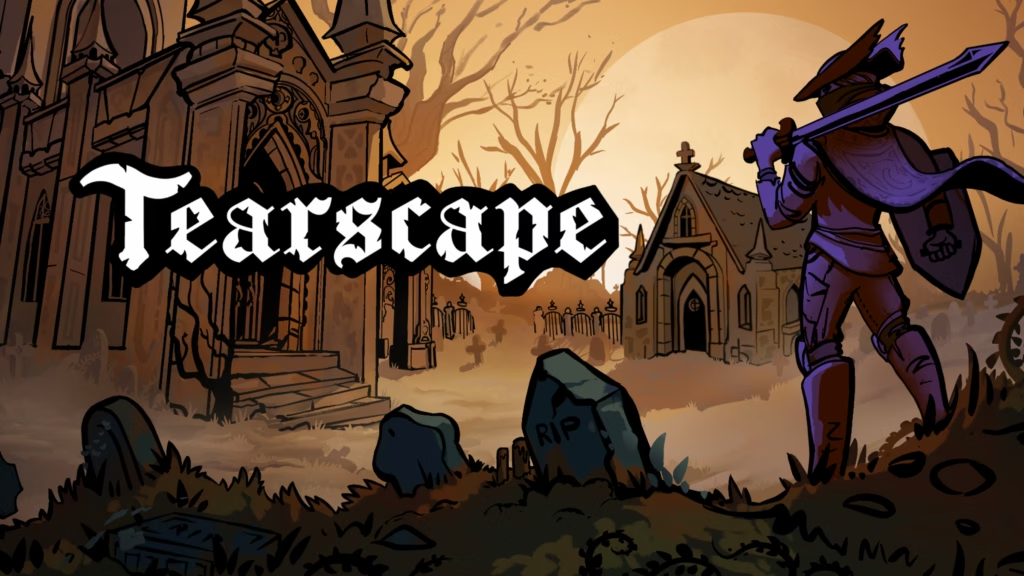
Tearscape is a game of contrasts, and it shows them off within seconds. Its 8-bit pixel art looks like something pulled from a Game Boy Color cartridge, yet the gothic dread and tangled, interconnected world have more in common with Bloodborne. NERDS TAKE OVER makes no effort to disguise either influence, which raises an obvious question. Can a game that looks this nostalgic carry a design this dark, or does one side end up undermining the other?
The strongest answer comes from the presentation. The pixel art captures the charm and the technical limits of classic handheld adventures, then fills that space with gothic architecture, unsettling creatures and imagery that is openly grotesque. Most retro-styled games lean on bright colours and warm nostalgia, so seeing the same style used for something this grim gives Tearscape a personality that is hard to confuse with anyone else. The Bloodborne influence is clear, but the game never tries to shrink that world down to sprite size. Instead, it runs those darker ideas through its own retro filter, and the result feels like an original creation rather than a tribute.

The setup is straightforward. You play a Hunter summoned by the Grand Mandate to deal with the beasts that have begun terrorizing the realm, and a short tutorial covers movement, combat, dodging and environmental interaction before pushing you out the door. It moves quickly and does not linger, which suits a game that would rather have you learn by exploring. Once the tutorial ends, Tearscape opens into a large map filled with dungeons, NPCs, side quests, hidden areas and paths that stay closed until you have earned the right ability.
That structure is the heart of the experience. Progress is not simply a line from one area to the next, because every new ability recasts the places you have already visited. A ledge that seemed decorative or a passage that would not budge becomes a destination the moment you gain the means to use it. This gives the world a satisfying sense of depth, since the map keeps rewarding you for remembering what was there and finally being able to act on it.

A few well-chosen tools keep that loop from becoming tedious. Fast travel between discovered shrines saves you from long, repetitive walks, and custom map markers let you flag anything odd, blocked or out of reach so you can return once you are ready. Marking a mystery and coming back to it hours later never stops being satisfying. Side quests add to this by sending you to different corners of the world for specific objectives, with rewards that include maps and tokens that provide passive bonuses. The tokens give your Hunter another layer of customization without ever becoming a system that demands constant attention.
Combat is where the Soulslike DNA is easiest to spot. Enemies drop Tears, which are used to strengthen your Hunter, and dying carelessly means risking everything you have collected. The fights reward patience over speed, asking you to study enemy patterns, wait for clean openings and treat the dodge as your most important tool. Encounters call for restraint, since rushing in and attacking as quickly as possible will get you punished. Fortunately, the game keeps that philosophy approachable. Some bosses will take several attempts, but Tearscape rarely feels like it is trying to overwhelm you just to prove a point.

Weapons help keep the fighting fresh. The basic sword you start with eventually gives way to daggers, great swords, shields, chains and other options, each of which changes how an encounter plays out. Lighter weapons let you stay on the offensive, while heavier ones favour timing and careful spacing. Because of this, finding a new weapon means more than a small bump in numbers. It changes the rhythm of a fight, which is especially handy when you return to enemies you have already defeated several times.
Bosses are where the combat shines brightest. They come with more complex attack patterns and more distinctive designs than the regular enemies, and that gives each fight a real sense of occasion. Learning a boss and gradually finding a way through it is rewarding without feeling cruel. The same care is not applied to the ordinary enemy roster, unfortunately. The same creatures show up again and again, and later versions are often just earlier ones with more health. Combined with a large map and a lot of ground to cover, the small selection of foes becomes more noticeable the longer you play.
Puzzles take a similarly interesting approach at first. Tearscape rarely points out what you can interact with, and it tends to bury its solutions in the environment itself. A piece of scenery that looks like background dressing may be the clue to a puzzle several areas away. This encourages you to look closely at your surroundings rather than follow obvious prompts, and it feels great when a detail you barely registered earlier turns out to matter.
The trouble is that this approach loses some of its magic over time. Once you understand how the puzzles are constructed, many of them turn out to be variations on the same handful of ideas, and the sense of mystery fades. The environmental design remains one of the game’s smartest choices, but it needed more variety to stay sharp across the whole adventure. Tearscape teaches you how it wants you to think, which helps early on and then becomes a bit too predictable once the lesson has sunk in.

On Switch 2, the Switch version of Tearscape performs well. It holds a stable 60 frames per second in both docked and handheld modes, with no significant performance issues to report. How it fares on original Switch hardware is a separate question this review cannot answer. Handheld play is an especially good match, since the visual style feels like a darker, exaggerated evolution of the adventures that once defined portable gaming.
The controls are less polished than the visuals. Movement and attacks can feel floaty or stiff, which is a problem in a combat system built around positioning and timing. Some swings look like they should connect and do not, while other times you take damage from enemies who appeared to be out of range. None of this ruins the combat, but it does keep it from reaching the precision its Soulslike ambitions call for. There is also a mismatch between the slow, deliberate movement and the lively look of the pixel art, so some encounters feel less responsive than they appear.
Backtracking can also become a burden. Fast travel and map markers help, but after several hours it is still easy to forget exactly where a specific obstacle was, and that can make progress feel more convoluted than necessary. An avian guide eventually offers a nudge when you are stuck, which is useful, though its presence feels like a patch for the game’s sometimes unclear direction rather than a natural part of the adventure.

The soundtrack suits the mood, but tracks repeat often enough during long exploration sessions that the loops start to show. The environments can feel sparse as well, particularly compared with other games built around interconnected worlds. Tearscape prefers an open, uncluttered look, which fits the retro style but leaves some areas less memorable than they could have been. A handful of interface and control remapping limitations on Switch add to the impression that the game could have used one more round of polish.
Co-op is a welcome inclusion and adds a new dimension to the experience. A second player makes some of the harder encounters easier to manage and changes how exploration feels. The game is not designed around multiplayer, which is worth noting, because Tearscape works perfectly well as a solo adventure. Co-op is simply a nice extra for those who want it.
The main path takes around eight to ten hours, with more time available for those who chase side quests, secrets and hidden areas. That length suits the game well, because the world feels substantial without being padded out. The interconnected map gives exploration a steady purpose, and the combination of weapons, abilities, puzzles and secrets provides plenty of reasons to keep searching every corner.
Ultimately, Tearscape succeeds because its influences support one another rather than competing. The classic top-down adventure structure provides a solid foundation for exploration, and the Soulslike combat and gothic presentation give that foundation a darker edge. It falls short of its full potential, held back by repetitive enemies, puzzle ideas that grow familiar, imprecise controls and occasionally circuitous backtracking.

Even so, there is a great deal to enjoy. Tearscape understands why interconnected worlds are so appealing, particularly when a new ability transforms a place you thought you were done with. It captures the appeal of learning enemy patterns and discovering weapons that change your approach, and it treats observation as a real part of exploration. Most importantly, NERDS TAKE OVER does not hide what inspired it. The developers embrace those influences and adapt them into something that fits their own retro framework.
Tearscape may not match the heights of the games it draws from, but it does not have to. It is an atmospheric, engaging adventure that blends old-school exploration with modern action RPG ideas, and its gothic pixel art gives it a strong identity. There is plenty of room for NERDS TAKE OVER to grow, especially by sharpening the combat, adding more enemy and puzzle variety and making progression clearer. As it stands, Tearscape is a worthwhile journey for anyone drawn to retro adventures, interconnected worlds, gothic horror or a more approachable take on Soulslike mechanics.
Disclaimer: A review key was provided.