

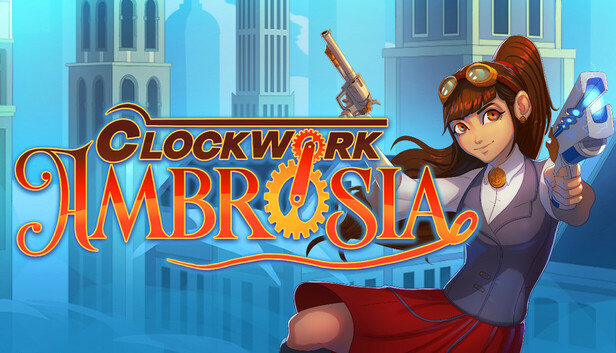
Most Metroidvanias build progression around movement. New abilities open new paths, which lead to more abilities, and the cycle continues until the map is fully unlocked. Clockwork Ambrosia takes a different approach. Instead of making traversal the centrepiece, it builds nearly its entire identity around an intricate weapon modification system that turns every firearm into a customizable experiment. The result is one of the more mechanically distinctive entries the genre has seen in years.
The story wastes little time with exposition. Iris is flying an airship when an attack sends her crashing into a ruined underground metropolis. After a brief encounter with one of the few remaining inhabitants, the objective becomes clear: survive the hostile environment, uncover what happened to this civilization, and find a way forward. Details about the world are deliberately scarce during the opening hours, allowing environmental storytelling to do most of the heavy lifting. That restraint works in the game’s favour, creating a lingering sense of isolation that makes exploration feel purposeful.

Presentation is where Clockwork Ambrosia immediately impresses. The pixel art is exceptional, with dense industrial backgrounds, glowing machinery, and fluid character animation that give the world a constant sense of motion. Enemy attacks are easy to read without sacrificing visual flair, while bosses fill the screen with elaborate patterns and effects that feel closer to a modern action game than a retro-inspired indie release. The soundtrack complements this perfectly. Each region introduces energetic tracks that reinforce the atmosphere and make long exploration sessions surprisingly easy to sink into.
Unfortunately, the map screen does not reach the same standard as the rest of the presentation. While the environments themselves are packed with detail, the map uses a much flatter visual style that feels disconnected from the game around it. Navigation becomes more cumbersome than it should be because regions lack clear labels, forcing players to rely heavily on memory when backtracking. The inability to fully zoom out only adds to the problem, particularly when trying to plan routes across multiple interconnected zones. It is a functional map, but it lacks the clarity and polish expected from a game built around exploration.

Fast travel introduces another small but noticeable issue. Teleportation crystals become available partway through the adventure and dramatically reduce the amount of backtracking required. In principle, this is a welcome quality-of-life feature. In practice, the system occasionally allows access to nodes before they have been reached through natural exploration. That convenience comes at the cost of some discovery, slightly weakening the satisfaction of charting the world organically. It is not severe enough to undermine the overall experience, but it does affect the pacing of an initial playthrough.
Those complaints fade into the background once the weapon modding system takes over. More than a hundred modifications can be found throughout the world, each altering some aspect of a firearm’s behaviour. A basic energy blaster can be transformed into a spread-shot monster, a piercing beam weapon, or a rapid-fire barrage machine depending on the combination of components installed. Projectile count, firing angle, trajectory, charge behaviour, and several other variables can all be adjusted. Combat quickly becomes less about simply shooting enemies and more about constructing a loadout tailored to the challenges ahead.

The brilliance of the system is that experimentation is constantly rewarded. A build that tears through groups of smaller enemies may struggle against a heavily armoured boss, while a precision-focused setup can make certain encounters dramatically easier. The game encourages frequent tinkering, and finding a new modification often feels as exciting as discovering a traditional Metroidvania movement upgrade.
A secondary weapon slot expands the possibilities even further. Carrying a heavy launcher, explosive weapon, or other specialized firearm alongside the primary blaster creates a layer of tactical flexibility that keeps boss fights engaging. Swapping between weapons on the fly allows players to adapt to changing attack patterns rather than committing to a single strategy for an entire encounter.
What ultimately makes Clockwork Ambrosia stand out is how confidently it commits to its central idea. Many Metroidvanias include weapon upgrades, but few build an entire progression system around them. The sheer number of viable loadouts gives the adventure substantial replay value and encourages creative experimentation long after the credits roll.

Between its outstanding pixel art, energetic soundtrack, and remarkably deep customization system, Clockwork Ambrosia delivers a memorable 20 or so hour experience that feels genuinely different from its contemporaries. The map interface and fast travel quirks are frustrating, but they are far easier to overlook when the core combat loop is this satisfying. For players looking for a Metroidvania that prioritizes tactical weapon design over traditional ability progression, Clockwork Ambrosia is an easy recommendation.
Disclaimer: A review key was provided