

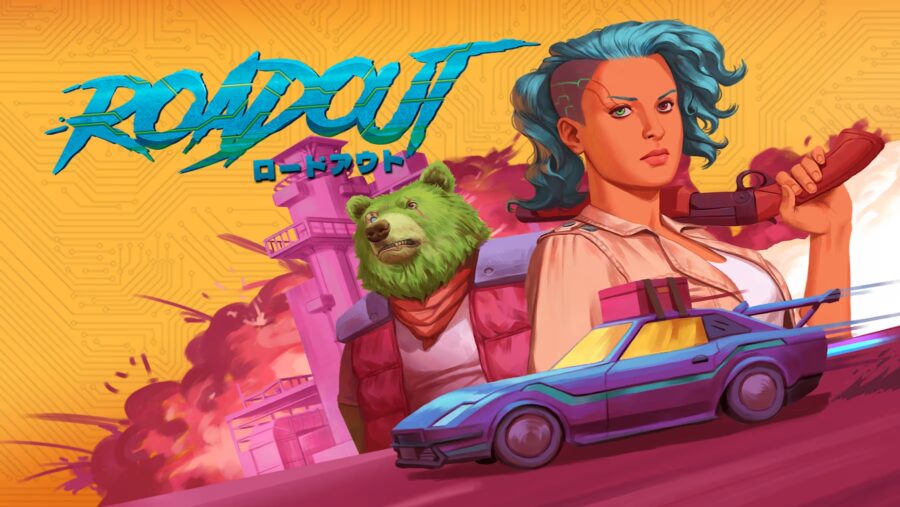
Indie games are more frequently becoming the last bastion of creativity in an industry increasingly affected by studio closures, lack of funding, and rising costs. As they reach larger and larger audiences, these games are increasingly becoming the mainstay of more gamers and are starting to becoming mainstream with greater frequency. One of the best publishers we’ve seen for these rising indie stars is Dangen Entertainment and today, it’s time to introduce another one of their releases, RoadOut from Brazilian developer Rastrolabs Game Studio.

RoadOut puts you in the shoes of Claire, a blue-haired mercenary the travels the Dead Zone looking for work, regardless of how violent it may be. Murder, sabotage, theft, nothing is off the table when it comes to survival. This is a bleak and desperate world where your car and your gun are the only things you can trust. There’s more than a bit of Mad Max baked into RoadOut and Claire is jaded and twisted by her environment by necessity. Her only friend is Ted, a local bartender who is just as selfish as everyone else, but at least he has a soft spot for Claire.

You’re dropped directly into the game with almost no idea what’s happening at the beginning of RoadOut, forced to look for resources deep in the Dead Zone to fix your car and the initial stage teaches you how combat works. RoadOut is a non-traditional action game however. The game looks like it’s two dimensional, but a flick of the right stick changes the orientation to an isometric perspective. You can reveal new details covered by the walls by changing the camera orientation. As you do, you’ll discover that everything in the action stages, while appearing 2D, is actually three dimensional. This modular design allows stages to hide all sorts of secrets, forcing you to explore both with Claire and with the camera itself in each room you enter.

Enemies are particularly vicious in RoadOut as well. You start out with a piece of metal as a shield and a crowbar for a weapon. To fight, you’ll have to get close to enemies and pummel them to death, and if you’re not careful, they’ll swing back fast. You have the ability to block with the shield and dodge away, but every move takes energy that takes a moment to replenish, so if you find yourself cornered, things get grim pretty fast. Fortunately you can use the broken items lying around dungeons in the waste to craft your own healing items to use while in battle from a d-pad hotlist. You’ll definitely need to as well, because after the introductory level, enemies tend to swarm you quickly with strong attacks, constantly knocking your health down as you struggle to survive.

Once you get out of the initial dungeon, you’ll have to drive to get where you’re going. While there is a fast travel system in RoadOut, you can only use it once you’ve been to a location and not every location works for fast travel. Driving is direction-based rather than turn-based like most driving games, so it takes a bit of practice to get the hang of it. You have to move the stick in the direction you want your car to go, rather than using the stick to turn and the accelerator to move forward. This requires much more active use of the analog stick than typical driving interfaces, though the R2 button accelerates and the L2 allows you to brake and slide around turns.

What you’ll quickly notice however is that RoadOut doesn’t hold your hand at all. The barest of explanations is given for each mechanic and you’ll have to master them yourself or die. Death just puts you back where you started at each level, but that can also be problematic if you’re stuck in a challenging boss room or a battle that’s unwinnable at your level and that can easily happen. Getting the hang of combat by dying repeatedly or learning how to race by losing with no chance to retry is quite frustrating, but after a while you’ll slowly get the hang of combat and racing that seem impossible at first. Learning to dash through attacks and wait for the right moment to strike with the right weapon while driving takes a fair amount of practice and hearkens to the From Software school of game design, though RoadOut is not quite that difficult.

Dropping back to the plot, this is a story-based game where you’re slowly piecing together bits of Claire’s unknown past. Once you’ve gotten past the initial story, learned to drive and fight, and made your way back to Ted’s bar, the game begins in earnest. This is a very open-world exploration where you can take merc jobs at Ted’s and get offered jobs by various denizens of the Dead Zone via communicator while you’re driving about. These can be all sorts of jobs and there are no difficulty ratings on them, meaning that you never know what you’re getting into until you get there. Sometimes that’s fine but other times it leads to incredible frustration as you suddenly find you’re extremely under-equipped to deal with the various challenges that the Zone presents. You’ll also be moving through the main story (a bit easier most of the time) which is designated by a yellow map marker instead of the white ones that all other missions have. Once you’ve driven to a key location, you can warp there with fast travel as well, making moving around the Zone a lot easier.

There are a number of tattoos you can get in RoadOut as well. These serve as upgrades to your character, making you more and more powerful as you get more and more tats. Unfortunately, the items required to get tattoos are difficult to obtain and upgrades are few and far between, leaving you much weaker than you’d like, even if you put a number of hours into the game. It’s great to have the system, but if everything is exploration-based and there’s no leveling, it’s tough to use. The same goes for the renown system. If you don’t have enough street cred with a particular group, you can’t enter their territory without being attacked. Unfortunately, some missions you are offered are in those same territories and you simply can’t complete them because killing those gang members turns them even further against you…unless you like being reviled.

What’s weird about RoadOut is how familiar it all feels. If you’ve seen movies like Mad Max, there’s a clear undercurrent here, but there are also worms reminiscent of Dune hiding in the desert, and there are some very strong parallels here with Horizon: Zero Dawn and Aloy as well. It’s like the game takes a bit of everything and makes old things feel new again. The game absolutely has its own lore and structure that’s unique, but everything still feels similar to other games. It’s more like a tribute to all the inspirations than anything else though, and that’s not a bad thing.

Of course, as a pixel indie game, the visuals are retro in the extreme and you cannot help but enjoy the fun pixel art, especially when it pivots to 3D and back as you’re rotating the camera in various building and cave explorations. There’s a ton of blood in the game too and it adds to the gritty, violent nature of the Dead Zone even though the pixels and somewhat low detail. With the complex bosses and interesting lighting and environmental effects, RoadOut looks cool pretty much all the time. Perhaps the least impressive visuals are actually the driving portions of the game, but that’s honestly ok because they’re so frantic when you’re being attacked that you’d barely have time to notice more detail anyway.

The music is fairly good in RoadOut as well. It’s just as frantic and exciting as you’d expect for a game like this but at the same time, nothing really stands out. Tracks kind of blur together after a while and the music fades into the background. That’s certainly better than it being irritating, but it isn’t a soundtrack you’re going to be dying for. The sound effects are fun however, and the squishy sound of bodies getting destroyed is commonplace. The sound effects really work well with the visuals here, making up for the average soundtrack.

Unfortunately, things are not all sunshine and skeletons in the Dead Zone. There a number of issues with RoadOut that take away from the experience. Most notable among these is the high difficulty level. It’s not just that the game is hard. It’s that the game is hard and the early game has essentially no weapons progression. If you want to just wander around the desert, you absolutely can, but you’re absolutely going to get your ass handed to you in random missions. Regular enemies are remarkably tough and require patience to beat. Often you’ll get locked in a room full of enemies as soon as you enter and get swarmed. Dying just puts you back at the beginning of the room, which would be fine if your weapons did any damage to the enemies. Instead, you’re just dancing around them with dodge, plinking away at their health. You get a pistol fairly early on too, but it does almost no damage and requires you to aim fairly accurately rather than auto-locking, making it almost impossible to use unless you’re on a direct horizontal or vertical line with enemies. If you’re utilizing the isometric camera angle, it’s even harder, and to top it all off, ammo is finite and you’ll have to make more with the scrap you harvest by killing enemies.

That’s not all. You would think that RoadOut would autosave and you’d be right…sort of. It does autosave, but not with every scene transition. That means that there are several random autosaves at any time. While we were playing we accidentally closed the game after a boss battle. The battle was over, and Claire had returned to Ted’s bar, then left and gone to do something else. None of that was captured by the autosave however and the entire portion had to be played through again. You can manually save of course, and you absolutely will have to because if you get stuck in a dungeon area that’s beyond your current weapons and tattoo boosts, you’re in big, big trouble. Instead, you’ll have to reload a previous save, lose your progress, and find an easier mission.

Driving is just as frustrating as combat too. You’d think you could just attack random enemies on the overworld screen but that’s a big mistake. Your regular weapon is quite weak and enemies are fast, forcing you to circle each other as you occasionally manage to shoot them a few times, whittling their life down. Animals attack you as soon as you get close and decimate your car. And missiles are a finite resource but the only thing that effectively kills enemies quickly in the early parts of the game. Racing also just tosses you in. You get your first race with essentially no practice at all and good luck winning that. Some people may take to the odd controls for driving but we found that it takes some practice to get the hang of racing and there’s no going back if you mess up. If you’re not manually saving regularly, almost everything feels like a struggle in RoadOut and that’s a shame because there’s a lot of cool design elements here.

RoadOut feels like a game with a solid core concept that simply tried to put too much together in one bundle. There’s so much going on that it’s hard to get a grasp on it all, the story seems interesting but is diluted by all the side content, and there are a bunch of smaller design issues that hold the game back from greatness. A more focused experience with clearer progression would have made this a much more fun experience but as it stands, RoadOut is a grind that has potential but lacks that fun factor that would bring it to greatness. Feeling persistently weak in a game just isn’t the best experience and players are likely to get frustrated with the game long before the payoff hits. It’s a unique concept that might be worth a look when it’s on sale, but as it stands, it’s hard to recommend RoadOut, even at its low $15 price point.

This review was based on a digital copy of RoadOut provided by the publisher. It was played on a Nintendo Switch in both docked and undocked modes and played equally well on both. RoadOut is also available on PS5, Xbox Series X/S, and for PC on Steam and GOG.

Nate Van Lindt has been a gamer since the days of yore (aka Commodore 64), and has played a bit of virtually everything out there. He's also an avid comic book collector, both vintage and current, and reads a fair amount of sci-fi and fantasy. On top of that, he watches a fair number of movies and TV shows as well. Oh, and he has a family, a full-time job, and lives somewhere in the urban wilds of Southwestern Ontario, Canada, foraging for old video cables and forgotten game soundtracks.