

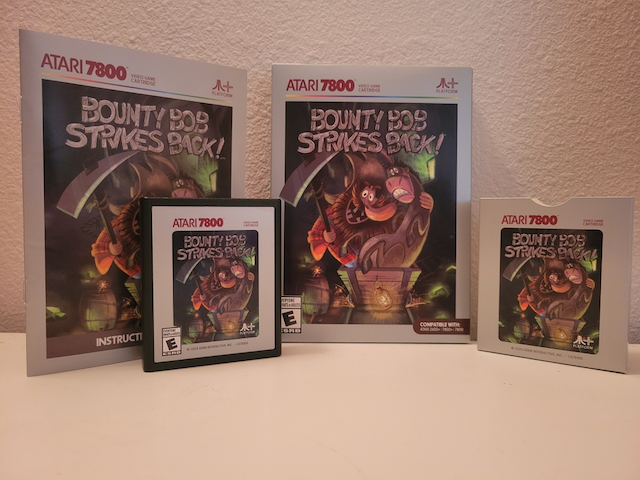
Bounty Bob Strikes Back! (a sequel to Miner 2049er) sets the player on a grand, demanding objective: traverse ten complex, multi-screen alien environments to collect every single object scattered across the treacherous landscape, all while fighting a relentless clock. The story is a simple backdrop: rescue the Marshal. That’s it, but for an arcade style platformer on the 7800, you really don’t need and can’t have a complex narrative.
The core gameplay of Bounty Bob Strikes Back! is its uniquely challenging platforming, defined by the dynamic movement system. Bob can run, climb, and, most distinctively, execute a high, arcing jump whose height is determined by the length of the button press. Mastering this variable jump is the key. The jump of which must be pixel perfect to land on tiny, moving platforms…is the source of the game’s infamous difficulty. The port to the Atari 7800 is solid, yet the console’s standard joystick often feels too loose and imprecise for the game’s required accuracy. Funny thing is, that even with the awesome CX40+, this still seems the case. This is due to how difficult and brutal the game is.
The ten massive, interconnected levels are masterpieces of early design, featuring cannons, slides, enemy patrols (Fungus Mutants and other hazards), and environmental triggers. However, the gameplay is unforgiving. There is little room for error, and deaths often feel sudden and cheap. These cheap deaths are sometimes caused by hit detection that appears inconsistent. This punishing difficulty, while characteristic of the era, makes the game a deeply challenging experience that rewards only the most patient and persistent player.

Visually, the Atari 7800 version is a notable upgrade from its 8-bit contemporaries. The game takes advantage of the 7800’s enhanced color palette, delivering vibrant, distinct environments that look crisp and clear. Bob’s sprite is detailed and well animated, This update in color palette helps to effectively convey his actions; from climbing a ladder to executing the critical high jump. The presentation is crucial here: the screen is well organized, clearly delineating safe platforms from dangerous energy barriers or gaps, which is essential for a game requiring such precision.
However, while the graphics are great for the 7800, they remain simple by modern standards. The enemies are somewhat blocky, and the background is mostly static. The game’s biggest visual strength lies in its ability to cleanly render complex, multi-layered screens and numerous interactive elements. This port is able to do this without significant slowdown or flickering. This is rather impressive given how chaotic the stages can be with all of the components on screen.

The sound design is characteristic of early 8-bit platformers: functional, minimal, and sometimes repetitive. The continuous chiptune loop is fast paced and upbeat, effectively conveying the urgency imposed by the time limit. Though to be honest, it can become grating during long sessions of repeated failure. Sound effects are basic but perfectly communicative: a high pitched bong for Bob’s jump, a brief musical sting when an item is collected, and a distinctive, alarming noise upon death.
The primary role of the sound is to reinforce the frantic pace, preventing the player from dwelling on failure. While the audio is not technically sophisticated, it effectively anchors the player in the arcade style competitive loop. While not over the top, it provides necessary auditory feedback without distracting from the demanding visual task of traversing the complex geometry. Given how brutal this game can be, the audio design is one of the great things about this game.

Bounty Bob Strikes Back! on the Atari 7800 is a monument to challenging retro platform design. Its strengths lie in the sheer scale and ingenuity of its level design and its commitment to a high difficulty. The port successfully leverages the 7800’s graphical capabilities, presenting a clean and fast experience. However, its core appeal is strictly limited by the unforgiving, pixel perfect demands of the controls. This is a game for the dedicated historian and the masochistic platforming purist. If you crave a genuine test of retro endurance, few games offer a more brutal but ultimately rewarding ascent.
As brutal as this game is, it really is a wonderful game on the Atari 7800. It also serves as a great sequel to the original. I would recommend checking this game out, but it’s not for the faint of heart.
Disclaimer: A review unit was provided

In addition to writing articles, Ryan Byers also creates content for his YouTube channel called "Obscure Games and Consoles", collects video games, and dabbles in video game development.