

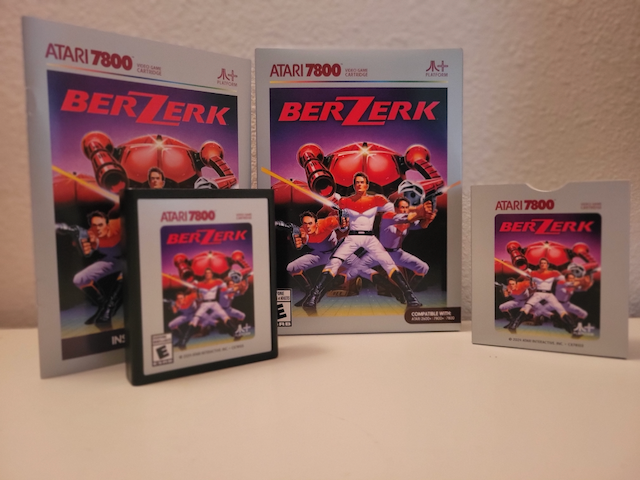
Berzerk is a game that started out in the arcades and then eventually made its way to the Atari 2600, and most recently onto the Atari 7800. As a huge fan of the 2600 port and the arcade game, I was super excited when the 7800 port came out. While it doesn’t have much in the way of a story, the game really doesn’t need one.
Berzerk’s gameplay is defined by its simple yet intense movement and shooting mechanics. Unlike most shooters on the Atari 7800, Berzerk requires the player to master maneuvering diagonally while simultaneously firing in a different direction; a technique critical for managing multiple closing threats. The gunplay is responsive, allowing for rapid, continuous shots essential for clearing screens quickly. However, the game inherits the most brutal feature of its arcade predecessor: touching any electrified wall results in instant death, often leading to frustrating collisions during desperate maneuvers.

The CX78+ Wireless joypad for the Atari 7800 is a great choice for the eight-directional movement and provides crisp input detection. Yet, the core functional critique remains the game’s inherent unfairness at higher score levels. The mazes become so densely populated with robots and so constricted by walls that avoidance becomes nearly impossible. While the port’s performance is technically sound with smooth scrolling and no noticeable slowdown, the unforgiving collision detection and the relentless speed of Evil Otto ensure that only exceptional spatial awareness can sustain a long run.

Visually, the Atari 7800 version of Berzerk represents a significant leap over the Atari 2600 port, bringing the arcade aesthetic much closer to life. The graphics are clean and colorful, with the electric maze walls rendered in solid, distinct colors that stand out sharply against the black background. The robot sprites are detailed and are flicker free. This allows for clearly differentiating their orientation and firing direction. The most crucial visual element, Evil Otto, is perfectly captured: his iconic, grinning, bouncing face induces immediate anxiety.
The presentation shines in how it uses the 7800’s graphical capabilities to maintain clarity amidst chaos. The screen can feature numerous bullets and enemies without becoming a confusing mess. The trade off for this graphical fidelity is that the environments, while varied in layout, always feature the same basic wall and enemy textures, but this is really to be expected given this title.

The sound design is the absolute highlight and defining feature of Berzerk. The 7800 port successfully incorporates digitized speech, which was revolutionary for its time and remains a powerful source of immersion. Hearing the robotic, synthesized voice declare “Intruder alert! Code red!” or mock the player with “Chicken!” or “Get the human!” creates an immediate, pervasive atmosphere of dread.
Beyond the speech, the sound effects are highly functional: the specific pew-pew of the robots’ laser fire, the repetitive, rhythmic clomp-clomp of the advancing robots, and the bouncing sound of Evil Otto as he closes in are essential audio cues. These auditory elements are perfectly synced with the action, transforming the game from a simple shooter into a high-anxiety sensory experience. The audio fidelity is excellent, ensuring the limited but crucial soundscape is crystal clear.

Berzerk on the Atari 7800 is an incredibly successful adaptation that captures the frantic, claustrophobic tension of the arcade classic. Its strengths lie in the perfectly recreated, low-latency control scheme and the definitive inclusion of the iconic digitized speech. While the game is dated by modern standards and remains punishingly difficult…especially given the simple nature of the walls causing instant death, it is an essential title for any 7800 enthusiast. It’s a masterpiece of early 8-bit performance that uses minimal elements to maximize player panic.
Berzerk is one of those titles that never gets old. Though as someone that loves the game, I am a bit biased. The game is a wonderful addition to any 7800 collection and is definitely worth picking up!
Disclaimer: A review unit was provided

In addition to writing articles, Ryan Byers also creates content for his YouTube channel called "Obscure Games and Consoles", collects video games, and dabbles in video game development.