

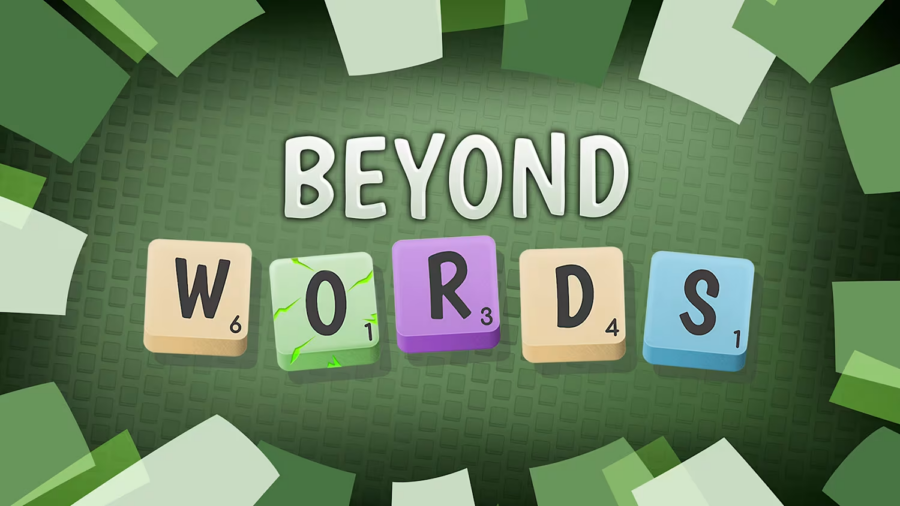
Remember back during COVID when everyone got hooked on Wordle? The creator made a fortune selling it to the New York Times and everyone was hopelessly addicted and challenging each other for high scores. It’s not like word games are anything new, even in digital circles but it’s the occasional game that happens to catch our attention that reminds us of word searches and crosswords in grade school. Harnessing that nostalgia for some fun that helps with our English skills has long been a goal of game developers but it’s incredibly hard to hit that sweet spot where everyone has fun and isn’t frustrated.

Enter Beyond Words from developer MindFuel Games and publisher PQube. Working at MindFuel are two industry veterans, Steve Ellis and David Doak, who worked on Timesplitters and GoldenEye respectively. While they may be well-known developers, this is a radical departure from their previous work, so don’t expect any exciting FPS action (not that you would with the screenshots from this one!

Beyond Words is basically an updated version of Scrabble. Nearly everyone in North America either has a copy of Scrabble on a shelf or in a closet somewhere or has at least played it once or twice. You receive tiles and have to make words out of them, starting at the Star point on the board. It’s identical with Beyond Words. You must make words from the tiles you are given, starting with the Star point (or points) on the game screen. Just like Scrabble, there are various icons on the board that give you bonuses as well. In fact if you play Scrabble, you’re fairly well-equipped for Beyond Words, but keep in mind that this game is designed heavily around the English language so if you’re a foreign language speaker, this is going to be a tough game.

That’s where the similarities end however. Beyond Words is more like an evolution of the Scrabble concept. Each stage has a different design and different layouts and you’ll have to create words to progress. Match the minimum score and you move to the next round, with nine rounds in each stage and three “boss” rounds where there are additional rules that hinder your progress. You can beat the stage and unlock the next to move on without finishing all nine rounds, but you won’t get that glorious gold trophy on the stage select field. *sob* There are branches on the stage selection as well, so you can jump up or down on the map to additional challenges, some of which are timed. You can also dump individual letters a few times per stage if you got a bad draw and re-scramble your tiles in a desperate search for inspiration that may or may not work.

As you play through each stage, the number of points goes up for each round, skyrocketing past the point of reason. To meet these outrageous goals, you’ll have to use cards and there are plenty of them in Beyond Words. Completing a round gives you gold coins which you can spend in a store to buy various types of modifiers. Some of those are Power cards which are persistent modifiers that directly affect gameplay. Others are Booster cards which are expended after use but may or may not have lasting impacts. Often, modifiers from cards will change the letters in your draw pile to different colors (built-in multipliers) or increase the frequency of asterisks or questions marks which can be used as wild cards for vowels or letters respectively. There are actually too many to go into here and you’ll have to learn them all to use them effectively. You can also buy Perks which change the points or gold you get at the end of a round or the cost of items in the store among other effects. Naturally, you’ll only get enough gold to buy a few things at a time and after each stage, your purchased items reset (which is frustrating).

The cards and perks that show up in the store are random but successfully beating levels and scoring high unlocks more and more powerful Booster and Power cards, making future rounds a bit easier within each stage. They give bonuses for individual letters, additional bonuses for certain sizes of words, and much, much more. It’s honestly impossible to even buy the sheer volume of cards you are shown so you’ll have to experiment a lot to figure out which combinations give you the best bonuses or you’ll be struggling to even complete some stages. Get the right combos and like any roguelike in this category such as Balatro, Dice-A-Million, or Clover Pit (review here) and you’ll suddenly be racking up massive scores and blazing through levels but unlike those games, you’ll have to start all over each stage. If you manage to hit the exact right synergy, you can score massively with even 2 and 3 letter words, but it’s frustratingly hard to pull off consistently.

Visually, there’s not a lot going on with Beyond Words. There are some cutesy drawings on the backgrounds and cards that are almost infantile, but the rest of the game is just tiles, game board, and GUI. Even if you do well in the game with a massive score for a particular word, there’s really very little to show for it. Just a bunch of multipliers zipping across the screen in a simplistic manner and you keep playing. While the trailers look enticing, it’s a surprisingly low-key game that you’ll spend hours sitting and thinking about; an almost introspective experience. The music is equally chill, running quietly in the background almost like elevator music but never really catching your attention or significantly impacting the experience. Honestly, Beyond Words plays pretty much the same whether the sound is on or off and that lack of auditory engagement takes away from the gameplay a bit.

One of the big failures of Beyond Words is the lack of payoff. If you’re well-read, you’re going to be able to consistently come up with words that are 6-8 characters in length but that doesn’t necessarily help you in the game. Instead, your modifiers are the key and your linguistic skills take a back burner to random draws that limit your ability to score points depending on your words and your branch placement to get board multipliers. This can be incredibly frustrating because coming up with a creative word simply won’t score you the points much of the time. On top of that, many of the bonuses from various roguelike elements only apply to words of a certain length, limiting your ability to maximize your score with available tiles. There’s just not much benefit in overachieving here and Beyond Words ends up becoming focused almost entirely on card combos rather than words.

When you do manage to squeak by with multiple words rather than one or two high scorers, you’re also hampered by your previous words, which stay on the board for the whole stage. Fewer words that score higher means more room for later rounds, but struggling to get through with 4 or 5 words per round means by the end your board will be loaded with words and you’ll have no room to place the good words you manage to come up with. Having a great word you simply can’t score is utterly rage-inducing and even if you manage to survive the round, that feeling stays with you. The game simply doesn’t move that fast unless you’re throwing out the first thing that pops off in your head so you sit there stewing about the words you can’t manage to pull off due to placement or how you are so close to using one of the multipliers on the board but just can’t quite manage it with your current word slate.

If those issues weren’t enough, there’s one more big flaw in Beyond Words and that’s the game’s dictionary. You’d think that a game like this one would have a spectacularly huge list of words to draw from but that’s not the case here. A number of words simply were not recognized by the game, including for content. Swear words do not work, the word “sex” was not in the dictionary, and a variety of others words both common and obscure were not considered words as well. For a game that purports to require strong English skills in its description, that’s a particularly notable failure. As a final comment, it should also be noted that while touch controls are implemented on Beyond Words, they’re a bit finicky and if you have larger fingers, it may be difficult to accurately place tiles with them and we found traditional controls more effective.

Beyond Words is a great concept. The idea of combining roguelike mechanics with a Scrabble base is definitely cool. Unfortunately, the lack of effects during gameplay, the slow nature of the game, the difficulty of building an effective set of cards, and the weakness of the dictionary all combine to take away from the core gameplay. Yes, it’s fun to slot words, but this is no fast-paced game and the fun slowly drains out of it as you creep through the stages. Concept is only as good as its execution and in this case, Beyond Words just doesn’t make the cut. It’s fine as a casual time-waster but the gameplay loop simply isn’t addictive or even all that fun and without that, the game collapses. You might get more mileage out of it than we did, but even at only $15, it feels like there’s not enough bang for your buck here.

This review is based on a digital copy of Beyond Words provided by the publisher. It was played on a Nintendo Switch in both docked and undocked modes and played equally well on both. Beyond Words is also available for PS5, Xbox, and PC on Steam.

Nate Van Lindt has been a gamer since the days of yore (aka Commodore 64), and has played a bit of virtually everything out there. He's also an avid comic book collector, both vintage and current, and reads a fair amount of sci-fi and fantasy. On top of that, he watches a fair number of movies and TV shows as well. Oh, and he has a family, a full-time job, and lives somewhere in the urban wilds of Southwestern Ontario, Canada, foraging for old video cables and forgotten game soundtracks.