

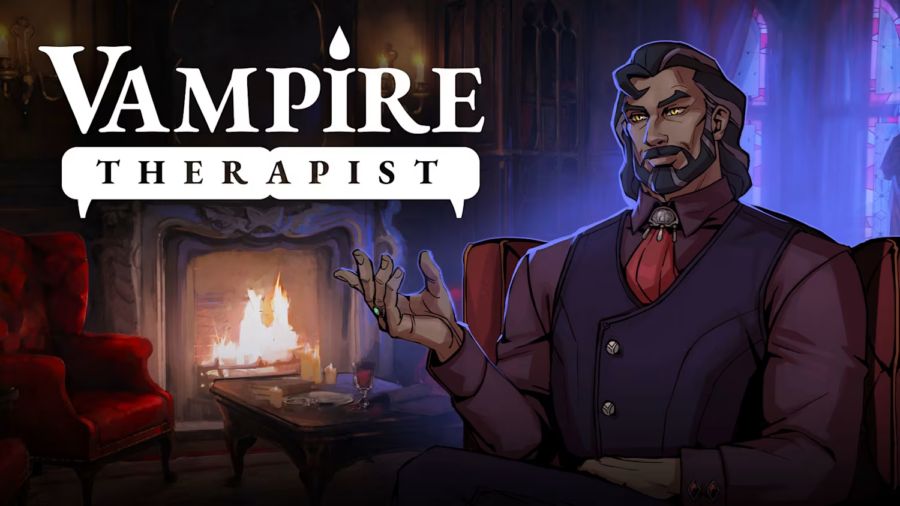
Vampire Therapist from developer and publisher Little Bat Games is one of those titles that would never get released by a major studio. This is the bread and butter of indie games, weird concept games that no one even had any idea they were looking for in the first place. As you might guess, the game is about providing therapy to vampires but it’s a bit more complex than you might think because while this is basically an interactive visual novel, you’re using actual psychology techniques.

That’s right, Vampire Therapist was actually developed in conjunction with real therapists using actual techniques that you might encounter in real therapy sessions. The game does not mince words saying that even though it is based in real methodology, it should not be used as a replacement for therapy or considered therapy in any way. If you’re a vampire looking for a shrink, just spend the money and pay for a real one…it’s not like you can’t make more money if you’re immortal anyway!

Seriously though, this is a pretty wild game. You play Wild West outlaw Sam Walls, who’s been a vampire since the 1800s and has learned the error of his vicious ways. To atone, he’s trying to help other vampires with their deepset neuroses, and if you’ve lived hundreds or thousands of years, there’s no way you don’t have a few! Sam is a caricature of every cartoon and movie you ever saw about the old West but he’s learned that modern ways of thinking have the ability to solve his issues. His thoughts on people’s rights and how to help others are admirably optimistic and honestly, he’d probably be considered ‘woke’ by some demographics, but he makes for an interesting character full of contrast and conflict.

Sam is aided by the ancient vampire Andromachos, who is very well educated and aiding Sam in becoming a therapist for other vampires. He runs a goth club in Germany where vampire fans go to, um, donate blood and party. Unlike movie vampires, Andromachos believes in consent and everyone in the club has to be ok with what’s going on, even in the *cough* kink room. Everyone is very respectful (outside of the therapy rooms) in Vampire Therapist, even when they’re getting their necks bitten in an odd minigame. Weirdly, Sam has no morality issues with sucking people’s blood as long as he doesn’t kill or turn them and it does seem like the vampires are a known quantity to those who visit the club. The casual approach to secrecy is almost weird. It’s not like the secret wouldn’t get out these days!

Regardless, you’ve got a variety of vampiric clients you need to help and each one has a number of hang-ups that are keeping them from solving their problems, ranging from addition to self-esteem issues and even work-life balance. To solve those problems, you need to listen carefully to what each vampire has to say and then decide which of the psychological issues or “distortions” applies to their statements (if any). Common concepts like control fallacies, ‘should’ statements, and labeling are all featured and if you’ve ever been to any kind of therapy or even watched a movie or show about it, some of that might be familiar to you. As you play, new issues pop up and the vampire responses become increasingly complex, further masking the issues they may be having and making it difficult to diagnose their distortions.

If you miss an issue, don’t worry. Andromachos is there psychically to help you figure out what the real diagnosis might be with some subtle tips. Much like Phoenix Wright: Ace Attorney, you can loop through the vampire’s statements infinitely until you select the right response to advance this interactive visual novel. That’s not to say you shouldn’t try to nail the diagnosis the first time around however. It’s weirdly gratifying to learn and apply various techniques in order to identify these vampires’ distortions and unravel their various thought processes. The core of the game is really getting to know both Sam and his patients. The wide variety of cultural references and modern day problems mixed with distinctly vampire issues is some exceptionally clever writing and if you have even the most fundamental grasp of pop culture, will leave you giggling fairly frequently.

That’s interspersed with the horror of actual vampirism though, and if you have any sexual abuse or violence hang-ups, this might not be the game for you. There are plenty of casual references to death and murder and some surprisingly blunt portrayals of various casual sexuality and sexual deviance, though nothing is pornographic by any means. Many other games and movies about vampires are much more explicit and the game manages to be somewhat comedic in its horror even as it pushes the boundaries of some players. Sex and violence have always been linked to vampires, right back to Stoker’s Dracula and Vampire Therapist certainly doesn’t hide any of those concepts and the game would fall on its face without a firm grounding in vampire lore. As it is, the vampires are believable, interesting, and remarkably creepy all at the same time, making for an excellent script.

Part of that believability is the voice work. The entirety of Vampire Therapist is voiced and the voice actors do an excellent job, especially Andromachos. While the characters are all archetypes and fairly over-the-top, they’re all also interesting with a wide variety of accents and reactions that come alive as you play. A few are a bit too ridiculous, but this is not exactly a realistic game and the comedy lightens the mood a bit. This is a game that depends almost entirely on story and good voice acting really improves the whole experience. Sure, there’s music in the background that’s good too and the club mix in club scenes isn’t half bad either but the real star of the show here is the voice acting. You’re definitely not going to want to skip dialogue here unless you keep missing the correct diagnoses in conversation and keep looping the dialogue.

While the comprehensive audio is particularly nice, the visuals here are a bit more lackluster than they could be. On the Switch, the game isn’t super crisp and it does seem like the line work could have been cleaner and edgier. The focus is all on story here and the static backgrounds are perfectly serviceable but not particularly memorable. The same goes for some of the characters, who are fairly standard. A bit more design time was clearly spent on the main characters over the vampire patients, but all in all, visual presentation here is average. The same goes for the GUI interface, which is quite basic and simply gives you the option to choose from a list of psychological diagnoses at the bottom of the screen. This is a bare-bones design and that’s entirely fine because fancy visuals are not the focus here. There’s no need for them because the script does all the heavy lifting and then some, giving you background food for thought while you play and making the entire experience remarkably introspective.

There is a fair amount of game in Vampire Therapist as well. In addition to the main game where you treat 4 clients over multiple sessions, all of the updates for the game are also packaged with the console release. These include The Blood of Troy, Spanish Nights, Fathoms Below, and the Couples Therapy DLC which was originally paid content on Steam. The Blood of Troy starts a fascinating deep dive into Andromachos himself, arguably the most interesting character in the game and all three are must-play expansions after completing the main game. Spanish Nights explores pre-Renaissance Spain and the final expansion looks at the birth of psychotherapy, all through the lens of Andromachos’ experiences. Finally there’s the Couples Therapy DLC which combines couples counseling with vampires for some uniquely entertaining challenges for poor Sam. Whew. That’s a pretty good spread of content for $15 and really expands the backstory of the game to boot.

Vampire Therapist is certainly a fascinating game with excellent stories and some very cool world-building, but it isn’t without flaws. During play on the Switch, we found several problems in our build of the game. First was that the text advanced whether the button was pressed or not, leading to missed dialogue and problems with the gameplay loop. It’s incredibly frustrating to identify the correct distortion, go to press the button to confirm it, and have the dialogue advance only to end up with an incorrect choice.

Next and probably most irritating was the fact that distortion selections often wouldn’t register, even though they were the correct choices. Much like the Phoenix Wright loop, dialogue in Vampire Therapist advances and then repeats until you make the correct distortion diagnoses. Once you’ve chosen a correct one, that dialogue option is greyed out and you have to continue to loop through choices until you correctly identify enough distortions to progress with the story. Unfortunately, since the selections did not work and the confirmation button seemed to randomly change from B to A and back, we ended up trapped in multiple loops until the game abruptly decided to allow our choices to register. Sometimes this happened for 10 or more loops in a row. This is the sort of issue that simply shouldn’t be happening and it’s weird for it to even be possible.

Finally there’s the DLC. All of the DLC loaded on our Switch build of the game and the game kindly notified us that you should finish the main game before playing the DLC due to narrative chronology. Unfortunately, after each introductory DLC sequence, the game asks you to choose the distortions you are selecting to play through the DLC and then became unresponsive. No distortions showed up, the only button that would work was the transcript, and we were forced to hard reboot the game every time.

All in all, for a relatively cheap price, Vampire Therapist has a solid 15-20 hours of content depending on how slowly you move through it and how many mistakes you make with the various distortions. The characters are interesting, the dialogue is good, and the heavy focus on psychology techniques is quite engaging. If you end up encountering the same flaws that we did with the distortion system and text advancement, the game is essentially broken with parts being entire unplayable. Hopefully this is a short-term issue that will be fixed with a patch, but as it stands, it’s hard to recommend Vampire Therapist even though the game itself is great. There’s a lot of content here and excellent worldbuilding that makes Vampire Therapist worth your time, but on Switch it isn’t fully functional based on the build we played.

This review is based on a digital copy of Vampire Therapist provided by the publisher. It was played on a Nintendo Switch in both docked and undocked modes and played the same on both. Vampire Therapist is also available on PS5, Xbox, and PC.

Nate Van Lindt has been a gamer since the days of yore (aka Commodore 64), and has played a bit of virtually everything out there. He's also an avid comic book collector, both vintage and current, and reads a fair amount of sci-fi and fantasy. On top of that, he watches a fair number of movies and TV shows as well. Oh, and he has a family, a full-time job, and lives somewhere in the urban wilds of Southwestern Ontario, Canada, foraging for old video cables and forgotten game soundtracks.