

Soooooo many Metroidvanias! There are just so many! Make no mistake, there are plenty of good Metroidvanias out there but it’s starting to be that every third or fourth game is a Metroidvania or a roguelike. That can get pretty old pretty fast. And if you haven’t guessed it by now, Ariana and the Elder Codex from developer Hyde Inc. and publisher Idea Factory is yet another Metroidvania…sort of.

It’s not surprising here that you play a young Librarian named Ariana Virellis. She has the unique ability to ender books called Codices which are books of magic spells that enable humans to use the ambient magic in the world. There are seven Hero Codices that control human access to magic in the world and somehow, they’ve been vandalized in a way that only you can fix due to your innate magical abilities. There is literally no one else who can do this in the entire world, so don’t die! The Library director has tasked you with repairing each Codex and returning magic to humanity and his expectations are absolute.

The world doesn’t solely consist of humans though. Demonkind and humanity have a truce and you’ll be working with demons in order to progress through Ariana and the Elder Codex. The demon Divina helps you by enabling you to learn new magic spells and also handles your Adventure book which rewards you for progress in the game with bonuses, handily providing you with an idea of what you need to do in stages as well. There’s also the automaton Vester, a servant who will create new magical items for you once you unlock the ability to build them. Everyone else in the library is an NPC, but don’t let that keep you from talking to them. Throughout the game, NPCs give you various magical items as well, enabling you to tweak your stats and abilities to maximize your effectiveness in battle.

To save the codices and save the world (no, you’re not a cheerleader), you’ll have to head down to the hall of the seven Hero Codices and physically enter each book. Each Codex has convenient descriptors that tell you how difficult the stage is and give you a rough idea of how to proceed. At first, you can only enter the four elemental Codices – Earth, Wind, Fire, and Water, but once you have completed those stages, you’ll be able to enter the more difficult Phenomena Codices and repair all that is wrong in the world.

Each stage in Ariana and the Elder Codex is set up similar to a Metroidvania. You work your way through side-scrolling combat using the various spells and magic items you have available to you. Enemies can be a bit irritating until you master the controls, but as soon as you get the hang of the damage-dodging dash and figure out how to attack effectively with your spells, there’s not all that much challenge here on normal. In the first 5 stages, we only died a couple of times. Death just sends you back to the last save point though with no consequences. Each stage is broken up into sections and returning to a previous area means all the enemies respawn, making grinding a cinch. You’ll need the crystals the enemies drop to upgrade and if you want to unlock everything,and you’ll have to spend them back at the library with Vester or at a rest area.

These stages are also a story that plays out as you explore and you’ll slowly be learning the story behind As you play through each stage, you’ll come across glowing purple rips in the fabric of the story itself. Repairing these fixes each Codex and as you repair more of each book, you slowly get stronger and unlock additional benefits. Some of these tears are enemy fights, others are timed exploration. Regardless, the more you finish, the more magic returns to the world and the more you benefit. Not all the tears are mandatory however, so you can skip some if you want to keep moving, but you’ll have to complete at least a few.

Magic is the key to the game here, and as you unlock more magics, you can combine different elements in order to damage different enemies. There’s not a huge variety of enemy types here, just a bunch of shadow covered monster types with different colored elemental affinity outlines, but hitting them with the element they are weak to does plenty of damage. You’ve got the ability to cast 6 different spells at a time and you can change your spells at rest points and in the Library. Having all four elements is a must as you start to progress. You’ll also eventually unlock an elemental burst which changes your outfit temporarily and gives you an affinity for a particular element, making you even more powerful against bosses. There are tons of magic spells available and each one requires a number of crystals and other items to upgrade, making the magical progression measured and slow. Seeing what’s available and not being able to access it makes your progress feel glacial at first though and the lack of slots for additional spells ends up feeling like you don’t even use ¾ of the magic in the game.

It’s an odd system that doesn’t reward a ton of experimentation and with a fairly low difficulty, levels tend to feel simplistic. That’s not helped by the level design of Ariana and the Elder Codex either. Levels tend to be fairly repetitive and while they do incorporate new mechanics such as double jumps, air dashes, and ground smashes, each is only used to overcome various barricades to access new areas in stages and to lock away a few sections, forcing you to return to previous stages to fully complete them. Since you acquire each ability organically through the story and don’t use most of them heavily, they feel kind of pointless. Combined with the basic designs of each stage and the repetitive nature of the enemy types, level exploration quickly becomes rote in the game, even though each level is visually distinct. Even hidden areas (and there are lots) are easy to spot after a couple of stages.

There are rest areas in each stage in the form of red couches that you can access once you’ve defeated the enemies near them. Each fully refills your health and allows you to access all the facilities of the Library through Divina’s mental link with you. You can also change your spells and equipment at the menu there and each rest point functions as a warp point on the map too, allowing you to skip through to areas you need to access when returning to levels. Incomplete areas are greyed out on the map, making it easy to figure out that you’ve missed a repair point too. Oddly, one of the only real failures of the GUI in Ariana and the Elder Codex is in the rest menu. Accessing Divina’s menus lets you craft, learn magic, and access the Adventure book, but when you back out of the dialogue to go to another menu, you end up leaving her dialogue and having to return to it. It’s a tiny but irritating flaw that comes back over and over each stage.

Bosses in the game are pretty cool and some have some solid attacks and patterns, but ultimately, they aren’t very challenging. Most bosses can be defeated in one or two tries and only one had an attack pattern that could be considered difficult. Even that was only because we forgot about the elemental affinity entirely for a bit and ended up just brute forcing it to death. The fact that you can just waltz through enemies and bosses on normal difficulty and there’s still an easy setting makes Ariana and the Elder Codex feel less than complete. There should be a bit of challenge, but between the multiple healing spells available to you and the tank-like health and magic skills you have, the game feels more like a casual experience than a deeper game, even with the vast array of magic and items at your fingertips. Stepping from games like Blasphemous, Ender Magnolia (review here), and Infernax (review here) to Ariana is like suddenly dropping to beginner mode for this genre of gaming.

Compounding the issues with difficulty and level design is the Library portion of the game. Ariana and the Elder Codex is about Librarians in an unimaginably vast magical library. There are a handful of books you can read and a handful of generic NPC librarians to talk to, but you’re stuck in a tiny area of the Library with only a few unique NPCs to talk to and only three of those even have character portraits. The story is incredibly limited for the thematic design of the game and it’s honestly rather off-putting that there’s not any more complexity to the Library portion of the game than there is in a NES RPG. In fact, aside from talking to NPCs to get additional items, there was very little point in being in the Library at all as you can do everything you need to at any of the rest areas in a single menu rather than walking all over the Library. This feels like a missed opportunity and the lack of any depth in most of the story severely hampers immersion into the game, even though there was clearly a lot of thought put into the world-building itself. It’s just disappointing that it doesn’t actually come through in dialogue and plot until the very end of the game.

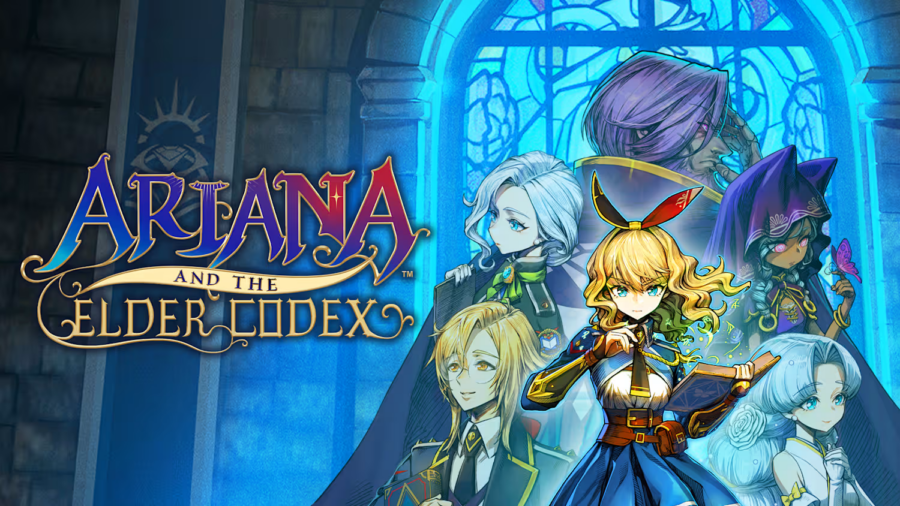
On the other hand, Ariana and the Elder Codex is a crisp and colorful game that’s an absolute delight to look at. The backgrounds are beautiful, the boss designs are complex and massive, the GUI is clean easy to navigate, and the overall vibe of the game exudes a thoughtful and creative aesthetic that is highly appealing. Ariana herself is cute but not to the point of waifu tropes and the rest of the small cast are interesting and well-designed too. The music is solid too with quiet background tunes holding your attention and adding depth to each stage and more energetic tunes kicking in when you get locked into an area to fight a series of enemies or during a boss fight. All things considered, the design aspects of the game are probably its biggest strengths.

Ariana and the Elder Codex is a fun little game as long as you’re not looking for anything too deep, serious, or particularly long as it weighs in at about 15-20 hours. There is a lot of missed potential in the plot and the combat is a bit too easy, but there’s enough gameplay there to justify the $30 price tag and a bit more story at the end. It’s also a very pretty game with solid music which will make most players a bit more forgiving of some of the faults. It’s always great to see a new IP out there and Ariana and the Elder Codex is no exception. Now let’s hope the developers want to expand the universe a bit and give us a stronger story the next time around!

This review is based on a digital copy of Ariana and the Elder Codex provided by the publisher. It was played on a PS5 using a 55” Sony 1080p TV and on the Playstation Portal where it ran well. Ariana and the Elder Codex is also available for Nintendo Switch and is forthcoming for Steam at the time of this publication.

Nate Van Lindt has been a gamer since the days of yore (aka Commodore 64), and has played a bit of virtually everything out there. He's also an avid comic book collector, both vintage and current, and reads a fair amount of sci-fi and fantasy. On top of that, he watches a fair number of movies and TV shows as well. Oh, and he has a family, a full-time job, and lives somewhere in the urban wilds of Southwestern Ontario, Canada, foraging for old video cables and forgotten game soundtracks.