

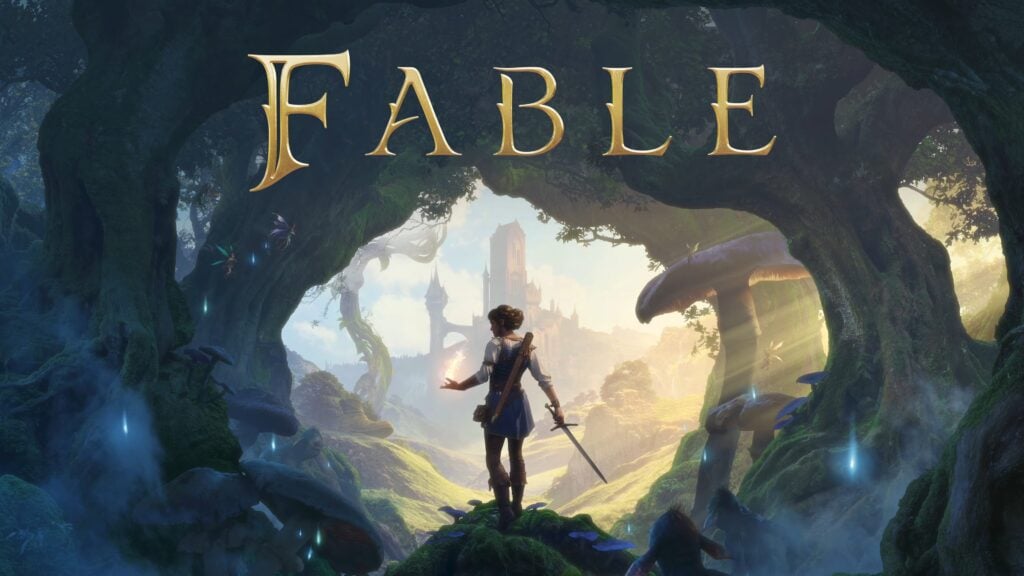
Xbox Game Studios and Playground Games have announced that Fable will launch for PlayStation 5, Xbox Series, and PC this fall, and will also be available via Game Pass.
About
Become the Hero you want to be in an immersive open-world action–RPG where each choice shapes your journey, reputation is everything, and fairytale endings are never guaranteed.
Key Features
- A New Beginning for a Legendary Franchise – Fable returns in a stunning reboot of a beloved franchise. As the first Hero in a generation, explore a living Albion filled with peculiar characters, dark humour, and chickens… lots of chickens. This isn’t just nostalgia—it’s a new beginning set in a beautifully vibrant open world.
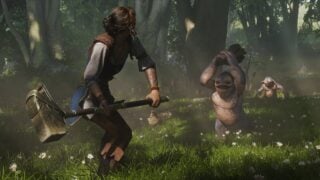
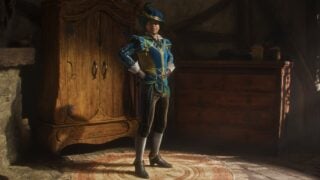
- Be the Hero You Want to Be – Customize your Hero’s appearance and wield powerful weapons as you weave melee, ranged, and magical combat. Take on bandits, beasts, and creatures—including brand-new enemies and fan-favorites like Hobbes, Balverines, and Trolls. Your power grows right alongside your reputation.
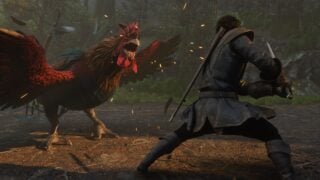
- Build an Extraordinary Life – Beyond all the combat lies a living world where you can carve your own identity. Get filthy rich as a landlord or blacksmith, romance a villager (or three), have a bunch of kids, and watch as your reputation precedes you. Being a Hero is a bit like being a celebrity… if celebrities carried swords and occasionally battled giant fire-breathing chickens.
- Your Choices Change the World – In Albion, a Hero’s reputation is everything. Your noble deeds and questionable decisions affect your relationship with each villager and can even shape the world around you. Whose opinion matters most? The choice is yours… and so are the consequences. It’s up to you to decide what it means to be a Hero.
Fairytale ending not guaranteed.
In addition Xbox Wire shared the following
Is this a full reboot of the entire series, or does it sit on the existing Fable timeline?
Ralph Fulton, Game Director and General Manager: We’ve always referred to this game as a ‘new beginning’, because one of the things we were convinced of was that we had to reboot the franchise. It’s been a long time since the end of that original trilogy—nearly two generations have passed in video game terms. And those original games are still available to play today, looking even better than they did back then thanks to the wizardry of Backwards Compatibility.
So, we’ve chosen not to be beholden to the timeline of the original games—the events, the characters—really just to allow ourselves the freedom to build our own Albion and tell our own, new story within it.
There’s a lot of faithfulness in the way we’ve approached this game—and certainly I think the inspiration of the original trilogy is really clear for everyone to see—but we wanted to make sure that this was a new beginning that would allow us to tell the stories that we wanted to tell.
How are you balancing making a new game while honoring Lionhead’s work?
Fulton: It’s one of the questions that we asked ourselves right at the start: ‘What are the essential components of a Fable game?’ And I don’t mean the features or the locations. I mean conceptually. Really, what is the essence of Fable?
But one of the things I said to the team was, ‘Look, we’re not Lionhead—we can’t try to make a Lionhead game.’ This has to be Playground game because I’m a really firm believer that the personality and the character of a team is visible in the work they do and the games they make.
And I think you can see Lionhead in that original trilogy. It would be pointless, I think, for us to try and ape that. And that’s really at the heart of the reboot question, right? It felt imperative to me that this was a reboot because we’re starting again as Playground Games, and making Playground’s Fable.
And if I’m totally honest, back then I wasn’t entirely sure how ‘faithful’ our Fable game would be to the Lionhead games we love. But as I said during Developer_Direct, I’ve been really pleased to see that this is identifiably a Fable game in lots of different ways.
So to answer your own question: what is the essence of a Fable game?
Fulton: We came up with a bunch of things—the first of which I would say we actually inherited from Lionhead. When we started working on this project, we got a treasure trove of documents from Lionhead that had been in storage.
Something that I thought was just brilliantly succinct was one of the documents, which said: ‘Fable is Fairytale, not Fantasy’—which is just super neat.
I guess our interpretation of what that means is that fairytale and fantasy probably exist on opposite ends of a spectrum. I think we all know what fantasy is—it’s The Witcher, it’s Skyrim, it’s Lord of the Rings, it’s Game of Thrones. And I think tonally it’s quite grand, it’s sweeping, it’s geopolitical, it’s serious. You know, you can almost picture the color palette of fantasy.
And then fairytale exists right at the opposite end of that spectrum. Fairytales are intimate, they’re small stories about regular people; they’re not grand and sweeping, they’re very personal and whimsical and ultimately, they deal with what happens when magic touches the lives of ordinary folks. And also they have this kind of moral component to them.
And I think that is a brilliant description of what Fable really is—it runs through our art style, it runs through our world building. We’ve really executed against that fairytale idea in every part of the game that we’re building.
And then Fable has this other tonal pillar, if you like, which is Britishness. You can’t mention Fable without mentioning that it’s quintessentially British. It’s cliche, but it’s kind of true. And I don’t think that’s just because Albion is obviously medieval England through a lens, and it’s not just because the cast have British accents.
I think—in the original games and in our game as well—there’s a very British sensibility, a tone of voice, a way of thinking about things. And it goes to the humor as well—that British humor that the original games used to such great effect is an absolutely essential component of our game as well.
And then it’s about choice and consequence. We call that freedom—in the sense that it’s the freedom to make the choices you want. It’s the freedom to be the kind of hero you want to be. It’s a freedom to go where you want and do what you want. And those things wrap up into what people really remember about the original Fable games, and therefore it became imperative for us to include that ability to make choices. Our game is packed full of choices. But also, to see the consequences of that and to live with the consequences of the choices you make.
So for us—at, like, DNA level—that’s what Fable games are, including our own.
How does this story begin—what’s the quest you’re following?
Fulton: In classic Fable fashion you begin the game as a child. We absolutely love that. And that’s when—and it’s not a spoiler to say—your heroic powers emerge. You realize you’re a hero, and everything changes for you from that point. And from there we do a time jump, and we rejoin you in Briar Hill, your starter village, in adulthood—and for the rest of the game you will play as a mature adult in their prime.
And it’s then that the real events of the game start to unfold. The inciting incident, the thing that’s the catalyst for your story, is what happens to your grandma and to the village that you grew up in—everyone in the village is turned to stone by a mysterious stranger.
You’re suddenly alone in this village and forced really to go out into the world, and your motivation is to try and figure out what happened to them and try and reverse it. The only clue you have is this mysterious stranger, who you really only caught a glimpse of at the start of the game. Finding the stranger seems like the only thread you can pull, the only lead you can follow. So that’s how we get you out into the world.
And there is one last thing that your grandmother says to you: she mentions Bowerstone, the Heroes’ Guild, and how it’s at the Heroes’ Guild that the great heroes live and, if you ever need help, they’re the people to go to. So there’s a soft implication that you should head for the Heroes’ Guild, and maybe there’s help that they can give you.
But the nature of our game is that as soon as you leave your village, you can go pretty much anywhere. It’s truly open world, so the world is yours to explore. And we’ve written the story so that although there are stakes—your grandmother, your village—there’s no ticking bomb.
There’s nothing forcing you along the path, because we want to allow the player the permission to just go and do something else in the game. You could go to the most northerly village in Albion, get a job, settle down and get married if you want. The story will wait for you, which I think is really important with the really rich side activities that Fable games come with.
How does the open world work? Are you ‘level gating’, or encouraging people to go to places in a certain order?
Fulton: Right from the start of the project, we’ve always felt it was important that the player can go wherever they want, from the moment you leave your village and venture out into Albion for the first time.
Even if we know the majority will do the sensible thing—you know, ‘I’ve got to save my grandma!’– we know there are a bunch of players who are going to be like, ‘OK, I’m going to go and see what this world is about.’
We want to accommodate them, probably more than accommodate them. We want to make sure that they have fun, exciting, immersive things to do, wherever they choose to go in the world. So we took that as the sort of North Star.
And then we built progression and leveling and difficulty balancing around that. I don’t want to go north and then find that there’s an area I can’t go into because I’m not a sufficient level.
We’ll talk more about levelling and progression at a future date, but you should know that being able to go to any one of the settlements in the world and have fun things to do there was imperative to us. And so we shaped our progression around that requirement.
How are you approaching combat?
Fulton: We’re taking the original game’s mix of melee, ranged, and magic—‘Strength, Skill, and Will’—and turning it into what we call style-weaving combat. We wanted to create a combat system which was fluid enough to allow you to really frictionlessly, seamlessly swap from melee to ranged to magic, without even a frame’s delay on it.
You should be able to strike with a sword and then hurl a fireball in a smooth movement. So that’s what we’ve set out to achieve with combat.
The combat scenarios that you’re going to find in our game are often about groups of enemies—and usually a tactical mix of enemies who will force you into choosing how you use your ranged, your melee, and your magic to crowd control, and to pick them off, and really to navigate the particular combat challenge that a particular set of enemies presents to you.
And there is still ample variety within those styles to allow you to pick the kind of fighter you want to be. You can opt for big damage spells, you can opt for tactical crowd control spells, you can go super precise or really blunt force with your melee weapons—it’s up to you.
You can still self-express when you’re in combat in our game, but it is all about cycling through and tactically using the different options available to you.
It looks like there are emergent elements to combat—we see a Hobbe accidentally hit one of his own companions, and enemy weak spots that can cause specific reactions. Is that built into how you play?
Fulton: Very much so. All of our enemies have strengths and weaknesses, and part of the fun of combat is figuring how to exploit them using the different weapons and abilities you’ve equipped yourself with. And obviously that sort of compounds when you’ve got multiple enemies in the same encounter and you’re trying to marshal all of them and find the best way through it.
That Hobbe that accidentally killed his pal in the video just happened by accident when we were capturing from the build. We thought we’d keep it in because it’s funny, and very much in keeping with that fan-favorite enemy.
But yeah, keeping in as much of that kind of friendly fire stuff as possible always adds a little bit of chaos and a lot of humor to combat. And that’s, I guess, one of the questions we’ve asked ourselves a lot: if humor is important to Fable, how does it manifest in combat—an inherently serious pursuit?
So I think those fairytale creatures have a ton of personality and thus, you know, a bunch of humor about them. And there’s a slapstick element to some of them as well.
How has the classic Fable morality system changed?
Fulton: To take it right back to the start, morality was always such an important part of the original trilogy. Even the box art was really about that dichotomy of good and evil. So we’ve talked about morality a great deal on this project. I think that original trilogy is inextricably linked with the concept of good and evil—but I think morality in video games has moved on in the intervening period.
How we think about morality in the world today has really informed how we wanted to represent it as a game system in this game. That’s to say: there is no objective good, there is no objective evil. Really it’s just about people’s subjective opinions and what they choose to value in someone else when they make that judgment.
So, as you saw in Developer_Direct, our version of morality isn’t a sliding scale—we’ve chosen to anchor this around the actions you do, and specifically the things you do in Albion that are witnessed by at least one other person. So, if the things you do are seen by one or more people, you’ll start to earn a reputation for that thing. Obviously, we always use the chicken kicking example, because kicking chickens is classic Fable.
So if a person sees you kicking a chicken, you will start to get a reputation as a ‘Chicken Chaser’—and if enough people see you do it, or you do it a lot, that reputation will become one of the things you’re known for in that settlement. And people will react to you based on what they think about that particular reputation.
But, crucially, different people will view that reputation in different ways. Kicking chickens isn’t objectively good or objectively evil in a way everybody will agree on—it comes down to the unique worldview of the NPC what they think of you because of it.
The same applies for being generous, or being a bigamist, or being a thief, and so on. There are a significant number of these reputations that you can get—you have a word cloud of reputations in every settlement, and they can be different from place to place. It means you can create completely different identities in all the different settlements by being a different person and behaving in different ways.
That word cloud is how people see you in that particular settlement, and therefore it defines how they react to you in every way they can react—and these peasants are not backwards in telling you what they think as you walk around. That ranges from catcalling you in the street, how likely they are to be romanced by you, if you can marry them, it can even affect prices in shops. There’s a whole systemic trickle-down effect of your reputations to your experience in that particular settlement.
It’s a more potential-filled system for you to go play with, because you are juggling the things you do, and you’re juggling who sees you do it. You’re deciding whether you’re OK with walking around the town with people thinking that you’re that.
And if you’re not, then there are things you can go and do about that to redress the balance—or you could just pay the Town Crier to start shouting about a new reputation to overwrite one of the old ones…
It’s why we say our game will never judge you, but the people of Albion will. Sometimes people have said, ‘Well, that’s the same thing, surely, isn’t it?’ But in a diegetic way, it’s really not, because different people in Albion will have different perspectives on the things you’ve done, which again kind of mirrors the real world.
The Living Population of NPCs is a fascinating addition—what does that offer the player?
Fulton: The Living Population is our cast of over 1,000 NPCs, each with roles, personalities and routines. That whole concept of persistent NPCs, each of whom is unique in a whole bunch of ways that you can go and interact with and mess about with, is incredibly complex.
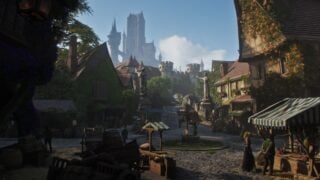
When you start working on it, you realize that every settlement has to have enough houses with enough beds, for everyone in the settlement to go and sleep in at the end of the day. It was a fun day when we explained that particular requirement to our environment art team [laughs], but they rose to the challenge like they do with everything.
In games, you don’t normally have to connect the dots quite so precisely. You know, you’re just building a nice-looking town. But in Fable it also has to be a functional town.
As an example, early in development we couldn’t work out why one town was so empty during the day. And when we zoomed out into debug mode, it was because NPCs were getting up to go to work, but they lived too far away from their jobs. So, they started walking to work, but didn’t get there before their schedule told them to turn around to go back to bed.
It’s required a lot of working through, but it pays off because, honestly, as you play the game, you get to know the names of the individual NPCs. You get to know what they like, what they’re looking for in a partner, where they live, where they work, all that kind of cool stuff. It’s an extra dimension to traditional NPCs.
Does the Living Population tie into the main quest?
Fulton: Tying the main quest and the Living Population together in a really overt way didn’t seem like the right way to go, so we’ve deliberately linked them in the lightest possible fashion. You know, there are some times when characters in the main quest will reference your reputations, or the things you’ve done previously—but we never want to force a player to have to go and interact with those things in order to progress the main quest.
We know there are some players—we call them ‘Bards’—who are just going to play through the main story. They’re going to start at the start, and they’re going to get to the end, and that’s going to be their experience. That’s entirely fine, that’s a totally respectable way to play.
But there are some players, who we call ‘Architects’, who we know are going to go and mess around with the systems and just see where they can push them, see what they can achieve with it, and we want them to have the freedom to do that at any point as well.
British humor is a big part of this game—and we’ve seen British comedians in the cast. Can you tell us more about the comedic side?
Fulton: British humour manifests in lots of different ways throughout the game. I think the Living Population are really funny because they react to you in a very dry, British way. And yes, it’s in the story and the characters you’ll meet along the way.
We have an amazing cast in this game—and we’ll talk more about the cast in future. Again, that’s in keeping with the original Fable games. If you go back and read their cast list, it’s a who’s-who. And we felt, OK, that is a challenge for us—we need to go and do something similar. We’ve got a sensational cast of characters that you’ll meet in the main story.
We were inspired by the incredibly rich variety of British comedies that have been around over the last 20 years like ‘Peep Show,’ ‘The IT Crowd’ and so many others. We started with ‘The Office’, which again started out as quintessentially British, but also travels really, really well. Not just that IP, but a lot of the techniques and the devices that it’s popularized, you know. It’s that really grounded, awkward style of humour which really appeals to us. And the actors who have been in a lot of these shows—and indeed some of whom are in our game—they’re known all over the world.
The other cool thing about The Office is something we’ve kind of nicked. You’ve maybe seen in our trailers that we have a sort of mockumentary interview style. I think a lot of people assume we just did that for those trailers, but it’s actually a device we use throughout the game.
I’ve never seen it in games before, but it allows you a way to really neatly tell a joke or drop a little bit of character detail in a way that would feel really clunky in a dialogue, but suddenly feels entirely natural when you do it to ‘camera’.
There’s lots more we haven’t seen here—can you tease what else we might learn about before the game arrives?
Fulton: So one element that we deliberately didn’t touch on much in Developer_Direct is the main story, beyond the opening few quests. There’s also the cast I mentioned. And there’s a lot of choice and consequence that happens all the way through.
But honestly, Developer_Direct for us is more about answering a bunch of questions we know people have of a game that we’ve been silent about for so long. This was the opportunity for the team who are making the game to talk about it and answer some of the questions we know fans have been asking.
Character customization is one that we were delighted to clear up. That’s something that we’ve been sitting on for years now, but it’s great to be able to tell fans that, of course, we have character customization. In Fable, you can be the hero you want to be in every sense.
As you heard in Developer_Direct, we launch in the autumn and before that we’ll be talking more about our cast, more about our story, and we can’t wait to go deeper into gameplay aspects like combat, progression, weapons, exploration, the social and economic sims and all that good stuff. We’ve got lots more to share…