

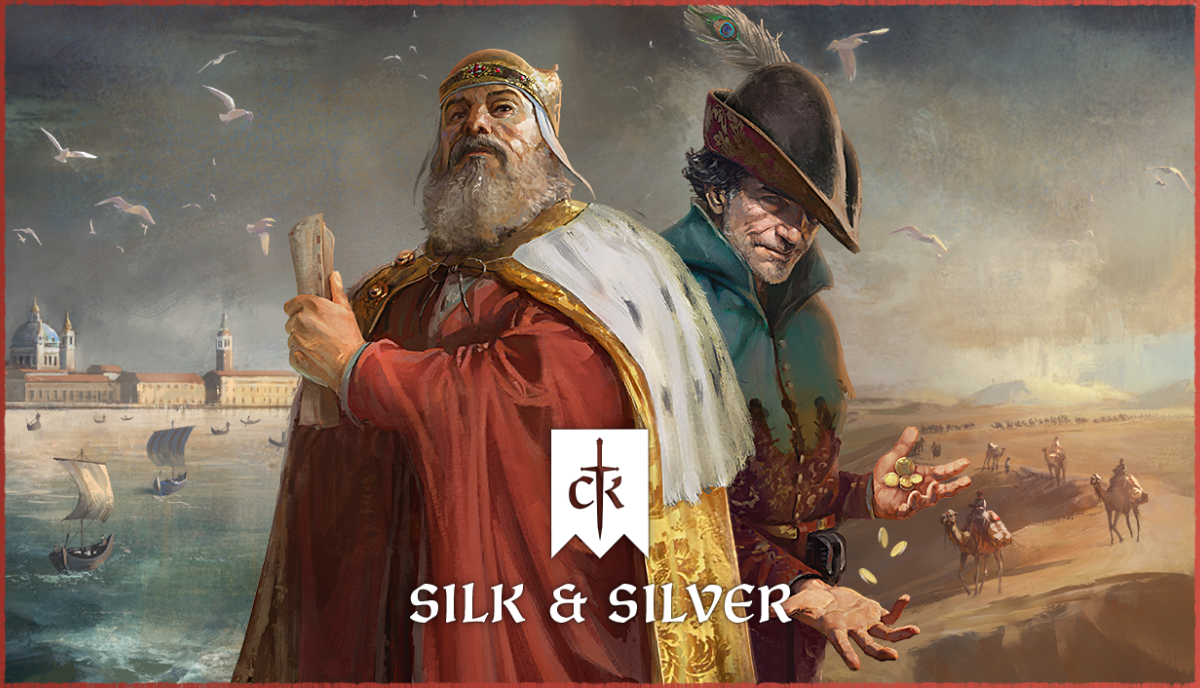
Crusader Kings III is expanding its medieval ambitions with the release of Silk & Silver, a major expansion that puts merchant dynasties, trading empires, and playable republics at the center of its latest addition. Available today, November 17, the expansion introduces an alternative route to power, allowing players to build their fortunes through commerce, political maneuvering, and control over lucrative trade networks.
Developed by Paradox Interactive, Crusader Kings III: Silk & Silver explores a different side of medieval society, where wealth can be just as influential as military strength and royal bloodlines. Rather than relying exclusively on traditional territorial expansion, players can lead a landless merchant family, establish a trading company, and gradually transform an obscure enterprise into a powerful dynasty with influence reaching across the medieval world.
The new Merchant government type introduces an extensive trading system built around more than 40 trade goods and a network of profitable trade routes. Players can specialize in one of three different commercial paths, becoming a Caravaneer responsible for transporting valuable goods, a Creditor who lends money to rulers, or an Artisan who creates new artifacts. Developing expertise in individual trade goods unlocks additional bonuses, while growing a company’s reputation provides further opportunities to expand its influence.
However, accumulating wealth is only part of the equation. Merchant families can use their financial resources and political connections to lobby nobles, secure exclusive trading rights, and establish monopolies over particular goods. Their headquarters can also be expanded into an increasingly impressive mansion, providing additional opportunities to strengthen their operations and gain an advantage over competing businesses.
The expansion also introduces a second major government type with playable Republics, opening the door to political struggles within wealthy merchant-led states. Among the featured examples are the Mediterranean republics of Venice and Genoa, where competing patrician families vie for influence and the position of doge. Rather than simply inheriting power through traditional succession, players must maintain popularity, secure political support, and use everything from bribery to legislative maneuvering to keep their family at the top.
Republics also receive their own administrative systems, allowing players to determine how their government operates. Whether building a maritime commercial powerhouse, an expansionist aristocratic state, or a city-state guided by the will of its common people, these decisions influence the direction of a republic. Trade Posts can extend a family’s commercial reach into foreign counties, while Trade Leagues allow republics to establish partnerships that provide both economic and military advantages.
Two new historical bookmarks further expand the available scenarios. The 1066 bookmark, titled Channels of Commerce, focuses on prominent medieval merchants and the opportunities presented by an increasingly interconnected trading world hungry for spices, silk, and silver. Meanwhile, the 1178 bookmark, Guelphs & Ghibellines, explores the political and military conflict between competing factions in Northern Italy, with players caught between papal and imperial ambitions.
Additional historical activities include civic carnivals celebrating the accomplishments of individual republics, alongside opportunities to participate in the turbulent political struggles that shaped medieval Italy.
Crusader Kings III: Silk & Silver is available today, November 17, 2026, for $29.99 USD, £25.99 GBP, and €29.99 EUR. The expansion can also be purchased as part of Crusader Kings III Chapter V, offering another way for players to access the latest additions to Paradox Interactive’s grand strategy game.