

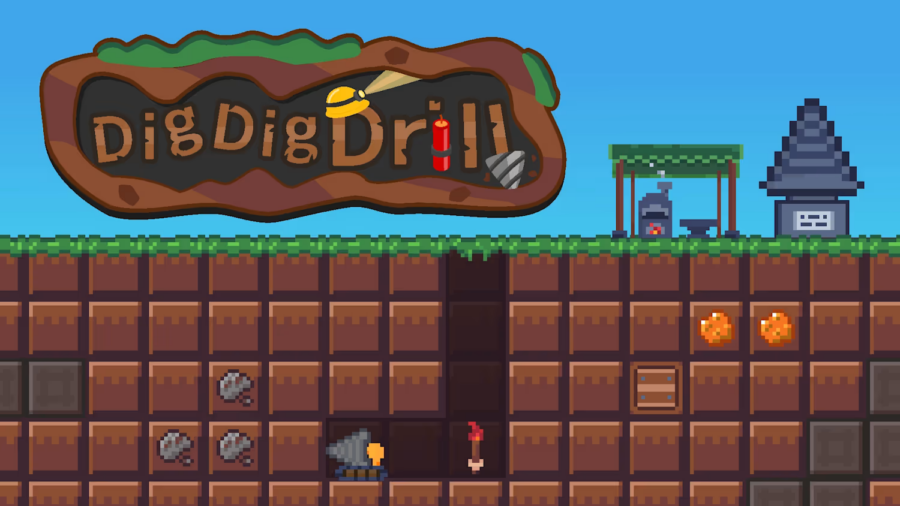
Digging games are fun. Whether it’s Minecraft, Terraria, Steamworld Dig, Dig Dug, or Shovel Knight Dig (review here), there’s just something weirdly gratifying about digging little digital holes in games. Maybe it has something to do with the lack of arcade style games these days. Sure we get lots of run n’ guns and Metroidvanis and beat em ups, but other, more simplistic arcade style gaming is mostly dead.

Fortunately, the digging genre manages to scratch that itch without resorting to intense combat situations and high difficulty levels. Digging games are fun, chill, and sometimes challenging, but you don’t see crossovers with the Souls concept of game design here. In fact, DigDigDrill from Japanese developer Toorai and publisher Phoenixx Inc. is about as far from a demanding game as you can get!

DigDigDrill puts you in control of a mining drill. Your job? To dig down 999 meters to the bottom of the drill area. That’s it! Of course, it’s not nearly as simple as you might like. You don’t have to worry about being attacked since there are no enemies in DigDigDrill, and you don’t run out of oxygen like in Mr. Driller Drill Land (review here), but every hundred feet is a barrier that you cannot drill through without first shattering three glowing crystal balls. These squares are strewn throughout the game and regenerate when drilled. Shattering the crystal balls slows down their regeneration, allowing you to drill through them and move to the next area. That’s the core stage design of DigDigDrill (at least at first), but it’s certainly not the only mechanic!

In order to drill through those barriers and reach the bottom level of the play field, you’ll have to upgrade your drill. To do that you’ll have to harvest a variety of metals and gems by drilling for them. There are usually 2-3 different types of materials available in each 100 meters of the playfield. Drilling through them gathers them into your bag and you must then take your haul to the surface and turn it in. There are also treasure chests buried with a variety of loot which you bring up and open, containing a variety of items. Metals and gems are the most important here though, so we’ll start with those.

Once you have some materials, you can craft new drill bits for your drill at the Forge, imbuing it with various abilities and making progress easier. To do that, you’ll be using blueprints. You start with a few blueprints and slowly earn more as you dig. Eventually you’ll also be able to make your own, but at first, you work with what you have. Each blueprint has a shape to fill in and each metal or gem you find is kind of like a Tetris block. To build new drill bits, you’ll have to fit the resources into the blue print, filling it as best you can. Early on in the game, you can’t fully complete most blueprints, but putting as much as you can in still nets you a new and usually more powerful drill bit. Installing that bit at the drilling station allows you to use its abilities underground. Fortunately, they’re all automatic so all you have to do is navigate with the left stick.

The key here is abilities. Each drill bit you build has different additional attributes and when you fill a blueprint completely it adds additional attributes, further boosting your abilities when it is installed. Once you unlock a second drill bit and sub-bits, you can switch between two sets of three bits each in order to maximize different abilities in order to drill more effectively. Whew. That’s a lot right? Well, you’ll find that DigDigDrill is absolutely full of unlockable mechanics, so full in fact that we can’t even go over them all in this review!

In fact, every time you start making noticeable progress, new abilities and approaches to gameplay unlock. First it’s forging drill bits, then it’s adding new bits and slots. Eventually you’ll be making new drill bits, upgrading bits, and adding additional energy while you create new blueprints. As you work your way down to the 999th level, you’ll slowly get the hang of each of the functions as well as learning how to search effectively. As progress speeds up, the game feels more immersive and the gameplay loop starts to feel more natural. The interesting thing about DigDigDrill is that there’s very little handholding. Sure, there’s an explanation for each new mechanic that may take several pages of text, but you really don’t learn how to use it all effectively until you try putting it into practice. It’s more of a “see what works for you” approach that makes each new progression end up being an exploration.

Once you finally figure out how to get to level 999 and unlock it, you’d think that was the end of this bite-sized adventure, especially for the measly $10 price tag, but you’d be wrong! Instead, there’s an entirely new play area awaiting you in the next part of DigDigDrill and a whole new set of mechanics to go with it! The Ruins have you digging under the desert for treasure and there is only a 500 meter deep playfield this time around. Unfortunately those old ruins hold curses and they’ll curse your drill, making it work significantly slower, making it difficult to progress. Fortunately there are yellow jars strewn throughout the depths that will reduce the amount of curse and graves that you can destroy that do the same, bringing you back to full power. Unfortunately, there are also purple jars that provide additional curse and if you’re powered up and creating random explosions by then, there’s a good chance you’ll end up blowing up some of those and re-cursing yourself.

The ruins also have Haniwas – weird little figurines that you can install and float around behind you providing additional boosts. You have to find spirits to inhabit the haniwas and then go up to the surface to claim them, kind of like chests in the first portion of the game. There are a number of functions you can perform with haniwas as well. You’ll also eventually unlock totems which give you additional boosts to various abilities and an ore tree to give blessings and so much more. Each time you complete the ruins you have the option of making them more difficult and trying again until you reach the 10th level of them. It’s a massive undertaking made more so by the exponential growth in curse levels requiring you to mix and match drill bits, haniwas and totems in order to progress effectively. It’s complex but fun and the lack of enemies and chill overall vibe makes the gameplay both relaxing and compelling.

Getting the hang of each mechanic and getting them working in tandem takes some time and practice but once you do, the easygoing nature of DigDigDrill allows for you to experiment with various builds and loadouts, allowing you to min/max drill enchants to work more effectively as curses get nastier. For a game with no real conflict, it’s insane how addictive gameplay is and you end up frequently going “just one more run” in your head before spectacularly missing bedtime or failing to notice the world around you. The level of immersion for the overall simplicity of basic gameplay is off the charts here and it’s easy to compulsively play DigDigDrill for hours.

While it’s an incredibly well-designed game, the visuals are quite simplistic. Basic pixel art and shading with some creative additions make for a game that’s not wildly visually stimulating but still entertaining. As you attach different bits, they change color, and each 100 meters has a different set of block designs. Later on, the haniwa all have different shapes and float around behind you as well. There are fun little visual effects hidden throughout the game as well at key points, with objects spinning off into the background, falling, or compressing that are neat with pixels but mostly quite subtle. That throwback style is both refreshing and relaxing to the eyes, making DigDigDrill that much more fun. Unfortunately, while the graphics are light and fun and the sound effects are good, the music is by far the weak point here, with short, repetitive tracks that slowly become tedious over time. Playing undocked with the sound off on the Switch is still just as fun though [and you can turn the music off in the menu if you want], and honestly as important as music usually is to a game, for some reason it doesn’t seem to matter so much here.

There really aren’t any negatives to DigDigDrill either. Normally, there’s always a flaw to be mentioned here or there, but everything here is well done aside from some weak music. The game is priced well, fun to play, addictive as all hell, and super chill. Honestly, this is one of the most surprisingly delightful games we’ve seen in a long time and is well worth taking some time away from more intense experiences in other games to just…dig. It’s a bit wild that something this simple (not the mechanics though) can just slide out entirely under the radar and we really need more games like this that focus heavily on fun factor and creative, simple interfaces. If you like the idea of a ‘cozy’ entertaining digging game or you just want a break from the regular, DigDigDrill is a fantastic little game that you’re going to play for hours and hours. Don’t skip this one!

This review is based on a digital copy of DigDigDrill provided by the publisher. It was played on a Nintendo Switch in both docked and undocked modes and played equally well on both. DigDigDrill is also available for PC on Steam.

Nate Van Lindt has been a gamer since the days of yore (aka Commodore 64), and has played a bit of virtually everything out there. He's also an avid comic book collector, both vintage and current, and reads a fair amount of sci-fi and fantasy. On top of that, he watches a fair number of movies and TV shows as well. Oh, and he has a family, a full-time job, and lives somewhere in the urban wilds of Southwestern Ontario, Canada, foraging for old video cables and forgotten game soundtracks.