

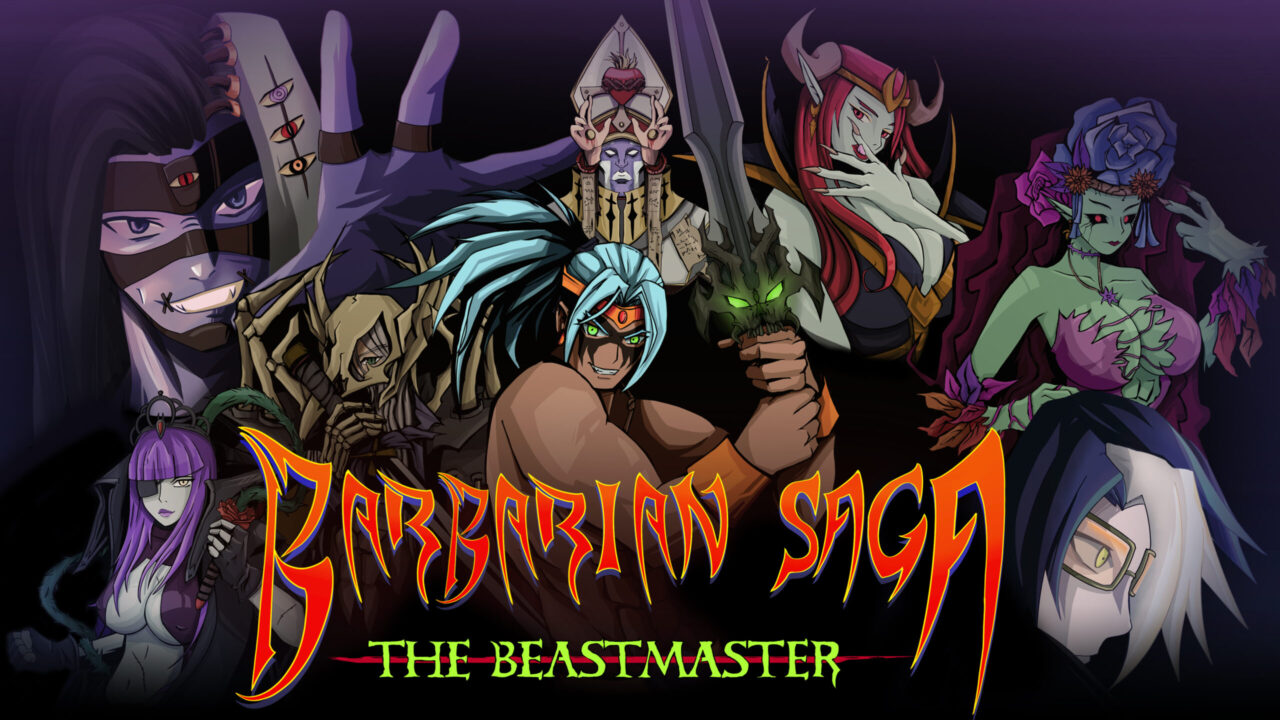
There is something immediately appealing about Barbarian Saga: The Beast Master. A hand-drawn sword-and-sorcery world filled with creepy creatures, dark magic, cursed weapons and interconnected environments is a pretty good foundation for a Metroidvania. Instead of going down the increasingly familiar gothic fantasy route, Dormidin Studio looks toward the pulpy fantasy adventures of the 1980s, giving Arboria a colourful Saturday morning cartoon aesthetic while still filling it with plenty of monsters, blood and other unsettling imagery. There is a genuinely cool game buried in here, but getting to it can be considerably more frustrating than it should be.
The game puts players in control of Ren, the last Beast Master, as he becomes caught up in a conflict involving humans, non-human races, dark magic and a prophecy that could determine the future of Arboria. Ren also happens to carry a cursed talking sword that, naturally, has its own opinions about what is going on. The premise has all the ingredients for a fun sword-and-sorcery adventure, but the story never quite manages to make them as interesting as they sound. Characters are thinly developed, conversations can drag on, and there are enough awkward lines and translation issues to make some of the dialogue difficult to follow.
The game also throws plenty of names, lore and characters at the player without always providing much reason to remember them. Optional quests, NPC interactions and multiple endings add some welcome ambition, but the story ultimately feels more like something happening in the background while Ren travels through Arboria. It provides a reason to keep moving forward, but it rarely becomes the reason to keep playing.

The world itself is considerably more successful. Arboria is made up of interconnected environments filled with hidden paths, dead ends, locked-off areas and locations that will eventually become accessible through new abilities. This is familiar Metroidvania territory, but the Beast Master concept gives the progression a little more personality. Ren eventually gains the ability to harness animal souls and take on different forms, and these transformations are more than simple cosmetic changes. They affect how he moves and interacts with the world, giving the game one of its most interesting ideas.
There are also plenty of other ways to develop Ren. Rings, fangs, amulets, sword techniques, curses, magical attacks and consumables give the game more customisation than its relatively straightforward combat initially suggests. New abilities can open up previously inaccessible areas, and there is that familiar satisfaction of remembering a location that could not be reached earlier and returning once the appropriate power has been acquired.
Unfortunately, Barbarian Saga does not always make that process as satisfying as it should. The map fills in as areas are explored, but it remains fairly vague, making it difficult to remember exactly where a particular blocked passage or unexplored route was located. Custom markers help, but they do not completely solve the problem. There can be a lot of wandering between areas simply because the game has not given enough information about where the next useful path might be.
There is nothing wrong with allowing players to figure things out for themselves, and getting lost is part of the appeal of some Metroidvanias. Barbarian Saga, however, occasionally mistakes a lack of direction for meaningful exploration. Fast travel eventually makes things easier, with save points also functioning as teleportation locations, but backtracking can still become excessive before enough movement abilities have been unlocked.

The save points themselves are useful additions to the exploration loop. They restore health and resources while also serving as fast-travel locations, creating a bit of a push-your-luck system. Continuing deeper into an area means potentially finding something useful before reaching the next safe point, but going too far can also mean losing progress when things go wrong. The concept works, although the spacing of these points can sometimes make a death feel more like an invitation to repeat old ground than an opportunity to learn from a mistake.
Combat starts off fairly simple, with Ren relying on his sword and a handful of basic abilities, but there are eventually more tools available. Blocking is based on timing rather than being something that can simply be held indefinitely, while dodging, special attacks and magical abilities give Ren more options. The controls themselves are responsive enough, and Barbarian Saga does not fall into the trap of making Ren feel like a slow, lumbering character whose every attack takes an eternity to complete.
The trouble comes from how those mechanics interact with the enemies. Flying and ranged enemies can be particularly irritating, especially when they are positioned around platforming sections. Ren does not initially have a convenient way to deal with enemies above him, while some attacks that eventually become available can leave him vulnerable if they miss. Offensive consumables cannot simply be used in the air to make these encounters easier, either. The result can be a frustrating cycle of jumping, landing a small attack, dropping back down and repeating the process.
Some enemies also attack from awkward angles or from off-screen, while others can become partially obscured by environmental geometry. These moments make the combat feel less like a test of timing and more like a battle against the game’s positioning. The underlying system is perfectly workable, but the enemy design does not always give it the opportunity to shine.

Platforming can run into similar problems. Most of the game’s movement is straightforward, but there are sections involving collapsing platforms, spikes and other hazards that require more precision. Falling onto spikes does not necessarily mean instant death, which is helpful, but combining platforming with enemies that attack from awkward positions can make some sections unnecessarily irritating.
Difficulty becomes an even bigger issue once resource management enters the picture. Barbarian Saga expects players to purchase healing potions and other consumables with coins earned throughout the world. There are limits on how many items can be carried, and using a potion leaves Ren vulnerable during its animation. This prevents healing from becoming something that can simply be spammed whenever health gets low, but it also means that mistakes can become expensive.
Coins do not always arrive quickly enough to keep up with the demands being placed on the player, either. Shops can become essential stops, particularly once enemies start dealing heavier damage, but building up enough currency to replenish supplies can mean repeatedly fighting enemies in the same areas. That grinding becomes particularly noticeable during tougher sections and boss encounters.
The bosses themselves are a mixed bag. Some have recognisable patterns that reward learning their attacks, and defeating a difficult opponent can certainly be satisfying. The arena-style encounters are another welcome change of pace, shifting the presentation closer to a one-on-one fighting game and putting more emphasis on spacing, defence and counterattacks. These duels provide some of the more focused combat encounters in the game.

The problem is that Ren’s offensive progression does not always keep pace with the enemies. New abilities are useful, particularly when they open up the world, but they do not consistently provide that satisfying feeling of becoming dramatically stronger. Boss fights can therefore become endurance tests, with large health bars and heavy attacks requiring considerable patience while Ren’s own damage output remains comparatively modest.
This is one of the biggest missed opportunities in Barbarian Saga. A Metroidvania should make exploration feel rewarding not only because it reveals new areas, but because the character gradually becomes more capable of dealing with the challenges found there. The animal transformations are an excellent idea and give the Beast Master concept some much-needed mechanical identity, but the wider progression system does not always create the same sense of momentum.
At least the world is interesting enough to make the exploration worthwhile. The hand-drawn presentation gives Barbarian Saga a distinctive look, with chunky characters and colourful environments sitting alongside some surprisingly creepy imagery. Giant spiders, undead warriors, strange creatures, flying skulls, eyeballs and other grotesque enemies fit comfortably into a setting that looks like a Saturday morning fantasy cartoon that stayed up far too late.
The Castlevania influence is also hard to miss, with dragon-headed turrets, gothic structures, candles, haunted locations and other familiar imagery scattered throughout Arboria. The game does enough with its own sword-and-sorcery aesthetic to avoid feeling like a straight imitation, however, and some of its environments are genuinely memorable. Haunted libraries, sprawling cathedrals, a sunken ship and more unusual natural areas give the world a nice sense of variety.
Not everything reaches the same standard. Character portraits and dialogue presentation can be inconsistent, while some of the artwork looks considerably rougher than the main environments. The music is serviceable and generally fits each area, but it rarely becomes a major strength, and some sound effects feel noticeably cheaper than the visuals surrounding them. These are relatively minor problems individually, but they contribute to the overall impression that the game needed another round of polish.

That is really the story of Barbarian Saga: The Beast Master. There are a lot of good ideas here. The Beast Master concept is interesting, the animal transformations give the game something of its own, the world has a distinctive visual identity, and the sword-and-sorcery setting is a refreshing change from the usual Metroidvania formula. There are enough enjoyable moments to show that Dormidin Studio understands why this genre can be so appealing.
The problem is that too many of those ideas are held back by the fundamentals. Exploration can be unnecessarily vague, combat can become stiff and frustrating in certain situations, enemy behaviour is inconsistent, resources are restrictive, progression does not always feel meaningful, and the writing could have used considerably more polish. None of these problems completely sinks the experience, but they constantly remind the player of the game that Barbarian Saga could have been.
Barbarian Saga: The Beast Master is ultimately a rough-around-the-edges Metroidvania with a lot more personality than its shortcomings might initially suggest. Its colourful sword-and-sorcery world and unusual Beast Master mechanics give it a foundation worth exploring, while the combination of animal transformations, customisation and interconnected environments provides plenty of potential. Unfortunately, the execution does not always match the ambition.
For players willing to tolerate some rough edges, there is still an interesting adventure to uncover in Arboria. The game has enough charm, atmosphere and genuinely good ideas to make it more than a forgettable Metroidvania, but its frustrations are difficult to ignore. With stronger balancing, smoother combat, better guidance and another layer of polish, Barbarian Saga: The Beast Master could have turned its promising ingredients into something considerably more memorable.
Disclaimer: A review key was provided