

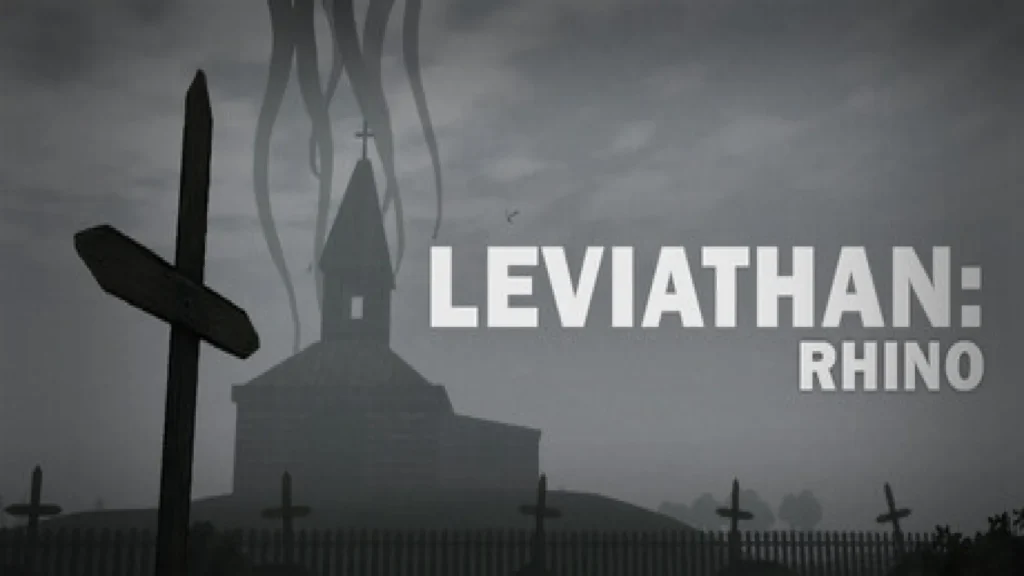
There is something unsettling about a threat that is simply too big to fight. Horror games usually give players survival as a goal, but what happens when survival is no longer an option and all that remains is deciding how to spend the time left? Leviathan: Rhino, developed by Amortiz Games and published by solarsuit.games, explores that idea through a cosy psychological horror experience that hits harder than its modest scope might suggest. Released on Steam for PC on November 6, 2026, it is a quiet, strange little game that has stayed with me.
You play as Petro, an elderly man living in a small village while a Leviathan, one of the colossal creatures that have long been part of this world, makes its way closer. Nobody can stop these things. People can only track their movements and get out of the way in time, and that is exactly what the people of the village are doing. Petro has nowhere to go and no real reason to leave, so he stays. There is no grand quest, secret weapon, or plan that can make the problem disappear. Leviathan: Rhino is about the final days, the people who remain, and the little things that make life worth living.
That premise is what makes the game so compelling. The creature is an enormous presence on the horizon, and watching it gradually creep closer is one of the most effective ways the game establishes its scale. The village slowly deteriorates, the atmosphere grows increasingly somber, and the player is left to witness something that cannot be stopped. One moment in particular, looking towards the horizon and seeing what is coming, makes the situation feel utterly hopeless. It is a simple scene, but an incredibly effective one.

Interestingly, the Leviathan itself is not frightening in the traditional sense. The creatures that accompany it, referred to as fleas, are manageable, and dealing with them mostly comes down to using the weapons at your disposal. Even the supernatural encounters with the dead are not especially frightening. The real horror comes from the circumstances surrounding them. There is no escape, no way to stop the Leviathan, and no possibility of reversing what is happening. Knowing that everyone has to live with that reality is far more unsettling than any individual monster encounter.
Despite the subject matter, Leviathan: Rhino is genuinely cosy. There is little reason to rush through the village when the end is coming either way. You can visit neighbours, spend time with the remaining residents, pet the cats, and occasionally fire a shotgun. These ordinary activities take on a different meaning against the backdrop of an approaching apocalypse. Life carries on even when there is no future to look forward to, and the game does an excellent job of making those small moments feel meaningful. There is something strangely comforting about being able to take your time while the world is falling apart around you.
Playing as an elderly man is particularly fitting for this story. Petro’s perspective brings a weariness and acceptance that would be difficult to capture with a younger protagonist, and much of the dialogue deals with loss, resignation, and the difficulty of accepting what cannot be changed. The conversations feel believable, with characters who come across as ordinary people trying to make sense of something far beyond their understanding. A flashback sequence adds another emotional layer, providing more insight into Petro’s connection to the world around him and making the present circumstances hit even harder.
The story is relatively straightforward, but it raises some interesting questions along the way. What does it mean to keep living when there is nothing left to look forward to? How do people find peace when they know the end is near? Is there any value in maintaining ordinary routines when everything is falling apart? Leviathan: Rhino does not try to answer these questions outright. Instead, it lets its characters and circumstances carry the themes, giving the story an emotional weight that lingers after the credits roll.

The presentation helps considerably. The stylized, hand-drawn visuals have a nostalgic quality that suits the small setting, while the atmosphere maintains an appropriately sinister edge. The world is not particularly large, but it is the right size for the story being told, and there is enough to explore for the village to feel like a place where people have spent their entire lives. Watching it deteriorate reinforces the sense that something irreversible is happening. The sound design is just as important, particularly as the Leviathan draws closer. Seeing and hearing its approach is a constant reminder that things are getting worse, even when you are occupied with everyday chores.
Unfortunately, while the narrative and atmosphere are the game’s greatest strengths, some of its gameplay decisions are less successful. Leviathan: Rhino is very much a walking simulator, so anyone who enjoys exploring at a relaxed pace should feel at home. The deliberate pacing is appropriate for a story about waiting for the end, but the amount of walking can become tedious, particularly when travelling between locations. The running mechanic complicates things further. Moving too quickly carries consequences, which is an interesting idea in principle, but it can make getting around feel slower than necessary. A little more flexibility with movement would have made exploring the village more enjoyable without compromising the intended atmosphere.
The difficulty options are another curious aspect. Even on the hardest setting, the game is not particularly challenging, although you do need to pay attention to the running mechanic. That is not necessarily a problem, since the emphasis is clearly on the story rather than testing your combat skills. Still, anyone expecting a demanding horror experience may be surprised by just how manageable the encounters are.
The story’s choices could also have used more attention. Several decisions appear to carry considerable weight, but their actual consequences are limited, making those moments less satisfying than they should be. The situation involving Michael, another village resident who is contemplating suicide, is a particularly frustrating example. Being given the opportunity to save him suggests that the outcome might meaningfully change the story, perhaps even allowing him to remain with Petro for longer. However, the decision makes little difference to what follows. His subsequent appearances as a supernatural presence do not meaningfully explore the possibilities introduced by that choice, either. It is disappointing because the game establishes an emotionally difficult situation that deserved more room to develop. Giving these decisions a greater impact on the people around Petro would have made them considerably more compelling.

There are also some questionable decisions surrounding Petro’s cow. One of the more significant choices involves deciding whether to put the animal out of its misery or leave it to its fate. The way this plays out is awkward, particularly when a later dream sequence has you feeding the cow regardless of what happened to it. The dialogue does not adequately reflect the different outcomes, making the sequence feel less emotionally coherent than it should. These moments do not ruin the story, but they highlight how much stronger its narrative could have been if the choices had been given more consideration.
The village church is another missed opportunity. It is a noticeable part of the environment and appears in promotional screenshots alongside the cemetery, yet its actual relevance is surprisingly limited. There are a few references and brief appearances, but you cannot properly explore it, and it never becomes particularly important to the story. Given the religious and existential questions raised throughout the game, the church could have provided an interesting setting for exploring faith, mortality, and how people respond when confronted with something beyond their comprehension.

There are a few smaller issues as well. Some interface elements could use additional polish, including settings menu buttons that do not always display properly. Controller users may also notice the mouse cursor appearing in the middle of the screen during dialogue, which can be distracting. The November 23 update notes mention several minor bug fixes, but do not specify whether these particular issues were addressed, so I cannot confirm their status in the latest build. The weapon labelling is also a little amusing, with the double-barrelled shotgun identified as a rifle despite clearly firing buckshot. It is hardly a major problem, but it is the kind of small inconsistency that stands out.
Ultimately, Leviathan: Rhino succeeds because of its atmosphere and the emotional story it tells. Its limited scope leaves little room for elaborate gameplay systems, and some of its decisions could certainly have been handled better. Even so, the world Amortiz Games has created is compelling, and there is plenty of potential in revisiting it from another perspective. The premise could support more stories, particularly if the developer chooses to expand on the strange mythology surrounding the leviathans. There is considerably more to this world than the relatively small story being told here, and I would be interested in seeing where else it could go.
What makes Leviathan: Rhino memorable is that it understands how to approach the end of the world without turning every moment into a desperate struggle for survival. The end is coming, nothing can be done about it, and there is little point in spending every remaining moment in a panic. Sometimes the best thing to do is enjoy the time that remains, spend a little while with the people around you, and pet a few cats. The world might be ending, but that does not mean life has to stop before it does.

Leviathan: Rhino is not a particularly frightening horror game, nor does it make the most of every idea it introduces. However, its combination of existential dread, nostalgic presentation, and understated storytelling makes for a moving experience. A little more care with its choices and opportunities for exploration would have made it even stronger, but there is something special about a horror game that can leave you feeling less afraid of the inevitable and more appreciative of the time you have left.
Disclaimer: A review key was provided.


