

Spoiler warning: This article discusses major plot developments, childhood revelations, and the ending of the 1986 television serial.
A private detective, a murdered woman, Russian agents, a nightclub stage, and a city where everyone is hiding something: these are the ingredients of a familiar noir story. In Dennis Potter’s The Singing Detective, they are also the contents of one man’s head. The hard-boiled fiction plays out inside the imagination of a hospitalized writer whose memories, fantasies, and present-day suffering refuse to stay apart. Potter uses noir less as a genre than as a way into the mysteries people carry within themselves.
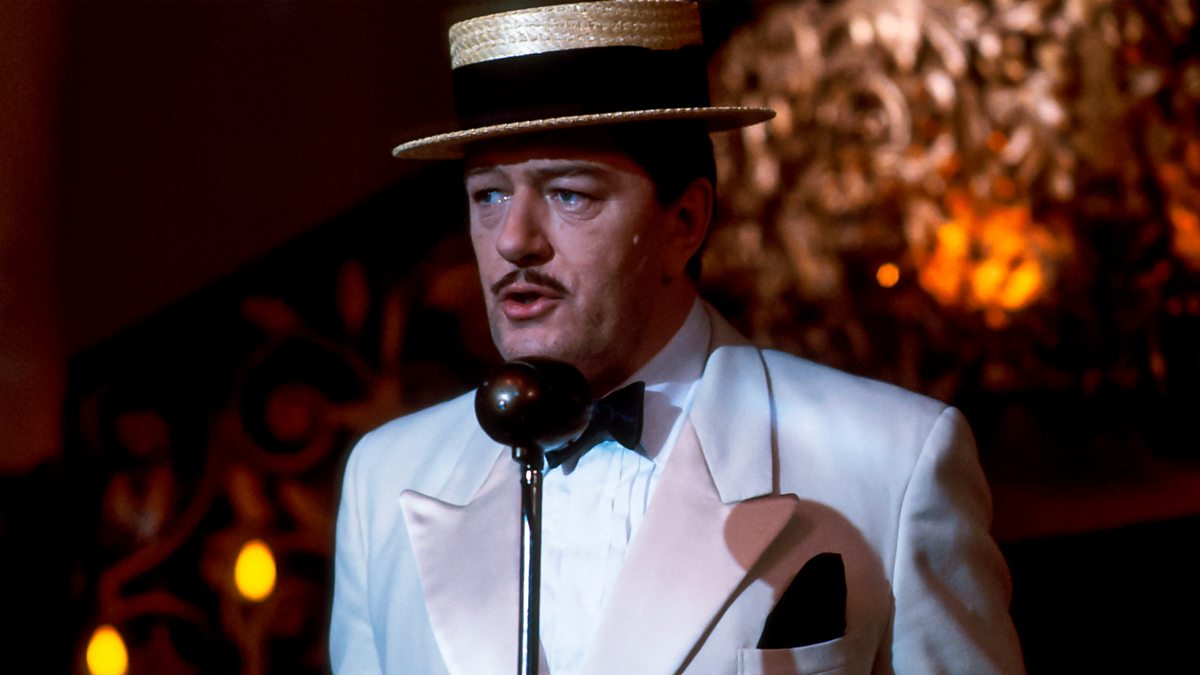
Broadcast on BBC1 across six episodes from November to December 1986 and directed by Jon Amiel, the serial follows Philip E. Marlow (Michael Gambon), a pulp novelist confined to a hospital bed by psoriatic arthropathy. Potter himself suffered from the same illness, while Marlow’s childhood in the Forest of Dean draws upon elements of the writer’s own background. Irritable and cynical, Marlow retreats into the detective novel he wrote years earlier, revisiting it in his imagination because his condition leaves him unable to write by hand. That novel gives the series its title: its hero is the Singing Detective, a private eye who moonlights as a nightclub singer and gets tangled in an espionage plot. Gambon plays both men, which is the first sign of how closely Potter ties them together.
The name Philip Marlow is no accident. It nods to Raymond Chandler’s Philip Marlowe, and the novel is soaked in the world-weary cynicism that Chandler helped define. The crime story begins as an affectionate recreation of pulp fiction, with shadowy alliances, sexual intrigue, and a general sense that trusting anyone is a mistake. But Potter isn’t interested in imitation alone. The detective story becomes the means by which Marlow processes experiences he cannot face directly, allowing the series to slide between crime fiction, psychological drama, musical fantasy, and autobiographical elements without settling into any one of them.
That slide is what makes the series such an unusual entry in the noir tradition. Noir has always been concerned with pasts that won’t stay buried, with guilt, obsession, and betrayal. Marlow’s past lives in childhood memories of the Forest of Dean and a wartime stay in London, and they return in fragments. These include witnessing his mother having a sexual encounter with Raymond Binney in the woods, as well as the guilt surrounding a lie he tells at school that results in his classmate Mark Binney being severely punished by their teacher. His fictional detective, meanwhile, acts out Marlow’s anxieties about women, sex, and trust. In the present, Marlow suspects his ex-wife Nicola (Janet Suzman) of conspiring with a lover against him, and the same suspicion bleeds into the novel. The mystery shifts from who committed the crime to why certain experiences have shaped a life so thoroughly.
Marlow’s imagination offers an escape from the helplessness of the ward, but one that keeps circling back to the same fears. His detective has the freedom and control Marlow lacks, yet the stories he constructs are far from comforting. Violence, jealousy, and paranoia saturate the fantasy. Fiction becomes another place where unresolved feelings surface, even when Marlow would rather they stayed hidden.
The musical numbers complicate things further. Characters lip-sync to popular songs of the 1930s and 1940s, and the effect can seem like an eccentric interruption of a bleak psychological drama. In fact, the music is central. The songs are cheerful and nostalgic, and that cheerfulness clashes with what is happening around them. Nor do they stay inside the novel: they spill into the hospital ward, where doctors and nurses launch into “Dry Bones” and the hospital itself becomes a musical stage. Marlow’s fantasies invade his present-day reality, and the line between the two is never safe. The songs give the characters’ desires and memories a shorthand, making the gap between fantasy and truth more unsettling.
There is something inherently noir in that contradiction. Noir often glamorizes its own world, with seductive danger and life outside respectable society, while gradually exposing the ugliness underneath. The Singing Detective asks whether nostalgia can comfort anyone when the memories beneath it remain unresolved. The stories people tell about themselves can be as deceptive as the lies in any crime novel, and Marlow’s ability to separate what he remembers from what he wishes were true is tested at every turn.
The series also gives Marlow someone who can see through all this: Dr. Gibbon (Bill Paterson), the hospital psychiatrist. Gibbon’s sessions with the resistant Marlow become the series’ own investigation, gradually revealing how much of his psychological suffering has been concealed within his fiction. His novel contains clues to problems he cannot consciously confront, almost as though some part of him wants them discovered. Noir usually ends with the truth bringing ruin. Here the truth, painful as it is, begins to bring recovery. It’s a quiet inversion of the genre, and one of the most hopeful things about a very dark story.
Gambon is essential to holding all of this together. Marlow is cruel, self-pitying, funny, and hard to like, but Gambon never lets him become merely unpleasant. His bitterness is inseparable from his pain and loneliness, and that humanity makes even the most surreal shifts land emotionally. The supporting cast, including Joanne Whalley as Nurse Mills, Patrick Malahide, and Alison Steadman, brings further complexity by playing multiple roles across the series’ layers of reality.
The story was later adapted into a 2003 American film directed by Keith Gordon, working from a screenplay Potter completed before his death. Robert Downey Jr. played the Marlow figure, renamed Dan Dark, while Mel Gibson, whose Icon Productions helped bring the project to the screen, played the psychiatrist. The remake has its admirers, although its reception was more divided. Condensing the original serial’s sprawling narrative into a feature-length film inevitably changes the way its psychological layers develop, leaving the 1986 series as the fuller realization of Potter’s vision.
Noir doesn’t always require a rain-soaked street or a femme fatale. Sometimes its darkness lives in memories that refuse to fade. The Singing Detective treats the human mind as a labyrinth every bit as tangled as a crime-ridden city, and by turning noir inward, Potter made a work in which the hardest mystery to solve is the self.
Source used: