

Spoiler warning: This article discusses major elements of Grim Fandango’s story.
Noir has always had a fascination with people who find themselves trapped in systems they cannot control. Its protagonists are often worn-down outsiders, working around the edges of respectable society and discovering that the people in charge are just as compromised as everyone else. LucasArts’ Grim Fandango takes that familiar sense of distrust and gives it an unusual setting: the Land of the Dead, where corruption follows people into death.
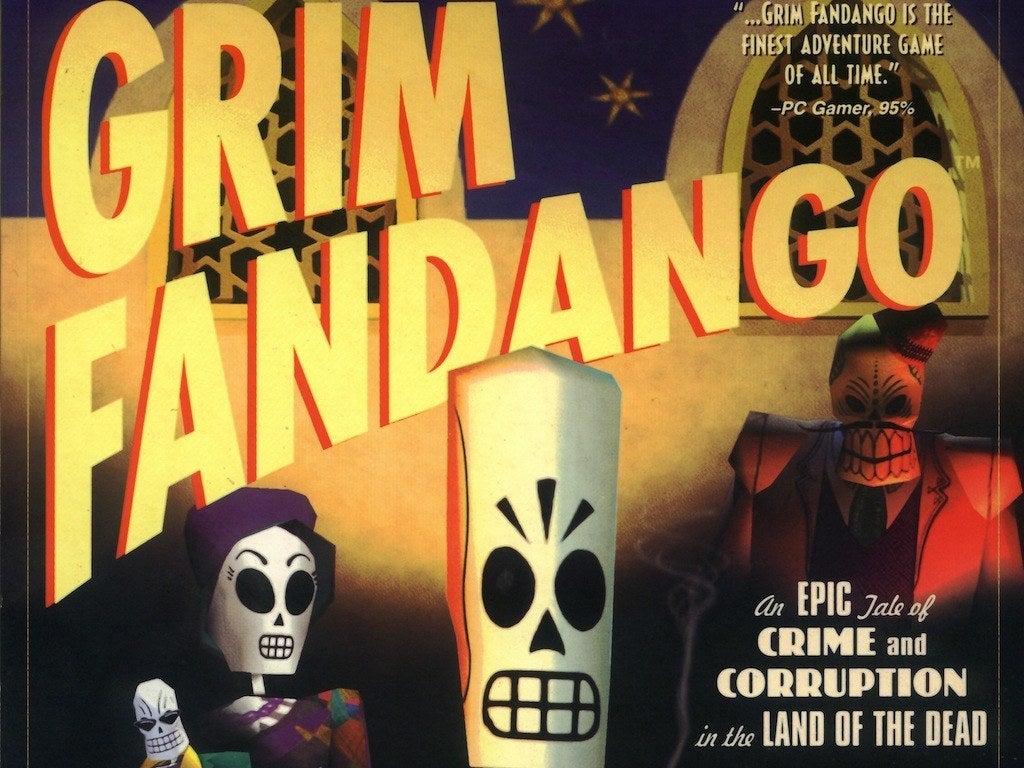
Released in October 1998, Grim Fandango follows Manny Calavera, a travel agent employed by the Department of Death. His job is to arrange transportation for newly deceased souls as they begin their journey through the afterlife. Those who lived virtuous lives qualify for the Number Nine train, which carries passengers to the Ninth Underworld in just four minutes. Everyone else must make the journey on foot, a dangerous trip that takes four years. It sounds straightforward enough until Manny discovers that the system is far less fair than it claims to be.
Manny is no glamorous detective, and that was the point. In a 2003 interview with Celia Pearce, director Tim Schafer described the game as a loving homage to film noir rather than a satire. He wanted to move beyond the familiar image of Sam Spade, the whiskey bottle, and the mysterious woman walking into a detective’s office. Instead, he was drawn to Double Indemnity, a story about an insurance salesman whose attempt to take a shortcut leads him into a spiral of crime and corruption. That thinking explains why Manny is a travel agent. He is an ordinary employee trying to work off his debt to the Department, secure better clients, and get ahead of his rival. One attempt to land a particularly valuable lead pulls him into a conspiracy that threatens far more than his career.

That lead involves Mercedes Colomar, known as Meche, a deserving soul who has been denied her Number Nine ticket. Manny’s pursuit of a better commission becomes personal, and the trail leads him through the Department’s rotten core. Schafer has identified Casablanca as the biggest cinematic influence on the game, followed by The Big Sleep and Double Indemnity. Yet Grim Fandango does more than borrow their atmosphere. It takes their interest in betrayal, desperate characters, and compromised institutions and applies it to a bureaucracy that controls how the dead reach their destination. Even in the afterlife, employees are capable of abusing their power, and the people at the bottom are left to deal with the consequences.
The corruption gives the game its criminal underworld. Genuine tickets are being stolen from deserving souls and replaced with counterfeits sold to wealthy buyers. Domino Hurley, Manny’s main competitor at the Department, is part of the racket. His polished appearance and professional confidence make him look like the sort of employee who has mastered the system, but his success depends on exploiting it. The rivalry between the two travel agents gives the conspiracy a personal dimension, since Manny’s attempts to improve his position are undermined by someone who has no intention of playing fair.
Above Domino sits Hector LeMans, the criminal kingpin behind the operation. His business depends on stealing genuine Number Nine tickets from deserving souls and selling counterfeit replacements to wealthy customers. He is also accumulating the genuine tickets for himself, hoping to secure his own passage to the Land of Eternal Rest. Hector’s ambition reveals the full extent of the corruption: the man profiting from the system’s injustice intends to use the rewards meant for virtuous souls to escape the consequences of his own actions. His position at the top of the operation makes him a fitting noir villain, with greed and self-preservation taking precedence over everyone caught in his path.
Rubacava provides the perfect setting for that kind of corruption. The port town is filled with gamblers, nightclub patrons, hustlers, and people who seem to have arrived with something to hide. As Florian Deckers discusses in his study of the game’s cultural influences, the casino Manny runs there is a clear homage to Rick Blaine’s Café Américain in Casablanca. The chapter also includes a beatnik café, a racetrack, and a police station, giving Rubacava a dense urban atmosphere. Its collection of businesses and gathering places makes the town feel like a destination where everyone has an angle, whether they are looking to make money, escape their past, or find someone willing to listen.

Meche is essential because she gives Manny a reason to look beyond himself, but she is no damsel waiting to be rescued. When Manny finally finds her after years of searching, the afterlife has hardened her. The kind, charming woman he remembers has developed a tougher exterior and is willing to threaten him at gunpoint. That change captures the damage caused by a corrupt world, showing how even the most deserving people can be forced to protect themselves. It also makes Manny’s loyalty to her more meaningful. What began as a way to secure a better position becomes a matter of doing something worthwhile in a place where so many have abandoned any sense of responsibility.
The supporting cast reinforces that contrast. Salvador Limones leads the Lost Souls Alliance, a resistance group working against the Department’s corruption. Glottis, a giant demon mechanic with an obsession for hot rods, becomes Manny’s closest companion. Deckers draws an interesting connection between Glottis’s design, which takes inspiration from the hot-rod monsters of artist Ed Roth, and the Aztec deity Xolotl, associated with death and guiding souls through the underworld. The combination gives Glottis a personality that draws from both American car culture and Mesoamerican mythology. He provides much of the game’s comedy, but his loyalty and role as Manny’s companion also make him an important part of the journey.
The visual design is another reason the combination of noir and Mexican folklore works so well. The skeletal inhabitants draw on calaca imagery associated with Day of the Dead traditions, while the architecture blends Art Deco skyscrapers with Mesoamerican motifs. Schafer has explained that the skeleton designs also solved a technical challenge: their simple, tube-like bodies and painted ribcages were well suited to the limitations of early 3D character models. El Marrow’s skyline evokes familiar New York landmarks such as the Chrysler Building and Empire State Building, while indigenous-inspired ornaments and temple-like structures give its architecture a distinctive identity. Rubacava shifts the atmosphere toward harbourfront streets, casinos, and smoky nightclubs, creating a different kind of urban environment. These locations give the Land of the Dead a visual language that brings together American cityscapes, Mexican cultural influences, and the theatrical shadows of classic noir.
The mythology gives that setting a foundation beyond its appearance. Deckers connects the game’s four-year journey to Aztec beliefs surrounding Mictlān, the underworld that souls had to traverse before reaching their final destination. The journey was believed to take four years, matching the time Manny spends travelling through the Land of the Dead. The adventure also unfolds across four consecutive Days of the Dead, with each act beginning in a different year. This structure makes the passage of time central to the story and gives Manny’s travels a connection to the mythology that inspired the game’s afterlife.

Music is another key part of the atmosphere. Composer Peter McConnell has discussed drawing on the jazz and swing scene around San Francisco’s Mission District, Mexican folk recordings, and the mariachi musicians he encountered there. Schafer also lent him a collection of Humphrey Bogart films, including Casablanca and The Maltese Falcon, which informed different parts of the score. Deckers additionally identifies Andean pan-flute influences in the music, helping explain the soundtrack’s mixture of Latin American and American musical traditions. The result gives Rubacava’s clubs their smoky atmosphere while lending the more dramatic moments a distinct character. Tony Plana’s performance as Manny complements the music, giving the protagonist a weary charm that makes his occasional optimism more effective.
As an adventure game, Grim Fandango asks players to investigate rather than simply move through its world. Conversations matter as much as examining objects, and dialogue often reveals the motives and secrets of the people Manny meets. Puzzles revolve around collecting and using inventory items, making connections between seemingly unrelated objects, and paying attention to details in the environment. Some solutions are deliberately odd, but the strongest draw on the characters and setting rather than feeling arbitrary. The original keyboard-driven tank controls take some adjustment, though they suit the deliberate movement and staging of its cinematic scenes.
The game was also an ambitious technical departure for LucasArts. Built on the GrimE engine instead of the SCUMM technology behind earlier titles, it combined three-dimensional character models with pre-rendered backgrounds and cinematic camera angles that reinforced its film-inspired look. Double Fine Productions’ 2015 remaster brought the adventure back with repainted high-resolution character textures, dynamic lighting, a soundtrack re-recorded with a live orchestra, and more than two hours of developer commentary. It also improved the controls, making Manny’s journey easier for a new generation of players to experience.

Despite critical acclaim, including a GameSpot Game of the Year award, Grim Fandango struggled to find a large audience at launch. It arrived during a difficult period for adventure games, as the industry increasingly shifted toward action-oriented experiences and the market for traditional adventures began to shrink. GamesBeat reported that Double Fine COO Justin Bailey put the game’s sales at more than 500,000 copies, citing Tim Schafer, while former LucasArts director of production Steve Dauterman believed it had likely been profitable despite its reputation as a flop. LucasArts would release one more graphic adventure, Escape from Monkey Island, in 2000 before moving away from the genre. Yet Grim Fandango endured, gradually becoming a cult classic and one of the studio’s most distinctive achievements. Its commercial struggles never told the whole story of its lasting appeal.
Grim Fandango succeeds because it understands that noir does not depend on detectives, glamorous criminals, or familiar city streets. It is about people trying to find their way through a world shaped by greed, betrayal, and institutions that have stopped serving those beneath them. By placing those ideas in an afterlife inspired by Mexican folklore, LucasArts created a setting that feels both familiar and entirely its own. Manny begins as a man trying to work off his debt, but his journey becomes something much larger: a four-year struggle to help someone who deserves better and to find a measure of justice in a world that has made a business out of denying it.