

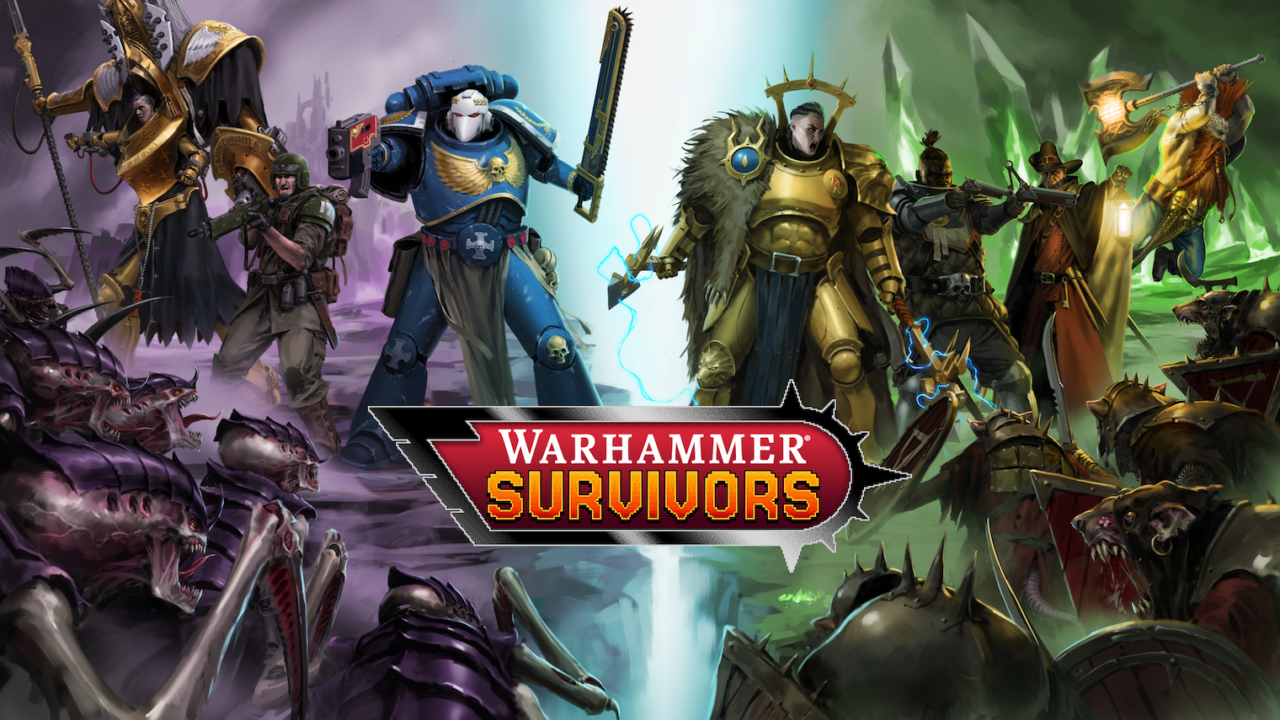
Warhammer and survivors-style games always felt like they were destined to meet. Drop a lone Space Marine into an ocean of enemies, hand them steadily sillier weapons, and let the carnage sort itself out. Warhammer is a franchise built on gigantic wars, monstrous foes, and warriors who refuse to die, so the pairing is almost too obvious. Warhammer Survivors comes from Auroch Digital, the studio behind Warhammer 40,000: Boltgun, working alongside poncle, and it carries the Vampire Survivors formula into both Warhammer 40,000 and Warhammer Age of Sigmar. The result is an entertaining and surprisingly substantial bullet heaven that understands why people love its source material. Of course, a handful of design choices keep it from being everything it could have been.
If you have played anything in the genre, you already know how this works. Your character attacks nearby enemies automatically, so your job is to keep moving, stay out of trouble, and collect experience. Defeated enemies drop experience skulls, allowing you to level up and choose new weapons, improve existing equipment, or acquire passive abilities. Each stage has a 25-minute time limit, and the goal is to outlast increasingly dangerous waves while assembling a loadout capable of handling the growing swarm. It is a simple loop, but the genre has proven time and again that simple can be deeply addictive. Regular bosses appear throughout stages, while certain encounters culminate in an Extremis Boss arriving at the 25-minute mark. These formidable opponents require specific preparation before they can be damaged, making them a considerably tougher test than the ordinary enemy waves.

One of Warhammer Survivors’ greatest strengths is that it refuses to treat Warhammer 40,000 and Age of Sigmar as the same game wearing different skins. Each setting gets its own roster, stages, factions, and objectives. The 41st Millennium delivers the grim science-fiction horrors fans expect, while Age of Sigmar leans into a more traditional fantasy atmosphere, complete with its own monsters and magical weaponry. Switching between them feels like a genuine change of scenery rather than simply choosing a different pile of characters.
That said, the two sides are not completely isolated from one another. Each universe has its own content and unlocks, but certain permanent progression benefits carry over, encouraging players to explore both. This makes the overall package feel considerably more substantial than the average licensed spin-off, while rewarding curiosity instead of forcing players to choose one setting and remain there.
There are more than 40 characters spread across both universes, including familiar faces such as Malum Caedo and Neave Blacktalon. Each comes with a starting weapon and a set of attributes, so every run begins a little differently. Some characters suit particular playstyles, while others encourage experimentation with weapon combinations that might otherwise be overlooked. Not every character feels especially distinct once a run gets underway, but the size of the roster provides a strong reason to keep returning. Malum Caedo’s inclusion is particularly welcome following Auroch Digital’s previous work on Boltgun, and it is good to see the studio bringing that same enthusiasm for Warhammer to a very different kind of game.

The follower system is easily the most interesting idea here. Characters cannot use every weapon they find, but selecting one they are not compatible with summons another character who wields it instead. These followers accompany the player and attack independently, opening up combinations that would otherwise be unavailable. Better still, enemies cannot hurt them, so there is no need to babysit allies while the screen fills up. It expands the available weapon combinations without completely compromising the identities of individual characters, and watching a growing collection of followers become an improvised fighting force is great fun.
However, followers do more than simply add extra bodies to the battlefield. Since attacks originate from them rather than always coming directly from the player character, positioning becomes an additional consideration. This can be useful when dealing with large groups, as followers can spread attacks across different areas, but it can also make certain weapons less predictable when companions move around during combat. The system adds an interesting tactical wrinkle, although its benefits are not always as straightforward as they initially appear.
Auroch Digital also clearly loves the tabletop hobby, and it shows. The references go well beyond recognizable characters and weapons. Alongside boltguns, flamers, chainswords, and a variety of fantasy armaments, players can acquire explosive dice and Nuln Oil. The latter is particularly amusing, taking a familiar miniature painting product and turning it into a weapon that damages and slows enemies while leaving them more vulnerable to fire. Anyone who has spent time painting miniatures will appreciate the joke, especially when the weapon becomes part of a particularly effective combination.
That humour gives Warhammer Survivors far more personality than most licensed games manage. The developers understand that Warhammer is about more than battles and characters, and the Hobby Table stage is perhaps the best example. It transforms a miniature painting workspace into a battlefield, which is a simple idea but an effective one. It demonstrates how much fun the franchise can be when it does not take itself too seriously, while giving longtime tabletop enthusiasts another reason to appreciate the attention to detail.

The enemy factions help each stage stand out as well. On the Warhammer 40,000 side, players face Tyranids, Orks, and the Death Guard, while the forces of the Mortal Realms bring their own threats to Age of Sigmar. Some enemies strengthen their allies, while others introduce hazards that interfere with movement and turn otherwise manageable situations into dangerous encounters. These faction-specific mechanics encourage players to adapt their approach rather than relying on the same weapon combinations throughout every stage. The result is a little more variety than simply throwing increasingly powerful enemies at the player.
There are plenty of reasons to jump back in after a failed run. Permanent enhancements improve character attributes and make later attempts easier, while new characters, weapons, and other unlockables provide longer-term goals. The game also rewards exploration and experimentation, encouraging players to investigate the stages and discover the requirements for unlocking additional content. The bestiary and collectible elements provide further incentives to keep playing, particularly for anyone interested in uncovering everything Warhammer Survivors has to offer.
Stage design introduces its own complications. Some environments feature narrow corridors, enclosed spaces, and obstacles that change how players approach incoming waves. These layouts create opportunities to funnel enemies into chokepoints, but they also make movement more demanding. Unfortunately, the way enemies interact with environmental obstacles is not always consistent. Some appear capable of crossing terrain that stops others, making it difficult to predict whether a particular route is actually safe. The stages are more interesting than simple open arenas, but clearer rules governing enemy movement would make navigating them considerably less frustrating.
The pacing needs work as well. The opening minutes of a run can drag, especially when characters have limited equipment and relatively weak attacks. Enemies do not always drop experience skulls, so levelling up can take longer than expected. This makes the early portions of a run feel considerably less exciting than the explosive battles that eventually develop. The opening stretch is where the game is most likely to test the patience of newcomers, particularly those unfamiliar with the gradual progression that defines the genre. Once enough weapons and upgrades have been collected, however, the experience becomes considerably more engaging. Weapon evolutions and passive abilities can transform a build, and finding the right combination can turn a difficult run into a spectacular display of destruction.

The problem is that reaching this point can take too long, particularly when repeated early deaths make permanent progression feel mandatory rather than rewarding. The Extremis Boss encounters introduce another challenge, but their requirements could be communicated more clearly. These bosses arrive at the end of certain stages and require players to obtain specific equipment or meet particular conditions before they can be damaged. This adds an interesting layer of preparation, encouraging players to think about their builds before reaching the final encounter. Unfortunately, the game does not always make those requirements sufficiently clear, meaning an otherwise successful run can end in frustration when the necessary preparation has been overlooked.
Then there is the readability problem, and the follower system plays a significant part in it. Cluttered screens are standard for the genre, but Warhammer Survivors can become especially overwhelming once several followers and elaborate weapons are firing simultaneously. With so many overlapping effects, it is easy to lose track of incoming threats and identify what is actually causing damage. Followers become more transparent in certain situations to help improve visibility, but this does not completely solve the problem during the busiest encounters. It is not a dealbreaker, but the visual clutter can make already difficult situations considerably harder to manage.

Presentation remains a strong point. The pixel-art visuals capture the over-the-top violence and distinctive designs of both settings, while the animations give characters and enemies plenty of personality. The battlefield becomes chaotic, but that is partly the point, and watching a powered-up character carve through massive hordes while weapon evolutions and followers work together is a genuine spectacle. The audio complements the action well, reinforcing the constant sense of warfare without getting in the way of the gameplay. That excess is a big part of the charm, even if the visual effects occasionally make it difficult to follow everything happening on screen.
Warhammer Survivors does not reinvent the genre, but there is something deeply satisfying about turning a lone warrior into an unstoppable engine of destruction. Its two distinct settings, sizeable roster, extensive weapon selection, and numerous nods to the tabletop hobby give it an identity that goes beyond borrowing the Vampire Survivors formula. The follower system is a welcome addition, even if it sometimes makes combat harder to read, while the variety of unlockables provides plenty of reasons to embark on another run.

Uneven difficulty, a slow start, and unclear boss requirements keep it from being as consistently enjoyable as it could have been. Even so, the core gameplay remains compelling, and the amount of content makes it easy to lose hours experimenting with different characters and weapon combinations. Whether facing Tyranid swarms, exterminating Skaven, or sending entire armies of Orks back to whatever unpleasant corner of the galaxy they crawled out of, there is always another horde waiting to be slaughtered. Fans of Warhammer, the survivors genre, or preferably both, will find plenty to enjoy here despite its shortcomings. The Emperor protects, but a fully evolved weapon certainly helps.
Review conducted on Nintendo Switch 2. The game performed exceptionally well in handheld mode, with little to no noticeable slowdown, responsive controls, and quick loading times. However, after approximately 20 hours of play, the Joy-Con 2 controllers began experiencing connection issues specifically while playing Warhammer Survivors. This did not happen with other games, making it difficult to determine whether the cause is related to the game’s software or an isolated compatibility issue.
Disclaimer: A review key was provided.
Warhammer Survivors is available on PC through Steam and GOG, Nintendo Switch and Switch 2, PlayStation 5, Xbox Series X|S, and mobile devices through iOS and Android.