

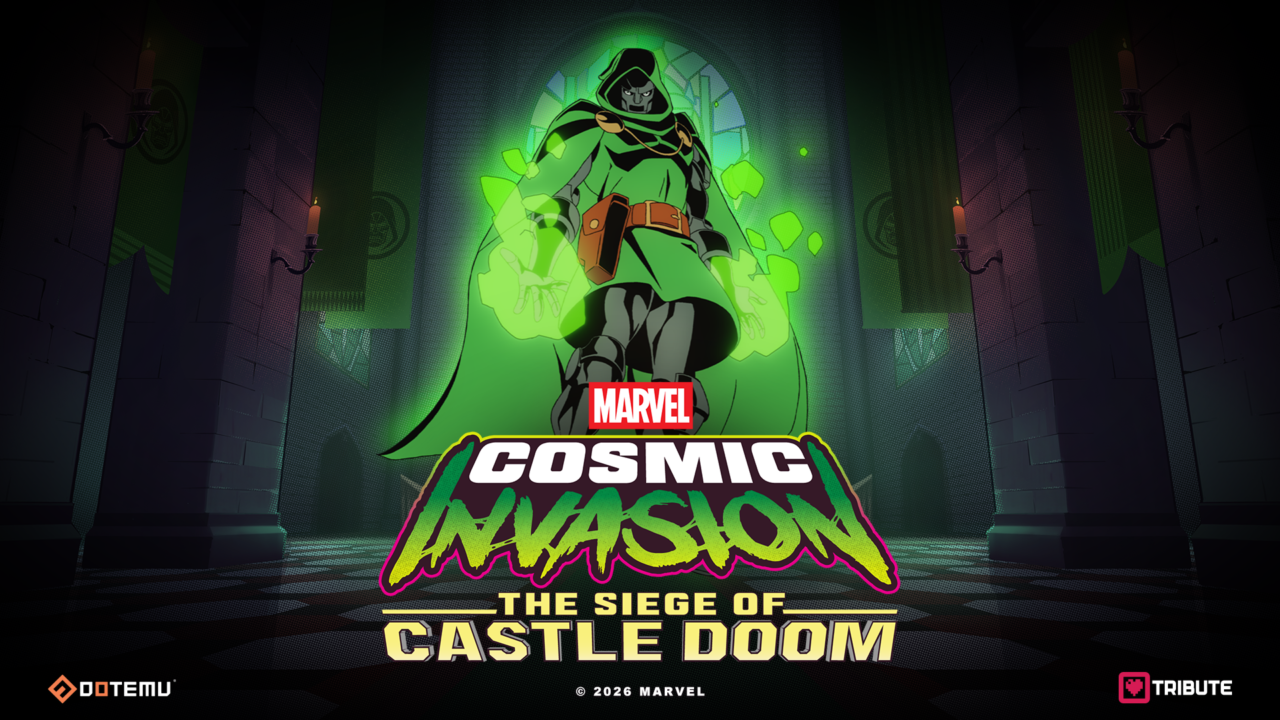
Marvel Cosmic Invasion had plenty going for it, including an enjoyable selection of characters, entertaining combat and a healthy appreciation for the history of Marvel’s comic books and video games. However, one of its biggest shortcomings was the limited incentive to return after completing the campaign. The first DLC, which introduced Cyclops and The Thing, expanded the roster but did little to address that problem. The Siege of Castle Doom takes a considerably different approach, introducing Doctor Doom and the Invisible Woman alongside an entirely new roguelite mode that gives players another reason to spend time with the game. It is a much more substantial expansion, although its ambitious new structure also introduces some balancing problems that prevent it from reaching its full potential.
The premise is exactly the sort of extravagant comic book storyline that suits Marvel Cosmic Invasion. With Annihilus threatening the universe, Doctor Doom decides that he is perfectly capable of dealing with the situation himself. However, his intentions are not entirely altruistic. He is charging the Cosmic Inductor, a powerful but unstable weapon that he believes will allow him to defeat Annihilus and make himself Earth’s Champion. Reed Richards recognizes the danger and supplies a group of heroes, including his wife Susan Storm, with a Stabilizer to counter Doom’s plan as they invade Castle Doomstadt. The resulting confrontation provides an entertaining excuse to bring together several Marvel characters while giving Doom another opportunity to demonstrate his considerable arrogance.

The main attraction is the new Siege of Castle Doom mode, which is considerably more ambitious than simply adding another collection of campaign stages. Players select two characters and embark on a series of increasingly difficult encounters throughout Doom’s fortress. Each attempt features different routes, enemies, environmental challenges and opportunities to improve the selected heroes. The structure borrows considerably from the roguelite genre, with room selection and randomized rewards determining how each attempt develops.
This approach works surprisingly well with the existing beat ’em up mechanics. Rather than following a predetermined sequence of encounters, players must consider which challenges are worth attempting and which rewards could prove most useful. The layout encourages experimentation, while the possibility of discovering different combinations of equipment and upgrades gives subsequent attempts a reason to feel different.
Castle Doomstadt is divided into multiple sections, with doors providing access to different encounters and rewards. Some offer healing, while others provide equipment, Battery Cells, special events or additional challenges. The symbols displayed on each door communicate what awaits beyond them, making route selection an important part of the experience.
There is a genuine risk-and-reward element to these decisions. Choosing a healing opportunity might preserve a team’s chances of surviving the next encounter, but passing up an equipment reward could leave the characters less capable of dealing with stronger opponents. Other doors provide temporary advantages, including opportunities to gain effectively unlimited ammunition or Focus. These rewards can dramatically change how an encounter plays out, particularly when they allow characters to unleash their most powerful abilities with considerably fewer restrictions.
Two interconnected systems determine the pace of each attempt: Reed Richards’ Stabilizer and Doom’s Siege Gauge. Defeating enemies and discovering battery rooms provides Battery Cells, which contribute towards charging the Stabilizer. Completing a charge allows players to select a temporary upgrade, with offensive, defensive and tactical options providing different advantages. According to Tribute Games, the Stabilizer features 12 perks across these categories, giving players several ways to develop their characters during a run. Once enough Stabilizers have been charged, the heroes can advance into the next section of the castle.
The Siege Gauge creates an opposing source of pressure. It increases as time passes, when players enter new rooms and whenever the heroes take damage, with enemies becoming faster and more dangerous as Doom’s power grows. Certain encounters and opportunities can help manage this threat, making route selection particularly important. Allowing the gauge to fill completely before reaching Doom ends the attempt.
The competing systems create an interesting relationship between progression and survival. Every encounter provides an opportunity to strengthen the team, but struggling through them gives Doom an advantage. Unfortunately, the balance between these systems does not always feel particularly fair.

The early stages can be especially unforgiving before enough permanent upgrades have been unlocked. A difficult encounter can leave the team weakened while simultaneously increasing the threat posed by subsequent opponents. This creates a situation where an unsuccessful battle can have consequences extending well beyond the immediate loss of health. Rather than simply recovering and approaching the next room with a different strategy, players can find themselves dealing with increasingly dangerous enemies while having fewer resources available.
There is a fine line between creating a demanding roguelite experience and making progression unnecessarily frustrating. The Siege of Castle Doom occasionally crosses that line, particularly when the difficulty escalates before players have had much opportunity to develop their characters. A more gradual introduction would make the mode considerably more accessible while preserving the pressure that gives its structure much of its appeal.
Fortunately, the encounters themselves offer considerably more variety than the standard campaign. Skirmish Echoes reintroduce bosses from the main game, giving familiar opponents additional opportunities to challenge players. Their increased strength, combined with the effects of the Siege Gauge, can make these encounters considerably more dangerous than their original appearances.
Environmental challenges are another important part of the experience. Blizzard conditions, for example, introduce freezing hazards that require players to manage their surroundings while fighting. A heating device provides a protected area, but maintaining its effectiveness becomes another responsibility during an already demanding encounter. These situations force players to pay attention to more than just the enemies directly in front of them, adding another layer to the combat.
Equipment and temporary upgrades further expand the available strategies. Different combinations can substantially change how individual characters approach encounters, while environmental hazards and enemy arrangements encourage players to adjust their tactics. Tribute Games has stated that the mode contains more than five times as many encounters as the main game, even before accounting for its additional events, traps and hazards. This comparison refers specifically to the number of encounters rather than the overall amount of content or potential playtime. That variety is an important part of what makes repeated attempts worthwhile.
The expansion also introduces a useful readability improvement: flying enemies now have markers beneath them. It is a small adjustment, but it helps players keep track of the action in crowded online multiplayer battles, where several characters and large groups of enemies can make it difficult to follow everything happening on screen.

Progression continues even after an unsuccessful attempt. Resources collected throughout a run contribute towards permanent unlocks in Reed Richards’ laboratory, where additional equipment, events and modifiers become available. Although temporary upgrades are lost when an attempt ends, these permanent unlocks provide further opportunities to customize subsequent runs, giving players something to work towards beyond simply reaching the final encounter.
The laboratory is an important part of the overall structure because it gives each attempt some longer-term value. Unlocking new equipment and modifiers gradually expands the available possibilities, while additional options can change the difficulty and rewards encountered during future runs. Completing a run also unlocks a new colour palette for the hero used, providing another small incentive to experiment with different characters.
However, the permanent progression could have a more noticeable impact on the difficulty. Some upgrades feel relatively modest considering how demanding the early encounters can become, and stronger initial unlocks would help establish a better sense of progression for players who are still learning how to approach the mode.
Character selection also plays an important role. Limiting each run to two fighters encourages players to consider how their abilities complement one another. Some characters are better suited to dealing with large groups, while others offer stronger individual damage or more dependable battlefield control. Selecting an effective combination can make encounters considerably more manageable, especially in cooperative multiplayer.
This is one of the most promising aspects of the new mode. Marvel Cosmic Invasion already emphasizes its tag-team combat, and the additional emphasis on character synergy provides another reason to experiment with the roster. Coordinating upgrades and selecting complementary abilities can create some interesting combinations, although the difficulty sometimes discourages players from experimenting with unfamiliar characters.
The two new additions are among the expansion’s biggest strengths. Doctor Doom and the Invisible Woman both bring distinct abilities to the roster, and their movesets provide worthwhile alternatives to the existing characters.
Doctor Doom is a powerful fighter who combines advanced technology with magical abilities. His attacks are particularly effective against groups, with his combos finishing in an area attack that can catch multiple opponents. His charged attack places a magical sigil on the battlefield, producing an upward blast when an enemy triggers it. Proper positioning makes this ability particularly useful for controlling space and punishing approaching opponents.
His special attack launches a powerful projectile across the screen, giving him an effective way to pressure enemies from a distance. His ultimate, meanwhile, releases energy bolts in multiple directions, making it particularly useful when surrounded. Together, these abilities give Doom a versatile offensive toolkit that rewards players who can manage groups of opponents without sacrificing their positioning.
Although Doom is not among the most agile characters, his considerable offensive capabilities compensate for that limitation. His animations also communicate his personality rather effectively, with practically every movement suggesting that he considers the opposition beneath his attention. The character feels appropriately imposing, and his combination of magic and technology makes him a satisfying addition to the roster.
There is, however, one particularly noticeable omission for fans of Marvel’s fighting game history. Doom’s famous Foot Dive attack from Marvel vs. Capcom 2 would have been an entertaining inclusion, especially considering how closely the character is associated with that series. Its absence is a missed opportunity for an otherwise fitting interpretation of the villain.
The Invisible Woman offers a considerably different approach to combat, relying on battlefield control and defensive abilities rather than simply overwhelming opponents with direct attacks. Her force fields provide several opportunities to manipulate enemy positioning, making her particularly interesting when encounters become crowded.

Her mobility is another useful aspect of her moveset. She can create an invisible platform beneath herself while jumping, giving her another way to avoid dangerous situations. Her dash also briefly turns her invisible before she follows up with a shielded kick, providing another way to reposition while avoiding incoming attacks.
Her defensive capabilities are equally useful. Protective bubbles can temporarily remove troublesome enemies from the immediate fight, providing opportunities to recover or reposition when encounters become overwhelming. A ranged grab also allows her to catch opponents across the screen, while her ultimate creates a damaging protective bubble that briefly provides immunity to incoming projectiles.
Her charged attack creates a spiked barrier that damages enemies while preventing them from advancing. Positioning is particularly important when using this ability. Placing the barrier near a wall can trap opponents between the two surfaces, allowing them to take repeated damage as they are knocked back and forth. This technique is especially effective against larger enemies and bosses, demonstrating how much potential her abilities offer beyond straightforward attacks.
Although invisibility is present in her moveset, it feels secondary to her force fields, considering how recognizable the ability is. Still, the combination of defensive options, mobility and battlefield control provides plenty of opportunities for creative play. She feels sufficiently distinct from the rest of the roster, making her a worthwhile addition.
Not every aspect of the expansion is equally successful. Considering that the entire mode revolves around invading Doctor Doom’s fortress, the enemy selection could have made considerably better use of his technological creations. Several new Doombot variants provide some additional opposition, but many encounters also reuse enemies from the main campaign.
There is nothing inherently wrong with bringing back familiar opponents, particularly when they are being presented through different combinations and modifiers. However, the frequency of these appearances makes the fortress feel less distinctive than it could have been. More Doom-inspired machinery, security systems and environmental traps would have helped establish a stronger identity for the new setting.
The Fantastic Four also receive somewhat limited representation. The Invisible Woman and The Thing are playable, but Mister Fantastic and the Human Torch remain absent despite Reed Richards playing an important role in the story. With Doctor Doom serving as the central antagonist and the Fantastic Four’s rivalry providing much of the narrative foundation, including more members of the team would have made the expansion feel more complete.

There are still plenty of reasons to appreciate what The Siege of Castle Doom accomplishes. Most importantly, it addresses one of the original game’s biggest weaknesses by introducing a substantial new mode designed around replayability. Rather than relying exclusively on additional characters and traditional stages, Tribute Games has experimented with a structure that changes how players approach the existing combat system.
That decision gives Marvel Cosmic Invasion a much stronger foundation for continued play. Randomized encounters, branching paths, temporary upgrades and permanent unlocks provide a considerable amount of variety, while the two new characters make the existing roster even more appealing. The combat remains enjoyable, and the additional mechanics demonstrate how much potential there is in combining traditional beat ’em up gameplay with other genres.
The difficulty is still the most significant obstacle. The Siege Gauge can make an already demanding experience feel unnecessarily punishing, particularly before permanent upgrades have had an opportunity to make a difference. A few balance adjustments, especially in the opening stretch of a run, would improve the experience without removing the challenge that makes the mode appealing.
Nevertheless, this is an interesting direction for Tribute Games to explore. The traditional beat ’em up formula does not necessarily need to be limited to a campaign followed by a handful of additional stages. The Siege of Castle Doom demonstrates how branching encounters, character combinations and persistent progression can give the genre another dimension. With further refinement, this structure could provide a compelling foundation for future projects.
The expansion also benefits considerably from having Doctor Doom as its central attraction. His personality and abilities are a natural fit for the game’s comic book-inspired presentation, and making him playable provides another reason for fans to revisit the roster. His presence helps distinguish this DLC from the previous character-focused offering, while Susan Storm provides an equally worthwhile addition through her more technical approach to combat.

The Siege of Castle Doom is not quite the expansion it could have been, but it is a meaningful improvement over the first DLC and a welcome addition to Marvel Cosmic Invasion. The new roguelite mode provides the replayability that the original campaign lacked, while Doctor Doom and the Invisible Woman bring two entertaining characters to an already impressive roster. Some balancing adjustments are needed, and the setting could have benefited from more original enemies and a greater representation of the Fantastic Four, but the underlying experience is strong.
Doctor Doom may consider himself superior to practically everyone in the Marvel Universe, but this expansion makes a convincing case for spending more time in his company. With some additional refinement, The Siege of Castle Doom could become one of the more interesting ways to extend the lifespan of a modern beat ’em up.
Disclaimer: A review key was provided