

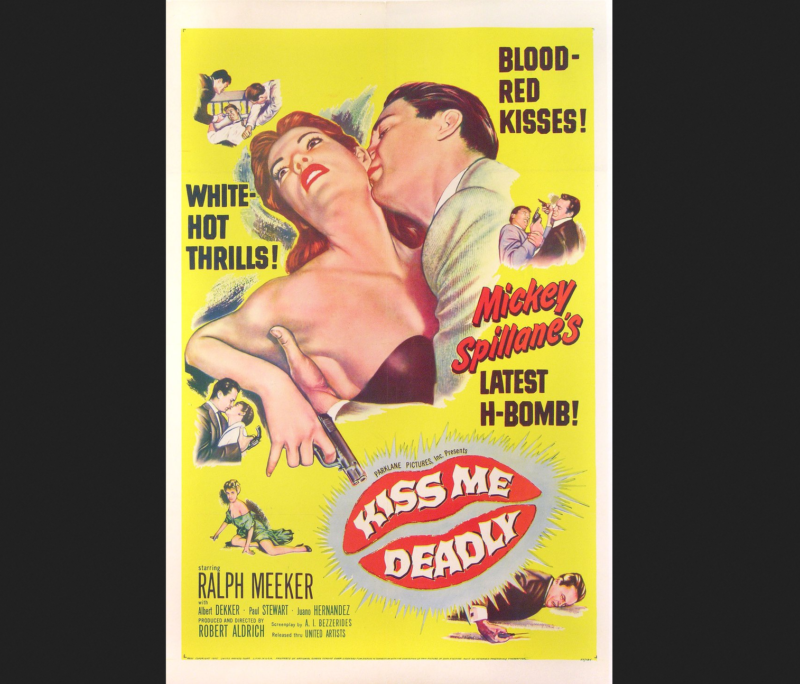
There is something fundamentally wrong with the world of Kiss Me Deadly. From its opening moments, Robert Aldrich’s 1955 thriller establishes an atmosphere of desperation, hostility and impending disaster that never quite disappears. A frightened woman runs barefoot along a dark highway, desperately trying to escape something that remains unseen. Her heavy breathing dominates the soundtrack as passing cars approach, their headlights illuminating the otherwise empty road. Eventually, one driver stops, although his decision to help her has considerably less to do with compassion than curiosity. What follows is a detective story that gradually abandons the familiar boundaries of the genre, replacing its usual criminal intrigues with something far more disturbing.
Adapted by screenwriter A.I. Bezzerides from Mickey Spillane’s 1952 novel and starring Ralph Meeker as private investigator Mike Hammer, Kiss Me Deadly takes the hard-boiled detective and places him in a world where violence is commonplace, trust is practically nonexistent and nearly everyone has an ulterior motive. Hammer is not particularly interested in justice, nor does he possess the moral convictions traditionally associated with the genre’s more sympathetic investigators. He is a self-centred, aggressive man who makes his living handling divorce cases, often relying on intimidation and questionable methods to get what he wants. His involvement with Christina Bailey (Cloris Leachman), the desperate woman he picks up on the highway, initially appears to be another inconvenience in an otherwise ordinary evening. However, after she is murdered, Hammer finds himself caught up in an increasingly complicated investigation involving dangerous criminals, suspicious government connections and a mysterious object that everyone seems willing to kill for.
What makes Hammer such an interesting protagonist is just how thoroughly unpleasant he can be. Meeker does not attempt to make the character particularly charming, instead embracing his arrogance, vanity and casual disregard for other people. Hammer treats violence as an ordinary extension of his profession, frequently displaying more concern for his damaged possessions than the suffering of those around him. Even when he appears to be helping someone, there is usually some personal advantage motivating his actions. He is less interested in understanding the people caught up in his investigation than in finding out what they know and determining how that information can benefit him.
Meeker’s performance is particularly effective because he never attempts to soften these characteristics. His Hammer is confident to the point of obnoxiousness, frequently treating other people as obstacles to be overcome rather than individuals deserving of consideration. Unlike Sam Spade or Philip Marlowe, Hammer seems to possess very little of the personal code that traditionally distinguishes the hard-boiled detective from the criminals he pursues. He is certainly capable of recognizing corruption, but he is hardly separate from the ugliness surrounding him. In many respects, he is simply another participant in the same destructive environment, using intimidation and violence whenever they prove convenient. His investigation is not necessarily an attempt to restore order to a broken world. It is an opportunity to satisfy his own curiosity and potentially make some money along the way.
The film makes this clear almost immediately through its remarkable opening sequence. Rather than introducing Hammer through a conventional establishing shot or a voice-over explaining his profession, Aldrich throws the audience directly into Christina’s desperate escape. Only after Hammer nearly runs her down and gives her a lift do the opening credits begin. They scroll down the screen from top to bottom, forcing the audience to read them from the bottom upwards and creating the impression that the film itself is moving in the wrong direction. The only sounds beneath them are Nat King Cole’s “Rather Have the Blues” playing on the car radio and Christina’s heavy breathing. Combined with the darkness of the highway, the effect is an atmosphere that feels almost detached from ordinary reality. It is an extraordinarily effective introduction, not simply because it creates suspense, but because it establishes the sense that something terrible has already happened and that everyone involved is moving towards consequences they cannot possibly understand.
Aldrich’s direction continues to reinforce this feeling throughout the investigation. Working with cinematographer Ernest Laszlo, he frequently uses unusual camera angles, sharp contrasts between light and darkness, extreme close-ups and compositions that make familiar environments feel strangely hostile. The film’s Los Angeles is not particularly glamorous, despite the occasional expensive car or impressive residence. Instead, its streets, apartments, gyms and shadowy interiors become part of an increasingly unpleasant landscape populated by people who seem incapable of trusting one another. Even when Hammer finds himself surrounded by seemingly ordinary individuals, there is an underlying suspicion that everyone is concealing something.
The supporting cast contributes considerably to this atmosphere. Maxine Cooper’s Velda provides an interesting counterpoint to Hammer, serving as his secretary and partner in his investigative work while demonstrating considerably more awareness of the dangers surrounding them. She understands his weaknesses and recognizes that his determination to pursue the mystery is becoming increasingly reckless. However, their relationship also reveals another unpleasant aspect of Hammer’s personality. He depends on Velda’s intelligence and investigative abilities, yet repeatedly places her in dangerous situations without demonstrating much concern for the risks she takes on his behalf. Cooper gives the character enough personality to make her more than simply an assistant, and her presence provides an important contrast to Hammer’s increasingly destructive behaviour.
Meanwhile, Albert Dekker’s Dr. Soberin and Gaby Rodgers’ Lily Carver, whose apparent identity conceals the real Gabrielle, introduce further layers of deception into an investigation that becomes progressively harder to follow. The characters are constantly manipulating one another, concealing their identities and pursuing their own interests, making it difficult to determine who can be trusted. Their motivations are rarely straightforward, and even seemingly minor encounters contribute to the growing sense that Hammer has stumbled into something considerably larger than he initially realizes.
However, the increasingly complicated mystery is not necessarily the film’s greatest strength. In fact, attempting to follow every development in Hammer’s investigation can occasionally become an exercise in frustration. Characters appear, disappear and reappear under different circumstances, while the detective himself frequently seems more interested in pursuing the next lead than understanding how everything fits together. Yet this confusion is also part of what makes Kiss Me Deadly so effective. The audience is rarely given enough information to feel comfortable, and the mystery becomes less about uncovering a conventional criminal conspiracy than about discovering what everyone is so desperate to obtain.
That object eventually becomes known as the Great Whatsit, a deliberately vague description that captures the strange nature of the entire investigation. Nobody seems particularly interested in explaining what it is, yet nearly everyone involved is willing to commit terrible acts to possess it. Hammer initially approaches the mystery as another opportunity to uncover valuable information, but the further he investigates, the more apparent it becomes that he has stumbled into something considerably more dangerous than an ordinary criminal enterprise.
This is where Kiss Me Deadly begins to distinguish itself from many of its contemporaries. Although its foundation remains rooted in the conventions of the hard-boiled detective thriller, the film gradually introduces anxieties that extend well beyond the criminal underworld. When Lieutenant Murphy warns Hammer off with the words “Manhattan Project, Los Alamos, Trinity,” the film strongly implies that the mysterious object is connected to atomic weapons, although it never provides a precise technical explanation of its contents. Suddenly, the film’s obsession with greed and violence takes on an entirely different significance. The characters are no longer simply fighting over money, influence or personal revenge. They are pursuing something capable of unleashing destruction on a scale that makes their individual ambitions seem almost absurd.
It is worth remembering that this atomic twist was a significant change made during the adaptation. In Spillane’s novel, the prize everyone is chasing is a stash of heroin, which Bezzerides replaced with radioactive material. The screenwriter later explained that the possibility of nuclear war was one of the foremost fears of the period, making the atomic material considerably more interesting to him than the original narcotics plot. Although the film has inspired numerous interpretations beyond its immediate story, its nuclear anxieties were not simply imposed on it by later critics. Bezzerides also incorporated the imagery of Pandora’s box, giving the mysterious object a symbolic significance that extends beyond its immediate destructive potential.
The Cold War setting is essential to understanding the film’s increasingly disturbing atmosphere. The atomic age had fundamentally changed how people understood the possibility of destruction, introducing the frightening prospect that human ingenuity could produce weapons capable of devastating entire populations. Kiss Me Deadly draws directly from those anxieties, turning the mysterious box into a physical representation of humanity’s increasingly dangerous relationship with its own technological achievements. Its contents are treated with an almost religious fascination, even though nobody involved seems fully prepared for what might happen if they are unleashed.
There is also something particularly fitting about having Hammer serve as the character who ultimately brings this danger into the lives of everyone around him. His investigation is driven by the same selfishness and disregard for consequences that define much of the film’s criminal population. He wants answers, but he rarely considers whether finding them is actually worth the trouble. The object becomes an obsession precisely because its value remains uncertain, and the possibility of possessing something extraordinary proves more attractive than understanding what it might represent. Hammer’s belief that determination and physical force can overcome virtually any obstacle is repeatedly reinforced throughout the film, yet the Great Whatsit represents something that cannot be intimidated, negotiated with or controlled. In that respect, the atomic imagery is not simply a reference to contemporary political anxieties. It is an extension of the film’s criticism of greed, masculine arrogance and the destructive belief that everything can be mastered through enough determination and force.
The final act brings these ideas together in a way that remains remarkably unsettling. Without relying on the conventional resolution of a detective story, Aldrich turns the mystery into a confrontation with the consequences of everything that has happened. The beachfront house becomes the setting for a climax that feels almost detached from the crime thriller that preceded it, with the mysterious box finally revealing why so many people were willing to risk their lives to possess it when Gabrielle ignores Dr. Soberin’s warnings and opens it. Its opening is less a moment of triumph than the fulfilment of a nightmare that has been building since Christina first appeared on that deserted highway.
The film’s ending also has an interesting history worth acknowledging. For decades, the shortened American release version was widely circulated, cutting away to the exploding beach house without showing Hammer and Velda reaching safety in the surf. This leaves their fate ambiguous, creating the impression that they have perished in the blast. The missing footage was recovered in 1997 after film historian Alain Silver and MGM editor Glenn Erickson helped locate a surviving complete print. The original ending shows Hammer and Velda stumbling into the water and watching the beach house explode behind them. Although this establishes that they escape the immediate destruction, it hardly provides a reassuring conclusion. Screenwriter Bezzerides himself cautioned against interpreting their survival as a happy ending, suggesting that the characters are still witnessing the end of the world. The Criterion Collection release includes the restored ending alongside the shortened alternative, making it possible to compare the two versions. The complete ending is unquestionably the one worth seeking out, particularly because it better communicates the intended progression of the final sequence.
What makes Kiss Me Deadly particularly interesting within the history of film noir is how effectively it pushes the genre towards something more extreme without abandoning its foundations. The familiar ingredients are all present: a cynical private investigator, dangerous criminals, deceptive women, murder, corruption and an investigation that gradually spirals beyond the protagonist’s control. Yet Aldrich takes those conventions and places them against the fears of a changing world. The result is a film that feels considerably more volatile than many of the detective stories that preceded it, anticipating the darker and more politically conscious thrillers that would emerge in subsequent decades. By the time the mystery reaches its conclusion, the film has moved so far beyond the boundaries of a conventional detective story that it begins to resemble an apocalyptic science-fiction nightmare.
There is a strong argument for considering Kiss Me Deadly one of the defining late-period examples of classic film noir, particularly because it demonstrates how the genre could evolve beyond its traditional concerns. Its vision of Los Angeles is not merely a place where criminals operate in the shadows, but a society where selfishness and violence have become so deeply ingrained that even an investigation into a seemingly isolated murder can expose something far more dangerous. Hammer may believe he is chasing another lucrative mystery, but the world around him has become too destructive for such a narrow understanding of his profession to remain sustainable.
Robert Aldrich’s film is not always interested in making its mystery easy to follow, and its protagonist is hardly someone audiences need to admire. Those qualities, however, are central to its identity. Kiss Me Deadly is a deliberately abrasive experience, one that takes pleasure in unsettling its audience and refusing to provide the reassuring moral boundaries associated with more conventional detective stories. Its greatest achievement is transforming the familiar pursuit of a criminal mystery into a frightening reflection of an age increasingly preoccupied with its own capacity for destruction. Mike Hammer might believe that everything has a price, but Kiss Me Deadly understands that some things are simply too dangerous to possess.