

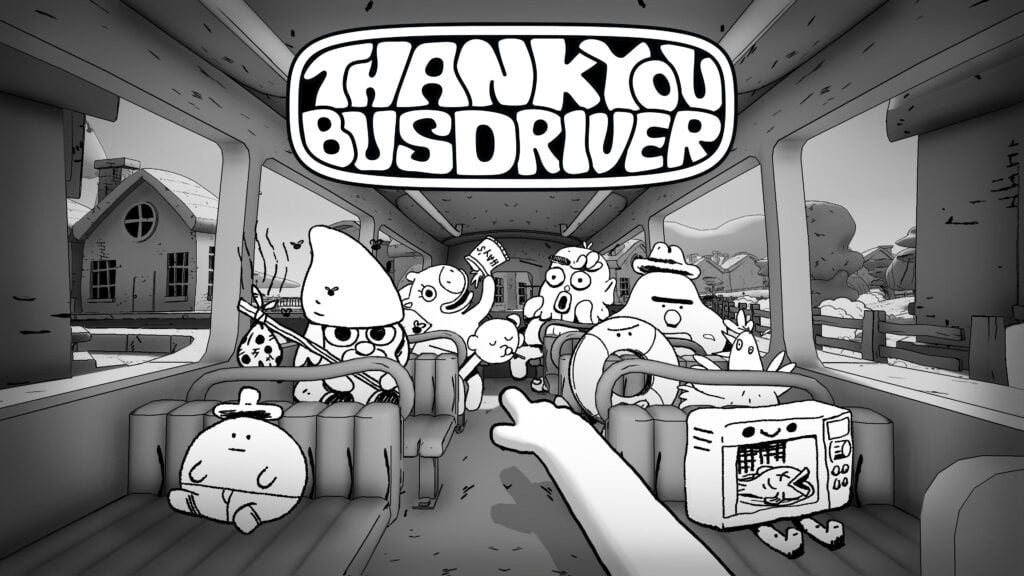
There are plenty of ways to make a bus journey miserable, but Thank You Bus Driver has found a particularly unconventional solution: let passengers break increasingly ridiculous rules, then give the driver a stretchy arm for slapping them into submission. It is an appropriately bizarre premise for Double Fine Productions, a studio known for its offbeat humour and unusual ideas. Unfortunately, while the concept provides some amusing moments, the game built around it struggles to maintain that initial appeal. Repetitive routes, frustrating visual clutter and a lack of meaningful consequences leave this inexpensive arcade driving game feeling more like a novelty than a particularly rewarding experience.
The objective is simple enough. You drive around a small town, pick up passengers and deliver them to designated stops before the timer expires. There is no story to speak of, and the broader goal is to complete shifts, earn thank yous and gradually unlock new items and environmental changes. The driving itself is straightforward, with basic acceleration, braking and steering, while the bus doors open automatically when you stop in the correct area. A giant cone floating above your destination and an on-screen map help guide you through the town, which combines rural stretches with urban streets connected by winding roads.

Finding shortcuts is one of the more enjoyable aspects of the driving. Certain gaps in fences allow you to cut across the landscape rather than follow the road, rewarding familiarity with the layout and making it possible to complete routes more efficiently. There is a little of Crazy Taxi’s arcade appeal in racing towards a destination and trying to save time, but Thank You Bus Driver never does much with the idea beyond sending you around the same small collection of roads. Once you have learned the best shortcuts, the driving becomes a matter of repeating familiar journeys rather than discovering anything new.
The passengers are supposed to be the main attraction. During each shift, announcements introduce rules that everyone must follow, prohibiting activities such as sleeping, eating, using phones and clipping toenails. The list grows as you progress through the day, turning what initially seems like a simple driving job into an increasingly ridiculous exercise in public transit supervision. If somebody breaks a rule, you can turn around and smack them with an arm that stretches across the bus. Persistent offenders can be thrown out entirely, adding another layer of cartoon violence to the proceedings.
It is a funny premise, and the exaggerated slapstick suits Double Fine’s sensibilities, but the actual process of policing passengers quickly becomes tedious. You are expected to watch the road, follow the map, manage the timer and inspect the bus for rule breakers, often at the same time. The game does not pause while you deal with any of this, so turning around to investigate a passenger can easily send you crashing into something or missing a turn. The map already takes up a considerable amount of screen space, and the need to keep checking the back of the bus makes the driving unnecessarily awkward.

The rearview mirror is meant to alleviate this problem, allowing you to spot misbehaving passengers without taking your attention away from the road. Unfortunately, it is not always reliable as a means of keeping track of everyone. Larger passengers can obstruct smaller ones, and the game’s busy presentation makes it difficult to distinguish individual characters when the bus fills up. Certain passengers tend to favour particular offences, but identifying exactly who is responsible can still feel like guesswork. A flashing indicator warns you when someone is breaking a rule, and a happiness meter gradually decreases until you deal with the problem, but neither system makes the process particularly satisfying.
Worse, the game barely encourages you to engage with these mechanics properly. Passengers do not seem to mind being slapped when they have done nothing wrong, so indiscriminate violence is a perfectly viable way to handle the situation. You can even throw everyone off the bus, although doing so ends your run rather quickly. The intended challenge of identifying offenders and keeping the peace is undermined by how little the game cares about whether you actually get it right. What could have been a clever multitasking mechanic instead becomes another distraction to manage, and the humour of repeatedly slapping cartoon passengers wears thin well before the end of a shift.
Driving recklessly is similarly consequence-free. You can plough into cars, pedestrians and other obstacles without suffering damage or facing much of a penalty. There is something to be said for a relaxed arcade game that does not punish every mistake, especially when the player is already juggling several tasks. However, Thank You Bus Driver goes so far in this direction that much of the driving feels inconsequential. The timer is the primary source of pressure, and earning thank yous from happy passengers adds a few seconds to it, but the overall structure rarely creates a compelling sense of risk. You either reach the final destination or run out of time and try again, with little meaningful progress at stake. The game is caught between wanting to be a hectic arcade challenge and offering a laid-back experience, without fully committing to either.
Progression provides some incentive to continue, at least initially. Thank yous serve as the game’s main currency and can be spent on items offered by a shady passenger who occasionally boards the bus. Each visit presents three randomly selected options, of which you can purchase only one. Some items improve passenger happiness, others increase the bus’s speed, and some provide additional thank yous. These effects last only for the current day, with your items and accumulated currency resetting when the next shift begins. Fortunately, the currency does not come out of your remaining time, so you can make purchases without sacrificing valuable seconds.

A separate progression map tracks your overall advancement along a single road dotted with question marks. Every thank you moves your bus icon forward, while completing an entire shift provides an additional boost. Reaching each marker unlocks new items or introduces changes to the world. Some of these are relatively inconsequential, such as additional rubbish on the streets or rainy weather, while others affect the structure of a run more noticeably. Night shifts bring more shady passengers into the mix, and certain upgrades provide a free item at the start of each day. There is a steady supply of things to unlock, but quantity is not the same as variety, and the rewards rarely change the experience enough to make another shift feel substantially different.
Some upgrades even reduce the need to engage with the game’s central mechanic. A super horn can wake sleeping passengers, while an air freshener prevents smelly passengers from appearing. Once a rule has been neutralized, it is crossed off the map, leaving you with fewer distractions to manage. These upgrades can make later shifts easier, but they also diminish the premise’s appeal. If the most effective way to play is to remove the very problems that distinguish Thank You Bus Driver from other driving games, the passenger management system begins to feel less like a feature and more like an obstacle you are gradually paying to eliminate.

The upgrades introduce another problem by adding more clutter to the bus itself. Items sit on the dashboard or dangle from the rearview mirror, obstructing the view even further. This is particularly frustrating because visual clarity is already one of the game’s weakest points. The colourful filters and overlapping scenery make it difficult to pick out passengers, and trying to identify a rule breaker while navigating the town can become an exercise in frustration. The visual assist mode, which highlights passengers in different colours depending on their behaviour, is a considerable improvement, but the fact that such assistance feels almost essential speaks to a larger problem with how the game communicates information to the player.
The art direction is otherwise one of its stronger qualities. The strange passengers and cartoonish environments give Thank You Bus Driver a distinctive identity, and the absurdity of its public transit creatures provides some of its best laughs. There is a recognizable Double Fine sensibility to the whole thing, even if the cast could have benefited from greater variety. Unfortunately, personality cannot compensate for the presentation’s practical shortcomings, especially when the player needs to make quick decisions based on what is happening around the bus.
Technical problems further undermine the experience. Players have reported passengers merging together, characters clipping through one another and offenders becoming difficult or impossible to identify because of overlapping models. The field-of-view slider has also reportedly caused the map to break entirely. An early update has addressed some issues, but the reported problems suggest that the game could have used more testing before release. A low price and a reportedly brief development period help explain the game’s modest scope, but they do not make bugs that interfere with basic gameplay any less disappointing. The timer can also feel unnecessarily stressful when combined with the visual clutter and constant demands for attention, particularly for players who would otherwise appreciate the game’s relaxed approach to driving.

Ultimately, the biggest obstacle is how quickly Thank You Bus Driver runs out of ideas. There is only one town to explore, the routes become familiar after a relatively short time, and the main gameplay loop changes very little from one shift to the next. The progression system provides a reason to keep going, but many unlocks are incremental improvements or minor environmental variations rather than substantial new challenges. Even the game’s funniest mechanics lose their impact through repetition. Its single-player structure also means there is no multiplayer mode to provide another reason to return once the novelty has worn off.
Double Fine’s return to independence makes it encouraging to see the studio experimenting with smaller, unconventional projects, and Thank You Bus Driver certainly has the makings of a memorable arcade game. However, an amusing premise is only a starting point. The passenger management mechanics are poorly served by the visual presentation, the driving lacks meaningful consequences, and the limited variety makes progression feel more like an excuse to keep repeating the same tasks than a genuinely rewarding journey.
At $4.99, Thank You Bus Driver is inexpensive enough to provide a few amusing shifts, and its strange sense of humour will appeal to players who enjoy offbeat games that do not take themselves seriously. Still, a low asking price cannot turn repetition into depth or make frustrating mechanics more engaging. There is a funny little game buried in here, but it never quite figures out how to make its best ideas last.
Disclaimer: A review key was provided