

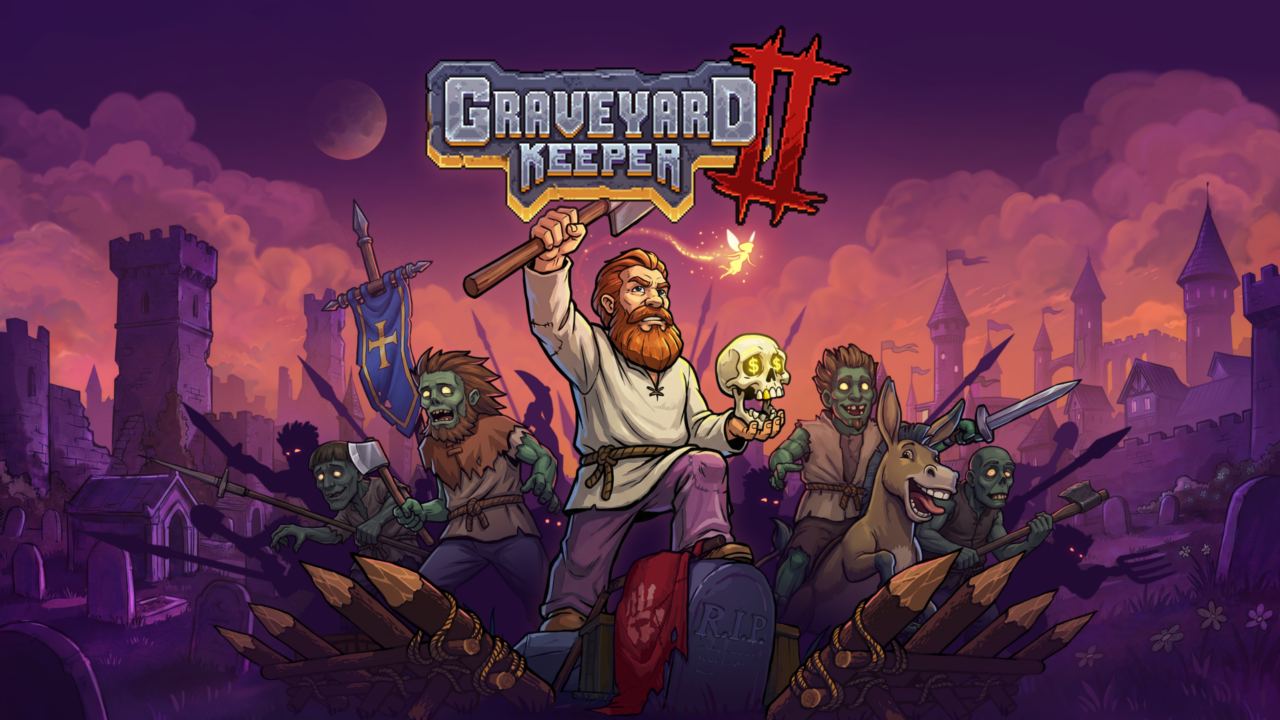
There is something immediately appealing about Graveyard Keeper 2. The original Graveyard Keeper built its reputation around taking the familiar management and crafting formula and giving it a wonderfully strange twist, and the sequel expands that idea considerably. There is more to build, more to automate, more ways to develop the Keeper, more activities to manage and, eventually, a much greater emphasis on using zombies to keep everything running. The result is a sequel that can be every bit as addictive as its predecessor, but it is also one that occasionally seems determined to make the player work harder than necessary.
At its best, Graveyard Keeper 2 understands exactly what makes this formula so effective. There is always another resource to collect, another building to construct, another technology to unlock or another production chain to improve. Completing one task frequently reveals several more, creating that familiar “one more thing” loop that makes management games so difficult to put down. Several players describe the game as an especially powerful progression loop, with almost every part of the world offering another task or upgrade to pursue.
That foundation has also been improved in a number of ways. Graveyard Keeper 2 provides more guidance than the original, its technology systems are more interconnected, the Keeper moves more quickly, the map is more compact in some areas, and voice acting gives the characters and story a greater presence. The sequel also introduces a broader progression structure through Mastery and Inspiration, while giving the graveyard more customization options and expanding the world beyond the original game’s familiar routine.

The problem is that Graveyard Keeper 2 has so many systems competing for attention that the improvements do not always fit together as cleanly as they should. The game increasingly moves toward automation, with zombies handling farming, resource gathering, crafting and other jobs before the factory introduces an even more elaborate production system. For players who enjoy automation games, this can be one of the sequel’s biggest attractions. The factory in particular adds a surprising amount of depth as production lines, machinery and zombie labour become increasingly interconnected.
Unfortunately, the automation can also become one of the game’s biggest sources of frustration.
The zombie system is a good example. Zombies are supposed to make the Keeper’s increasingly complicated operation easier to manage, yet the sequel places several restrictions on how many zombies can be employed and how efficiently they can be used. Public Relations and the resulting panic mechanic can reduce the amount of Faith generated by sermons, while Faith is itself required for an increasingly large number of progression systems. At the same time, the factory can require a considerable number of zombies simply to keep its machinery operating.
This creates an awkward contradiction at the centre of the sequel. Graveyard Keeper 2 encourages automation, but expanding that automation can make other parts of progression more difficult. Zombies are needed for farming, gathering and production, while additional zombies are also required for the factory and combat squads. Their skills also encourage specialization, making it less practical to constantly move workers between jobs. What should feel like the natural reward for building a larger operation can instead become another problem that needs to be managed.

The combat system adds to this problem. Zombie squads provide a new way to interact with the world and introduce a strategic element that was not present in the same way before. There is genuine potential in sending groups of zombies into battles, and the city encounters give the sequel another activity beyond its usual crafting and management routines. The problem is that combat can require zombies that are otherwise being used for production, forcing the player to disrupt carefully established automation chains.
The result is a system that can feel as though it is working against the game’s central philosophy. The sequel asks the player to build an efficient automated operation, then periodically requires that operation to be dismantled or rearranged to accommodate combat and other demands. Better ways to organize zombie squads, more flexibility in their skills or simply a little more room in the zombie limit could go a long way towards reducing that friction. Several player reports specifically identify the combination of the zombie limit, factory requirements and combat as one of the game’s largest mid-to-late-game problems.
Faith creates a similar issue. In the original game, Faith was already an important resource, but the sequel uses it for considerably more purposes. It is tied to progression, research, crafting, fast travel, zombie-related systems and the newer Inspiration and Mastery mechanics. The result is that Faith can become a bottleneck precisely when the player is trying to expand the systems the game has spent so much time encouraging them to develop.

The Inspiration system itself is an interesting addition because it rewards the player for performing many of the ordinary activities that make up Graveyard Keeper 2. Completing tasks and repeatedly using different skills can feed into progression, giving even routine work a greater sense of purpose. Unfortunately, the system can also become increasingly grindy as the requirements grow, particularly when Faith must then be spent to unlock the resulting progression. What initially feels like a clever way of rewarding experimentation can eventually feel like another gate placed between the player and the next meaningful upgrade.
There are smaller quality-of-life issues that make these larger problems more noticeable. Recipe pinning is one of the most obvious omissions. With so many crafting stations, resources and increasingly complicated construction projects, being able to bookmark what is currently being built would make a substantial difference. The lack of a proper search function in the technology tree and crafting systems can also turn finding the next required item into a process of repeatedly searching through menus rather than actually playing the game.
Storage is another area where the sequel could have done more. Resources are spread across multiple production areas, and there is no universal system that allows the different storage locations to work together efficiently. Chest filtering is also limited, meaning automated production can eventually fill storage with resources that are not being consumed quickly enough. That can leave the player manually clearing out accumulated materials simply to allow the automation system to continue functioning.
Production queues create a similar problem. The sequel introduces more automation, but certain stations still require the player to collect completed batches before the next batch can properly continue. That makes some of the automation feel less automated than it should be. Instead of setting up a production line and allowing it to run, the player may still need to make frequent trips back to furnaces, ovens and other stations simply to keep the queue moving.

These issues are particularly noticeable because Graveyard Keeper 2 is otherwise quite good at creating a sense of progression. The game has a satisfying amount of content, the world feels more developed, the story has more presence and the various systems are more closely connected than they were in the original. The sequel also makes several sensible quality-of-life improvements, including better guidance and a more interconnected technology structure.
The presentation helps as well. The characters have more animation and voice work, the world feels livelier, and the additional story material gives the sequel more momentum than the largely solitary routine of the original. Some players have found the opening particularly heavy on cutscenes, while others have appreciated the stronger narrative presence. There are also reports of occasional stuttering and technical issues, including zombies becoming stuck or memory-related performance problems during longer sessions, although some concerns have reportedly been addressed through patches.
The graveyard itself is another area where the sequel makes an interesting choice. There are additional customization possibilities and more ways to develop the surrounding world, but the broader focus on automation, combat and the factory can sometimes make the actual business of keeping a graveyard feel less central than expected. That is not necessarily a problem for players who enjoy the expanded management focus, but it does make the sequel feel somewhat different from what its title might initially suggest.

That broader focus is ultimately what makes Graveyard Keeper 2 such an interesting sequel. It is not simply a larger version of the original, even if much of the underlying structure remains familiar. It takes the basic management loop and pushes it further, introducing automation, factory planning, zombie specialization, combat squads, additional progression systems and a more developed world. For the right player, that extra complexity is exactly what makes the sequel so compelling.
The problem is that complexity does not always equal depth. There are moments when Graveyard Keeper 2 feels like it has added another system because there was room for another system rather than because the game genuinely needed one. The factory, zombie skills, Faith, Public Relations, Inspiration and Mastery can all be interesting individually, but their interaction can produce a considerable amount of unnecessary friction.
That is a shame because the foundation underneath all of this remains strong. The management loop is satisfying, progression is plentiful, the sequel provides a considerable amount of content and there is always something else waiting to be built or improved. The game can also be surprisingly stable, with some players reporting long sessions without crashes or major bugs.
Graveyard Keeper 2 therefore feels less like a failed attempt to improve the original and more like a sequel that does not always know when to stop adding things. Its best ideas build naturally on what made the first game work, while its weakest ideas introduce additional layers of management that can make the core experience unnecessarily tedious. The automation system is both a major strength and a major source of that problem, giving the sequel an entirely new dimension while also creating restrictions that can undermine the satisfaction of building an efficient operation.

There is a very good management game underneath the busywork, and much of Graveyard Keeper 2 succeeds because its central progression loop remains so effective. The sequel improves on the original in several meaningful ways, but it also demonstrates that more systems, more automation and more progression are not automatically better. With stronger quality-of-life tools, less restrictive zombie management and a more streamlined approach to Faith and production, many of the sequel’s biggest frustrations could become much easier to overlook.
As it stands, Graveyard Keeper 2 is an ambitious and highly addictive sequel that expands the original in fascinating ways, but it occasionally gets in its own way. There is plenty here for fans of the first game and for players who enjoy management and automation, yet the sequel would benefit enormously from remembering that the best management systems are the ones that make the player’s operation feel increasingly efficient, rather than systems that repeatedly ask the player to clean up after them.
Disclaimer: A review key was provided