

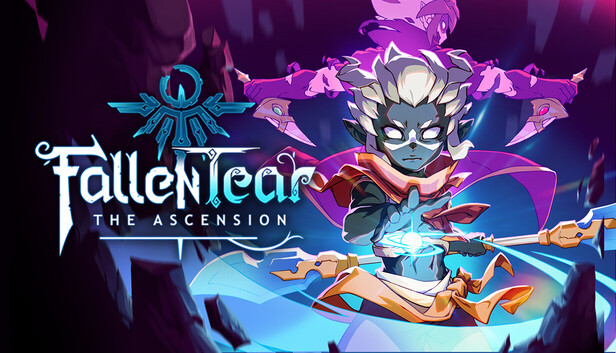
There is something immediately appealing about Fallen Tear: The Ascension. From the moment you begin exploring its world, it is clear that this is an ambitious Metroidvania that wants to give players a large fantasy adventure to get lost in. The art style is gorgeous, the environments are varied, the characters are well animated, and there is a surprising amount to discover across its sprawling map. There are times when exploring Fallen Tear feels exactly like what I want from a Metroidvania, with new paths opening up, abilities providing access to previously unreachable areas, and enough secrets scattered around to make wandering off the main path worthwhile. Unfortunately, the longer I played, the more I found myself wishing the game had been willing to do a little less.
Fallen Tear has a lot of ideas, and that is both its greatest strength and one of its biggest problems. There are different currencies, bonds, upgrades, weapons, abilities, fated tasks and plenty of other systems layered on top of the basic Metroidvania structure. Some of these work well enough on their own, but they do not always come together into a cohesive experience. Instead, there are times when it feels as though the developers kept adding another system without stopping to consider whether the game actually needed it.

That is a shame because the foundation underneath all of this is quite strong. Movement is responsive, the world is large, and once you start unlocking additional movement and weapon abilities, exploring the world becomes considerably more enjoyable. There is a real sense of progression when you finally gain the ability to reach somewhere that was previously inaccessible. Fallen Tear also does a good job of making its different regions feel visually distinct, so even when you are travelling through a large map, you rarely feel like you are simply moving through the same environment over and over again.
The art is easily one of the game’s biggest accomplishments. Fallen Tear looks fantastic, with detailed environments and fluid animations that make it clear how much work went into its presentation. There is also something strangely nostalgic about some of its locations. It does not necessarily remind me of one specific older game, but there is a familiar feeling to wandering through its world that makes the exploration more enjoyable. The soundtrack helps with this as well, giving the different areas their own atmosphere and making the world feel considerably more substantial than it might otherwise.
It is the size of that world that eventually becomes one of Fallen Tear’s biggest problems. At first, having so many areas to explore is exciting. Fifteen hours in, it can still feel as though there are countless directions left to investigate, which is an impressive achievement. The problem is that a large world needs to give the player good reasons to move through it, and Fallen Tear does not always manage that.

There are numerous occasions where I would travel through a lengthy section of the map, work my way through a platforming challenge or find what appeared to be an important route forward, only to discover that I was missing a traversal ability, key or quest requirement. Blocking progression until the player obtains a new ability is nothing unusual for the genre, but Fallen Tear does not always make these situations feel intentional. Instead, they can feel like the game has allowed you to waste your time.
This becomes particularly frustrating because the game is so large. Having to turn around and cross an entire region again is one thing when the area is relatively compact. Doing it repeatedly across Fallen Tear’s enormous map is another. The problem is made worse by the placement of save points and teleportation locations, which can leave you with lengthy journeys between areas. Fast travel exists, but having to spend currency to use it makes the system feel more restrictive than it needs to be.
There is a similar issue with some of the platforming sections. Fallen Tear has plenty of straightforward platforming, but some areas introduce long sequences involving spikes and other hazards where failure sends you back much farther than it should. These sections can be enjoyable when they are testing your movement skills, but the enjoyment disappears when the punishment for making one mistake is simply doing the same lengthy sequence again. The darker areas are another example. The idea of navigating through areas with limited visibility is perfectly reasonable, but some of these sections go on long enough that the atmosphere gives way to irritation.

The combat has some good ideas as well, although it never reaches the consistency I wanted from it. Basic enemies are varied enough to keep encounters from becoming completely repetitive, and there are some bosses that provide enjoyable fights. Once the different combat and movement abilities start coming together, there are moments when Fallen Tear feels genuinely fluid.
The problem is that the combat can also feel awkward in ways that are difficult to ignore. Armoured and shielded enemies can become particularly annoying when you do not have the appropriate ability available, while some enemies can block attacks or remain resistant during situations where it feels as though the player should have an opening. The backstep parry is an interesting mechanic, but it does not always feel reliable. Against enemies with multiple-hit attacks, successfully avoiding the first hit does not necessarily mean you will avoid the rest, and even when you time the counter correctly, an enemy can sometimes move away before the attack connects.
Bosses can make these inconsistencies even more apparent. Some are surprisingly easy, while others suddenly pile several mechanics on top of one another. There are fights where the difficulty feels like it comes from keeping track of several things happening simultaneously rather than from learning a particularly satisfying pattern. Fallen Tear can therefore move between being too easy and frustratingly difficult without always giving the player a clear sense of why the difficulty has changed.

The game’s progression systems suffer from a similar problem. I like the idea behind the bonds and the various ways of developing your character, but there are simply too many layers competing for attention. Some upgrades provide relatively minor statistical improvements, while other systems feel as though they exist mostly because the game needs another form of progression. The bond system has the potential to make your relationships with characters feel more important, but in practice it often comes down to unlocking abilities or improving your damage.
Currency is another area where the game makes things more complicated than they need to be. Losing currency upon death can make mistakes more costly, while teleportation also consumes resources. Neither system is inherently unreasonable, but when combined with the enormous map and inconvenient placement of travel points, they can turn simply getting from one part of the game to another into a chore. There are also situations where enemies do not seem to provide enough currency to make these systems feel particularly rewarding.
The story unfortunately does not provide enough momentum to compensate for these slower stretches. Fallen Tear begins with enough promise to make you curious about its world, but the writing rarely develops that promise as well as it could. Character motivations are often explained rather than demonstrated, and some characters seem to make important decisions with very little buildup. There are characters I enjoyed meeting, and the voice acting can be surprisingly good in places, but many of the cast members never develop far beyond their initial personalities.

The long gaps between meaningful story sequences also hurt the pacing. Fallen Tear is capable of creating a compelling opening and then leaving you exploring for hours before giving you another substantial piece of the narrative. Exploration can carry a game a long way, but when the world itself is already padded with large areas and lengthy routes, those gaps become more noticeable.
That said, I do not think Fallen Tear is simply a bad game. There is too much here that works for that assessment. The world is beautiful, there is a genuine sense of exploration, and the sheer amount of content is impressive. Finding a new ability and realizing how many places it can open up is still satisfying, and there are plenty of moments where the game captures the appeal of wandering through a huge interconnected world.
The problem is that Fallen Tear often seems determined to make the player work harder than necessary for those moments. A game can be challenging without being inconvenient, and a large world can be expansive without being padded. Fallen Tear sometimes crosses that line, particularly when lengthy platforming sections, backtracking, awkward fast travel and unclear progression requirements start piling up.
This is ultimately what makes Fallen Tear: The Ascension such a frustrating experience to evaluate. I can see the game that the developers were trying to make, and there are moments when they get surprisingly close to it. The presentation is excellent, the world is ambitious, and there is a strong foundation underneath all of its systems. But instead of refining those strengths, the game frequently adds more mechanics, more space and more obstacles, making the overall experience less focused than it could have been.

Fallen Tear: The Ascension feels like a game with considerably more potential than polish. There is a genuinely enjoyable Metroidvania buried underneath the excessive backtracking, inconsistent combat, padded environments and overcomplicated progression systems. With tighter level design, clearer progression, more focused writing and a little less unnecessary friction, this could have been something special. As it stands, there is still plenty to appreciate, particularly for players who enjoy large and exploration-heavy Metroidvanias, but the experience asks for considerably more patience than its best ideas should require.
Disclaimer: A review key was provided