

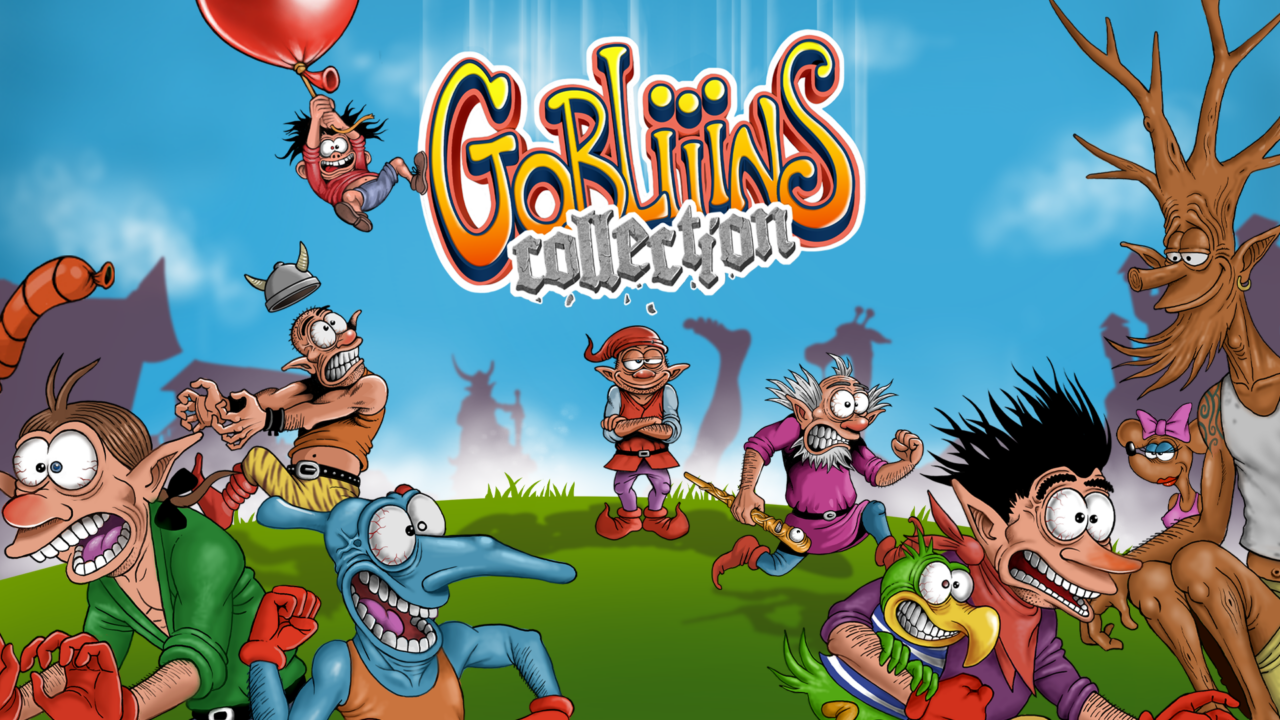
One of the unfortunate realities of any genre is that a handful of games end up defining the conversation while others quietly fade into the background. Point-and-click adventures from the ’90s are no exception. Mention the genre today and most people will immediately think of Monkey Island, Space Quest, Sam and Max or perhaps Myst or Grim Fandango, that is if they do not immediately think of modern Telltale style games. Far fewer remember the bizarre adventures of three argumentative little goblins who solved problems through equal parts ingenuity and complete nonsense. The Gobliiins series never reached the same level of recognition as its contemporaries, but it carved out its own identity with surreal humour, inventive puzzles, and a willingness to embrace the absurd. Gobliiins Collection finally gives the series the retrospective it has long deserved.
Thankfully, this isn’t the sort of compilation that simply dumps a handful of ROMs onto a storefront and calls it a day. Every mainline entry makes the cut, from the original Gobliiins through Gobliins 5, stopping just short of Gobliins 6: The Madmen of the Year 1000, which is simply too recent to have been included. The biggest surprise is easily the fourth game. While Gobliins 4 is often considered the black sheep thanks to its jump into early 3D graphics, it has also been frustratingly difficult to play for years. Seeing it preserved alongside the rest of the series means the franchise is finally available in one complete package, warts and all.

The collection also deserves credit for including both floppy disk and CD-ROM releases wherever applicable. It’s a thoughtful touch that acknowledges the series’ history instead of presenting a single “definitive” version. The only real omission is the lack of Amiga editions, leaving this as an exclusively MS-DOS-focused package.
Revisiting these games today, what struck me most wasn’t how old they feel, but how confident they remain in their own strange identity. Modern puzzle games often go out of their way to make sure players never feel lost, whether through generous hint systems or subtle environmental nudges. Gobliiins couldn’t care less.
Its puzzles operate on pure cartoon logic. You’ll combine objects that have no obvious relationship, perform actions that seem completely irrational, and somehow discover that you’ve solved a problem several screens away. Success rarely comes from following a logical train of thought. Instead, it’s about experimenting until the game’s wonderfully warped sense of humour reveals itself.
That sounds frustrating—and at times, it absolutely is—but the series avoids becoming outright punishing because failure is usually entertaining in its own right. Rather than scolding players, the games reward experimentation with exaggerated animations, slapstick mishaps, and plenty of visual gags. Watching your goblins fail is often just as amusing as watching them succeed, making trial and error feel like part of the joke instead of a punishment.
Well…mostly.

The original Gobliiins remains the collection’s roughest outing thanks to one design decision the sequels wisely abandoned: a health bar. Every failed action chips away at your limited health, meaning too much experimentation eventually leads to a game over. It feels oddly restrictive in a series that otherwise encourages players to poke at everything just to see what happens. Thankfully, every sequel removes this mechanic, allowing players to experiment freely without worrying about being punished for their curiosity. As a result, the series becomes noticeably more welcoming after its first outing.
Even with that caveat, some entries stand above the others. Gobliins 3 remains the undisputed highlight, striking the best balance between inventive puzzles, memorable characters, and the offbeat humour that made the franchise stand out in the first place. It’s the game where the formula finally clicks, embracing its own weirdness without becoming overwhelming.
At the opposite end of the spectrum sits Gobliins 4. Its transition to 3D was ambitious, but the technology simply wasn’t ready to capture the expressive charm of Pierre Gilhodes’ artwork. The humour is still there, but much of the personality gets buried beneath awkward visuals that have aged considerably worse than the series’ hand-drawn entries.
That leaves Gobliins 2 and Gobliins 5, both of which comfortably land somewhere in the middle. Neither reaches the highs of the third game nor stumbles as much as the fourth, instead delivering exactly what longtime fans would expect: clever puzzles, surreal comedy, and more than a few moments where you’ll inevitably mutter, “How was I supposed to figure that out?”

One area where this package feels surprisingly hands-off is its approach to modern conveniences. Aside from adapting the controls for gamepads and the Switch’s touchscreen, these are essentially the original releases untouched. There are no save states, no rewind feature, no built-in hint system, and no optional quality-of-life settings to smooth over some of the more dated design decisions.
Whether that’s a positive or a negative largely depends on what you’re hoping to get out of the collection. Purists will undoubtedly appreciate the commitment to preservation, but newcomers may find themselves wishing for a few optional features to soften the rougher edges. These games were designed around a mouse, after all, and while the updated controls work well enough, neither buttons nor touchscreen input ever feel quite as natural as simply pointing and clicking.
Outside of the games themselves, the compilation includes a modest but worthwhile selection of bonus material. A music player lets you enjoy the series’ wonderfully eccentric soundtracks outside of gameplay, while a small gallery showcases artwork from across the franchise’s history. The standout extra, however, is a multi-part interview with series creator Pierre Gilhodes. Rather than feeling like a token inclusion, it’s an insightful retrospective that offers genuine context on the development of the games and the creative process behind one of adventure gaming’s stranger success stories.

It’s the sort of archival content more retro collections should strive for.
That attention to preservation makes one omission all the more puzzling, though.
For reasons I genuinely can’t explain, the original manuals are nowhere to be found.
Considering the effort that clearly went into recreating the original packaging—including beautifully rendered 3D versions of the retail boxes and multiple regional variants—the absence of the manuals feels like a strange oversight. Instead, players are given little more than basic controller layouts before being left to figure everything else out on their own.
Normally, that wouldn’t be a major issue. Here, it absolutely is.
The Gobliiins games rarely explain themselves, and newcomers unfamiliar with old-school adventure games could easily miss mechanics or interface quirks that were originally covered in the manuals. Including those documents would have rounded out the preservation effort while making the collection far more approachable for first-time players. Their absence doesn’t ruin the package, but it does feel at odds with the obvious care shown elsewhere.

Fortunately, that’s about the only major complaint I have with the presentation. The games run well, the interface is clean and unobtrusive, and the bonus features demonstrate a genuine appreciation for the series rather than simply treating it as another retro release to push out the door.
Gobliiins Collection isn’t trying to reinvent these games, nor should it. Instead, it succeeds by making an overlooked series readily available again while respecting what made it memorable in the first place. The puzzles remain wonderfully nonsensical, the humour is still delightfully offbeat, and five full adventures provide plenty of content for anyone willing to embrace their peculiar brand of logic.
It won’t convert everyone. Adventure games built around surreal puzzle design are as niche today as they’ve ever been, and players accustomed to modern conveniences may find some of the older design philosophies difficult to overlook. Yet that’s also part of the collection’s charm. Rather than sanding away every rough edge, it presents the Gobliiins series largely as it originally existed, preserving both its strengths and its eccentricities.
Missing manuals and somewhat compromised controls prevent this from becoming the definitive archival release the series deserves. Even so, the care shown throughout the package makes those shortcomings easier to forgive. For longtime fans, this is an easy recommendation and a welcome reminder that one of adventure gaming’s most delightfully bizarre franchises hasn’t been forgotten. For curious newcomers, it’s a chance to discover a genuinely unique corner of the genre’s history—provided they’re willing to embrace a little chaos along the way.
Disclaimer: A review key was provided
Reviewed on Nintendo Switch