

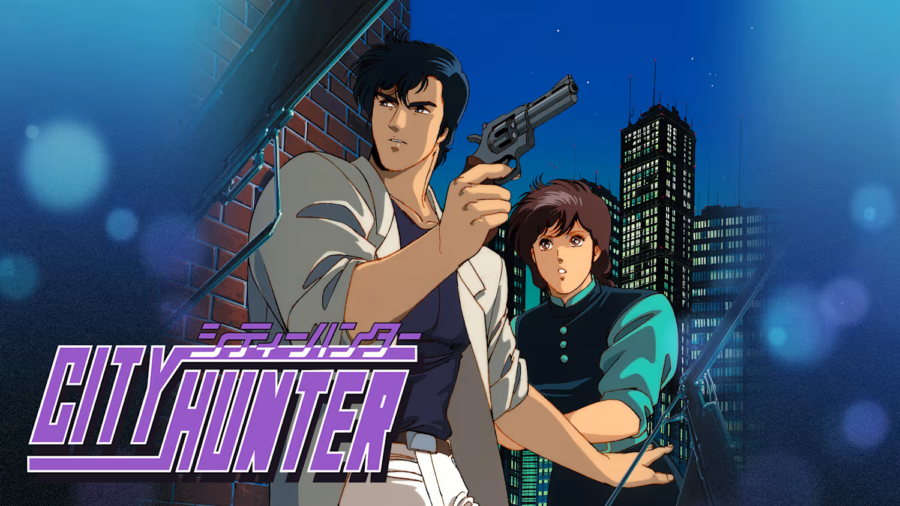
If you’re an anime fan, you’ve probably heard of City Hunter. With 4 series, 90 episodes, 4 movies, and 3 TV specials, it’s an expansive series that has been running off and on since 1987. The series is about a detective and mercenary named Ryo Saeba who works cases with his partner Kaori Makimura. Ryo is a playboy and there’s some fairly campy stuff in the show, but he’s also an expert marksman. While not as silly as Lupin the 3rd, City Hunter manages to bridge the gap between serious and offbeat pretty effectively with a bit more focus on the action.

With such a huge following you’d think that City Hunter would have a strong presence in the gaming world as well. It seems almost custom-designed to fit into the gaming world, but oddly only a single game was made in 1990 by Sunsoft for the PC Engine (Japanese Turbografx-16). What’s even wilder is that that game was never localized, even though City Hunter was, at least until now!

Thanks to developer Red Art Games and publisher Clouded Leopard Entertainment, City Hunter has finally been released in English! Now it’s time to see how this vintage title holds up. What you’ll immediately notice is that the new menu system is clean and responsive and there are multiple gameplay modes available. In addition to the original version of the game unchanged from the PC Engine, there is a new Enhanced mode that rebalances the game and tweaks some of the enemy responses. There’s also a hard mode for pure masochists if that’s your thing!

Starting City Hunter, you can immediately feel the age of the game but that’s not a bad thing in itself. Each stage provides you with a text description of the case you’re walking into and then drops you right into the action. You’ve got a pistol and…nothing else. It’s up to you to explore the building you’re in, figure out who to talk to, and what to do to progress. City Hunter definitely does not hold your hand no matter which version you choose either. The original and enhanced modes are almost indistinguishable for each other but after a while playing each, the enhanced mode does seem slightly more forgiving overall with noticeable tweaks to controls. As you run through each stage, enemies come rushing at you at extremely high speed but most only take one or two bullets to take down. Unfortunately, unless you’re really ready for it, there are likely to run into you, stab you, or shoot you almost before you have time to react. The sprites are huge and dodging or jumping over enemies isn’t really an option, even though you can jump.

Luckily, there’s a rewind function on this new version of City Hunter for those times when you accidentally rush right into almost sudden death or try to duck with the analog stick and manage to get hit by a bullet anyway. A few hits won’t really matter in City Hunter though since there are nurse stations strewn throughout the game that heal you to full health easily. There are other places to heal as well but we’ll talk about that more later. Regardless, enemies continue to spawn randomly when you leave their area and often chase you around until you whip around and shoot them. They almost invariably come from the left or right and only a few are out of normal shot range, which is good since you can’t shoot up or at an angle (until you get the weird missile launcher).

Wandering around shooting people isn’t the entire game, though it is the vast majority. What your real goal here is is stopping the bad guy (there’s not a lot of plot so we won’t ruin it) and to do that you’ll have to talk to people in various rooms around the levels. There are no enemies in rooms with NPCs so you’re always safe in these rooms but the levels are intentionally confusing and repetitive, making City Hunter take a fair amount of time due to design issues rather than being a long game on its own. The dialogue is fairly simplistic and references a plot that isn’t really clear in the game itself, but this isn’t exactly the strongest story to begin with, so you’re not really missing out. It’s a shame more effort wasn’t put into the story though. Most NPCs will ignore you until you’ve approached the previous NPC that triggers them, so you end up doing a lot of backtracking to figure out the order in which to talk to people. For such complex levels, City Hunter is an incredibly linear game and there’s only one way to complete each stage. The only thing that varies is whether or not you find the weapons hidden in each level. You can absolutely miss alternative weapons, making some of the bosses noticeably more tedious, so try not to miss any doors, even though they all look the same and half of the rooms do too.

There are several weapons that you can find, given to you by various characters tucked away in certain levels including a bakooka, a missile launcher, and a laser. All of them are more powerful than your standard handgun and each has unlimited ammo. Unfortunately, their fire rates and ranges very widely and you’ll have to use the center pad on the Dualsense to swap weapons. Walk into the wrong room with the wrong weapon and either you won’t be able to damage a strong enemy quickly with the weaker handgun, or you’ll have to wait for the slower fire rate of a more powerful weapon and end up taking damage. On bosses, you’ll definitely want the more powerful weapons but for the weaker guys that constantly flood most areas, the handgun fires far faster and is more effective. Coming in and out of rooms and up or down staircases can also be a hassle as the enemies spawn immediately and often almost on top of you rather than running from off screen, almost guaranteeing they will damage you. Depending on what way you’re facing when entering a door also factors in because if you’re faced the wrong way, you have to turn around to fire on those close enemies and the game just isn’t quite responsive enough for that without copious rewinds.

While there are definitely a number of bosses in City Hunter, they’re honestly a bit underwhelming. Every boss has simplistic patterns that are easily avoided, usually by running back and forth. If you haven’t found upgraded weapons, you’re guaranteed to take hits, but bosses don’t hit any harder than regular enemies, so as long as it’s only a few, you’ll absolutely be fine. There’s very little challenge to any combat in the game aside from the speed at which some enemies move and the durability of bosses who take a fair number of hits even with stronger armaments. Honestly, the main draw of City Hunter is a combination of nostalgia and anime fandom and there’s not a lot here to make the game a pinnacle of retro gaming, especially considering how amazing some huCards were on the PC Engine.

Visuals for City Hunter are crisp and clean and the game looks surprising good on the PS5. The pixel artwork has aged exceedingly well and the overall design work is quite good, except for the weak boss designs for most bosses. The GUI for the game is also very nice and accessing save menus and bonus materials is clean and intuitive. There’s a single CRT filter as well and it doesn’t interfere too much, which is a nice change from most digital filters. All in all, this is an excellent visual port in HD, which makes it sad that the music for the game is rather weak. There are only a handful of tracks and they all thunder through the level in short loops that try to make gameplay more exciting than it is and fail miserably. The sound effects are also fairly rudimentary, making the audio easily the weakest part of City Hunter, even more so than the convoluted levels.

There are some nifty bonuses included with City Hunter as well. Nothing too outrageous but the entire original game manual (in Japanese) is included in the bonus menu. There’s also an art gallery, something included with almost every retro release these days. Fortunately, City Hunter has always had excellent art design and the gallery is actually pretty interesting. Finally there’s a music player, another retro collection standard, but as with the gallery, the music from City Hunter is pretty good as long as you don’t play it in a pounding loop for hours on end. That’s about it for extras, but they’re all nice to have, even if you only use them occasionally.

Unfortunately, not everything is fantastic with City Hunter. We’ve already talked about the repetitive level design and high speed enemies and those definitely put a damper on the gameplay but there’s one more major issue with the game and it has to do with its age. As you’re wandering around City Hunter’s vast levels and checking every door because you don’t want to miss any weapons and need to talk to all the NPCs, you’ll occasionally walk into a women’s change room. There are no men’s change rooms to walk into though, and the further you get into the game, the more scantily clad the women are, eventually appearing naked and covering themselves, almost like a reward for exploration. They all scream at you to get out but very creepily, your health recovers every time you peep on them. In addition, some of the women make very suggestive comments that are quite sexualized during the course of the game. All in all, the subtext for City Hunter is noticeably misogynistic, much like the original anime. We have to consider that this is first, an archival re-release of the original game, and second, a product of its time but that doesn’t really make the content better. Instead, it’s important to remember that this was normalized in the late 80s and early 90s and remember that this sort of content is no longer appropriate, and that this content will definitely be a turn off to some players 35 years later.

City Hunter is a unique relic of the 16 bit era and it’s fantastic that Red Art Games and Clouded Leopard Entertainment have made sure that we can go back and play it at a reasonable $25. Even though it isn’t the greatest game ever, it’s a unique experience that plays like a high speed Rolling Thunder with a plot (as thin as it is) and while there are some major missteps in women’s representation in it, it still ends up being an enjoyable and somewhat frustrating experience. Fans of the anime and retro enthusiasts are definitely going to want to play this one, but it certainly won’t be for everyone.

This review is based on a digital copy of City Hunter provided by the publisher. It was played on a PS5 using a 1080p 55” Sony TV and on the Playstation Portal where it played equally well. City Hunter is also available on Nintendo Switch, Xbox, and PC on Steam.

Nate Van Lindt has been a gamer since the days of yore (aka Commodore 64), and has played a bit of virtually everything out there. He's also an avid comic book collector, both vintage and current, and reads a fair amount of sci-fi and fantasy. On top of that, he watches a fair number of movies and TV shows as well. Oh, and he has a family, a full-time job, and lives somewhere in the urban wilds of Southwestern Ontario, Canada, foraging for old video cables and forgotten game soundtracks.