

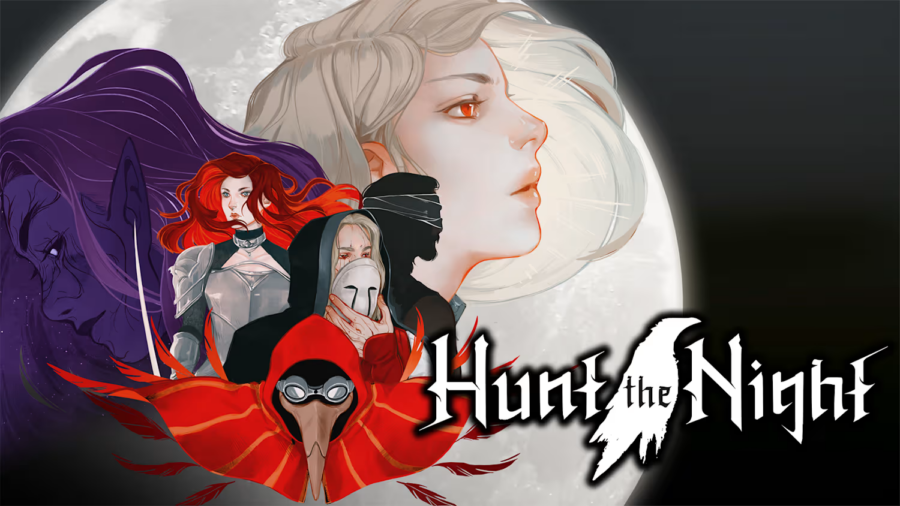
Indie gaming is pretty much the core of modern gaming the last few years. With more and more traditional studios being bought up by investment groups, siphoned dry, and then closed, major AAA content is starting to disappear and more experimental and niche titles aren’t approved anymore, so we’ve been seeing independent titles picking up that slack and innovating these days. That’s why we’re seeing interesting new games like Hunt The Night from Spanish developer Moonlight Games and publisher Dangen Entertainment.

Hunt The Night sounds like a vampire hunting game but it’s far more interesting than that. Very basically, you play Vesper, a mute Stalker. Stalkers hunt creatures of the Night (capital N) in order to help drive back the darkness that will take over the world of Medhram. Day and night aren’t diurnal in this world and the humans had found (discovered?) a seal that would keep the world in perpetual day, holding monsters at bay and ensuring humanity’s survival. Unfortunately, that seal is shattered and some argue that it cannot hold back the Night indefinitely. Regardless, as a Stalker that can use the powers of the Night, you are uniquely imbued with the strength to retrieve the broken shards of the Seal and bring light back to the world.

Medhram is slipping into darkness and it’s on you to save it. The game starts out with Vesper’s fellow Stalkers being attacked by some sort of monster and drops you right into the fray, exploring a dark and eerie castle full of powerful monsters, traps, and puzzles to solve. Working your way through is complex and in many ways this feels like a darker version of the gameplay from The Legend of Zelda: Link to the Past. Vesper is armed with both edged weapons and guns, and as you play you’ll slowly unlock several versions of each. What you’ll quickly find is that Hunt the Night is a particularly unforgiving game and that combat requires patience, skill, and dedication.

What Hunt the Night also has in spades is atmosphere. This is a spectacularly creepy experience all the way through. From the soft, menacing soundtrack that amps up during major events to the intensely creepy creature designs and weird backdrops, it just oozes style with every screen. There aren’t many games that absolutely nail the aesthetic the way this one does. Everywhere you go manages to be menacingly oppressive and it really feels like you’re the last thread of defense before the extinction of humanity. It’s an outstanding design achievement and everything from exploration to combat feels amazing.

Slashing weapons require you to get in close to enemies that quickly counterattack, often before you have time to react. The combat isn’t based solely on melee though. Instead, your most powerful ability is a dash that makes you temporarily invincible and slightly draining your magic bar with each use. You can dodge directly through bullets, enemy attacks, and even over empty spaces in order to get to otherwise unreachable areas. In combat, you’re frequently in tight quarters, so dodging is an absolute necessity. Fortunately the control system is pretty tight so once you get the timing down for enemy attacks, they become much easier to fend off. Rushing in is almost always deadly though, so you’re forced to attack with patience, using hit and run tactics to worry away at enemies. Even weak enemies take more than a few hits, forcing you to plan your attacks in order to survive. You can dash all the way through most enemy hordes as well, but you’ll need the Noctilum (money) that enemies drop so you don’t want to skip too much combat!

Melee combat and dashing is complemented by your ranged weaponry. You start with a single long range six-gun which targets with the right stick and fires with the right shoulder button. Later, you’ll also pick up a very close range shotgun that uses three bullets at once and a crossbow that fires three bolts in a spread pattern. The weapons can all be upgraded to more powerful versions in Ravenford with enough Noctilum and those upgrades will definitely help you. Ranged combat can keep you from taking damage with tougher enemies and your bullets, while limited, can be regenerated with melee combat. Three strikes in a row replenishes a bullet, making it so you have to get in close enough to keep your ranged weapons full so you can do the additional damage or hit distant enemies and balancing your use of both melee and ranged techniques is a necessity. Guns are also used to open up timed platforms, allowing you to jump across vast chasms. Run out of bullets because you weren’t planning ahead and you’ll be stuck or fall though. Falling will take a health point and put you back where you started and being stuck means restarting the game at the last save.

Save points are few and far between in Hunt the Night and you’ll have to plan carefully to make it through. Dying puts you back at your last save but some things (opened doors, key items, etc) stay opened or available when you die. It’s still irritating to go all the way back to a save point and fight your way through yet again, but after a bit of practice, it’s clear that the game is straining you to slowly build your skill and confidence before breaking it back down over and over again. This is a hard game and at first it seems like everything is tough but fair. That soon gives way to punishing difficulty informed mostly by memorization. There are no maps to help you on your quest. No difficulty settings to give you a chance in story mode. Just death and restarting until you figure out what to do and memorize the areas, much like 16-bit games of old.

Once you’ve finished the initial portions of the game, Hunt the Night opens up into a semi-open world game where you can explore various areas once you’ve unlocked the requisite powers to move through them. Once you hit a save point, it also unlocks fast travel to that save point, though you’ll miss out on grinding and end up poor fairly quickly. Fighting your way through a ton of enemies is worthwhile because you can come back to Ravenford where the only human encampment is. There are a variety of merchants there who will allow you to buy equipment including health upgrades, new weapons, armor, moonstones (ability modifiers), and weapon upgrades. Having those boosts will help you survive the rather unforgiving nature of Hunt the Night, at least for a while, so don’t hesitate to spend your cash when you have the chance! There are also plenty of items hidden in various places in the world around you so explore, explore, explore! You might end up locked in a nasty room with a bunch of monsters but there’s always something good…if you survive.

You’d expect a game called “Hunt the Night” to involve hunting in some way and you would be correct. In addition to working your way through major levels to retrieve the shards and bring back the day, you can also go into the bar in Ravenford and buy contracts to kill particularly powerful monsters. Each contract costs Noctilum, but if you find the monster’s lair and defeat it, you’ll get an additional health point each time, making you a heck of a lot more durable. Some of the fights are particularly challenging though and you’re definitely going to get put through the paces to earn that extra life. Any time you see a weird orange eyeball stuck in a wall somewhere, that’s a hidden monster lair. If you can’t access it, you haven’t bought the right contract yet.

Some areas will initially be inaccessible in Hunt the Night but you’ll eventually gain the help of Umbra, a creature of the Night inhabiting your mind who helps you survive and sends her body across pools of purple goo that are otherwise impassible. You can then swap bodies with Umbra to transition through the Night across the pools and progress, though this drains your magic bar quickly. Eventually, Umbra will gain some additional abilities unlocking access to even more areas as well. Using Umbra is easy, but your body can take hits while she’s drifting away so you sometimes have to carefully time her use and it can be a bit frustrating.

While Hunt the Night might be challenging, it’s also an absolutely gorgeous game with amazing art design and creative levels. Each area looks radically different and appropriately creepy as the Night is slowly encroaching on all of civilization, rotting and mutating creatures, buildings, and nature until they look like corrupted Lovecraftian horrors. There is very little repetition with new enemies and visuals in each area, so you never know what to expect from abandoned medieval villages to frozen wastelands and even a mental asylum that runs on actual electricity. Everywhere you go, the care and detail put into the top down Zelda-style pixel art is fantastic and the monstrous creations often craftily hide secrets strewn all across the land. There’s no map either, so you’ll have to memorize anything you want to come back to and check out and you don’t want to miss any hidden areas. Hunt the Night is a triumph of pixel art that oozes both slime and style.

The audio for the game is similarly impressive as it is particularly subtle. Composed by Hiroki Kikuta of Secret of Mana fame, the soundtrack that accompanies your explorations is slow, methodical, and dismal, reinforcing the slow death of the world around you as it is strangled out by the Night. Key battles and action sequences ramp up the music, adding stress and tension to already difficult battles and the sound effects are well-executed, making hits seem more tangible as you both take and give them. In short the entirety of the soundscape for Hunt the Night heavily adds to the immersion level of the game and you’ll quickly lose the world around you as you play, getting sucked into the minutia of exploration and survival as you guide Vesper through the horrors around you.

While it’s an awesome game, Hunt the Night is also a bit of a flawed experience due to the intense and variable difficulty that slowly ramps up as you play. Make no mistake this is a challenging game by any means, but the initial levels leave you with the impression that it is tough but fair. Once you learn most of the enemy patterns in the open world areas, it feels like things are balancing out, but by about halfway through, there’s a massive difficulty spike. Weirdly, some bosses are incredibly easy while others are painfully challenging, leading to a lot of frustrating when you initially feel like you’ve mastered your approach to the game and then get your ass handed to you on a platter as soon as you start being a bit confident. Pattern recognition and timing are everything here and honestly, most players are going to give up and get frustrated by halfway through between the lack of a modern map system, the convoluted overworld, and the extremely high challenge level of the game when you do progress.

There’s also a major glitch in Ravenford where the main merchant who sells weapons, armor, and moonstones has his inventory just disappear. Only one weapon remains and there are no options for other selections in the menu. If you buy that weapon, your inventory management screen also disappears and you’re left unable to change weapons, armor, or moonstones at all. The only way to clear this glitch is to go back to a previous save and it was a known issue with the PC version of the game as well. Hopefully it will be patched as it would be great to be able to actually buy more powerful items!

One final issue is with the Switch version of the game. We were lucky enough to play both the PS5 and Switch versions of the game and sadly, the Switch version is limited by a noticeably lower framerate and longer load times which interfere with game flow. While we rarely talk about framerate here, in a side-by-side comparison, the Switch version of Hunt the Night felt choppy and less responsive and with the precision required by the game, it’s difficult to recommend the Switch version. The PS5 version of the game is noticeably smoother and definitely the better way to play the game. That’s a shame because the controller for the Switch, especially the Switch Pro controller, is markedly better for precision gaming and cam mostly make up for the framerate lag, but there are limits to the amount of compensating you can do, even with a good controller.

Hunt the Night is an incredibly cool, atmospheric action game that amps up challenges intermittently to an almost unreal level. This is definitely an experience that’s designed solely for hardcore players, which is a shame because a bit of approachability here for varied skill levels would have made the game an absolute smash hit. As it stands, be prepared to struggle, swear, and cramp your hands on the controller as you inch your way through the incredibly challenging second half of the game, but every bit of Hunt the Night is fascinating and rewarding. At only $20 it’s a heck of a game that will push you to your limits and beyond, but it won’t be for everyone and by now you should know exactly what you’re in for.

This review is based on digital copies of Hunt the Night provided by the publisher. It was played on a PS5 using a 1080p Sony 55” TV and on the Switch in both docked and undocked modes. The PS5 version of the game plays noticeably smoother than the Switch version. Hunt the Night is also available for Xbox and PC on Steam.

Nate Van Lindt has been a gamer since the days of yore (aka Commodore 64), and has played a bit of virtually everything out there. He's also an avid comic book collector, both vintage and current, and reads a fair amount of sci-fi and fantasy. On top of that, he watches a fair number of movies and TV shows as well. Oh, and he has a family, a full-time job, and lives somewhere in the urban wilds of Southwestern Ontario, Canada, foraging for old video cables and forgotten game soundtracks.