
Picross is kind of a niche genre where the occasional game comes out, some of which are poorly done, and some excellent. The nonogram puzzle style has been around for quite some time at this point though and they are starting to get a fairly good following among puzzle gamers. The gold standard picross games are from Jupiter, makers of Nintendo’s series. Today however we’re looking at an indie picross game that challenges the traditional notion of picross a bit.

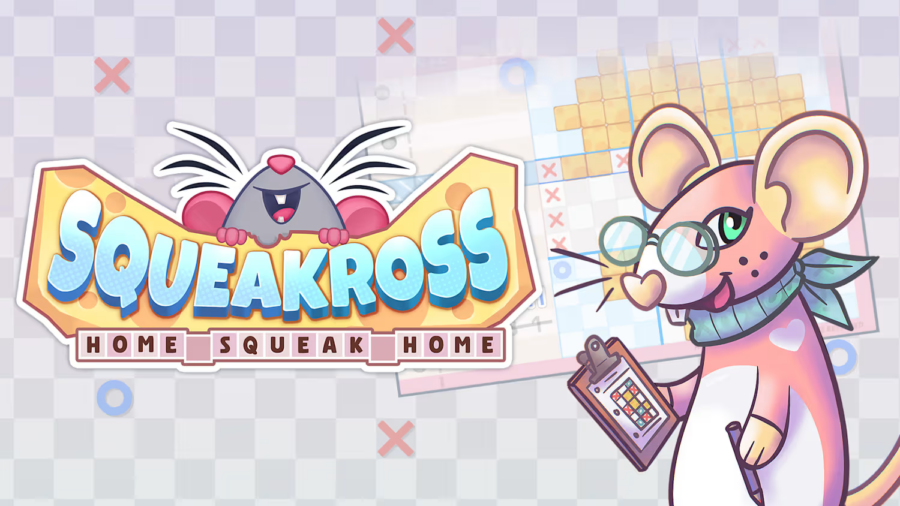
Squeakross: Home Squeak Home (we’ll just call it Squeakross) from indie dev Alblune is an interesting picross game where you are unlocking décor and outfits for a rat. Yes, you read that right. You actually get to design your rat with a customization interface and then solve picross puzzles to unlock décor for their room and outfits for them to wear! Yes, this is an odd concept but it works surprisingly well. Once you’ve designed your rat (fur markings, whiskers, eyes, etc), it’s time to start solving puzzles. Initially, you’re given a catalog (Home Squeak Home) but as you solve puzzles in it, you will eventually unlock Volume 2 of the catalog. Two new furniture and clothing catalogs were just added to the game as well, Volume 3 of Home Squeak Home and The Spirit and the Mouse, dropping in hundreds of additional puzzles.

In Squeakross, the puzzles are very similar to other picross games, at least at first. Choosing which blocks to X out and which ones to mark to complete the images is a fairly well-known operation at this point. However, Squeakross has all of the assistance turned on by default, so if you want to try and brute force your way through puzzles, you absolutely can with no penalties. Mistakes are clearly labeled in bright red on the fringes of the screen and they’re easy to fix. For a harder challenge, the various help systems can be manually disabled in the option menu but unlike Jupiter’s games, there are no penalties for using assistance systems. You can also adjust visual settings to dark mode and other small tweaks, which is a nice change from other titles.

The real difference in Squeakross is actually something you might not expect. We’ll get to the decorating later because that’s different too, but the big change is in the puzzle structure. Squeakross uses non-standard grids regularly and it can be more than a bit confusing for veteran picross players. The standard for picross games is 5×5 squares that contain 25 smaller squares and are formed into larger grids of up to 30×30 if you hate your life. Squeakross throws that standard right out the window with 6×6 grids, 8×8 grids, and a variety of weirdly nonstandard sizes of puzzles that throw off the automatic mental calculations of long-time picross players and force you to actually think about the puzzles. At first this can be more than a bit frustrating but what you’ll soon realize is that the change in puzzle structure leads to actually thinking about the puzzles a bit more while you’re solving them and ends up being a fresh way to revitalize gameplay in a genre that has limited options for change. It’s a clever little shift that makes Squeakross stand out among its competition.

Each time you solve a puzzle from the catalog, that item is then available “for sale” in the Home Squeak Home catalog, allowing you to install it in your apartment. At the touch of a button, you can switch from the catalog screen to the home screen, allowing you to use the drop down menu to select furniture, décor, and outfits that are dropped either into your house or directly onto you in the case of outfits and accessories. Initially you start with a single room to decorate and a smattering of furniture and accessories. Lamps, books, and other things simply drop on the floor if there’s nowhere to put them so it’s important to unlock enough furniture before you start decorating.

Once you’ve got enough gear to get things going, you can start installing beds, couches, TVs, appliances, and plenty of other stuff. Each puzzle unlocks something you can actually use, which is a refreshing change from games that just provide you with things to look at as a kind of prize to make you feel special. Squeakross eschews that approach and instead allows you to decorate your own private room a la Animal Crossing. Even if you’re not into décor, the interface is so simple and the finished rooms are so gratifying that it’s actually fun to decorate and even change walls, flooring, and furniture layouts. This sort of thing is not for everyone but it absolutely works in Squeakross and you just have to try it our take our word for it.

There are literally hundreds of things to unlock, meaning that every individual player will have wildly different décor depending on which puzzles they choose to complete and their personal decorating preferences. One of the more surprising details in Squeakross was the inclusion of pride and trans flags and gear, something that is not at all mentioned or alluded to. What’s particularly awesome about this is that it is entirely normalized, inclusive, and optional. This is the way this sort of content needs to be present everywhere, not in your face, but just there in the same way as any other content that you wouldn’t think twice about. Once you get multiple rooms, you’ll probably reconfigure from a studio apartment design to more spacious multi-room living, allowing you to experiment with thematic furniture like space and pirate gear once you’ve unlocked it. There are plenty of options and combinations to choose from that work and it’s nice to occasionally drop out of the puzzles to freeform decorate before jumping back in.

Speaking of decorating, while there is plenty of décor to choose from, it might not necessarily be suited to your personal aesthetic. Or perhaps you might want two or 3 of the same item in your Fortunately, once you complete each catalog page a new option opens up called Nini’s Challenge that allows you to complete an additional puzzle for that item. Once you have done so, it unlocks the ability to change the color of that item when you place it in your house. You can also place multiple instances of any given item once it’s been unlocked in the challenge. Adding extra puzzles and additional palette swaps is a pretty sweet bonus in a puzzle game in general and it’s great that Squeakross rewards additional play without it feeling forced or tacked on. Gameplay also unlocks a number of fun emails that add world background and show cute pictures of rodents at various intervals, a bonus that’s been added recently to the game.

Visually, there’s nothing particularly wild about Squeakross. Your rat is cartoon cute and the various outfits range from ridiculous to classy, to hilarious. Room visuals are similarly slightly exaggerated but a lot of care was clearly taken designing each object and it makes the whole experience that much more rewarding. The GUI for Squeakross is well-designed too and easy to use, though we kept jumping to the apartment rather than the catalog at first. The picross board itself also has options for night mode and various visual responses to puzzle solving such as error alerts. The grey and crossout functions work well too and it’s easy to read puzzle numbers on all but the largest puzzles, even on the small portable screen of the undocked Switch. The only thing that is a bit difficult visually is seeing the transition grid lines for non-standard grids. Repeatedly counting the number of squares in those grids was a bit frustrating here and there but this is relatively minor and you do get used to it after a while.

Surprisingly, the audio in Squeakross is actually quite interesting. While there are only a handful of noises (rat squeaks, puzzle noises, etc), the soundtrack is great. During any given puzzle you can change the track easily in a menu screen and go back to playing with music on your own terms. There is some excellent instrumental jazz on the Squeakross soundtrack and while a few of the tracks almost seemed too upbeat, others would not be out of place in the background of someone’s home or business and almost deserve their own track releases. For such a small indie game, the soundtrack for Squeakross is solid.

While there are plenty of positive when it comes to Squeakross, it isn’t a perfect game. A couple of minor flaws surface once you’ve spent enough time with the game, especially on Switch. First is the lack of a touch interface. Every picross game on Switch should have tactile controls as well as controller support and Squeakross is controller only. The other problem with Squeakross is the difficulty of the game. While puzzles get larger, the vast majority seem fairly easy, especially in comparison to the picross games from Jupiter which are borderline unfair at best and downright evil at worst. This is more of a cozy picross game, making the puzzles seem almost friendly and even when there’s an opportunity to challenge players a bit, it feels like the puzzles in Squeakross play it just a bit safe, with multiple solution possibilities in most every puzzle. That’s not a bad thing, but veteran players expecting a significant challenge might be waiting a bit longer than they’d like to.

Squeakross: Home Squeak Home is a solid picross game that’s better than most of the indie picross experiences out there and has some fun additions with decorating and additional palette swaps for items that are unlocked through bonus puzzles. The music is good, the presentation is fun, and it’s an all around great picross game that’s fun to play, even if it’s not the toughest one out there. At only $15, it’s a great game with a ton of gameplay available and well worth picking up for your Switch or Switch 2!

This review is based on a digital version of Squeakross: Home Squeak Home provided by the publisher. It was played on a Nintendo Switch in both docked and undocked modes and played equally well in both. Squeakross: Home Squeak Home is also available for PC on Steam and Itch.io.

Nate Van Lindt has been a gamer since the days of yore (aka Commodore 64), and has played a bit of virtually everything out there. He's also an avid comic book collector, both vintage and current, and reads a fair amount of sci-fi and fantasy. On top of that, he watches a fair number of movies and TV shows as well. Oh, and he has a family, a full-time job, and lives somewhere in the urban wilds of Southwestern Ontario, Canada, foraging for old video cables and forgotten game soundtracks.