

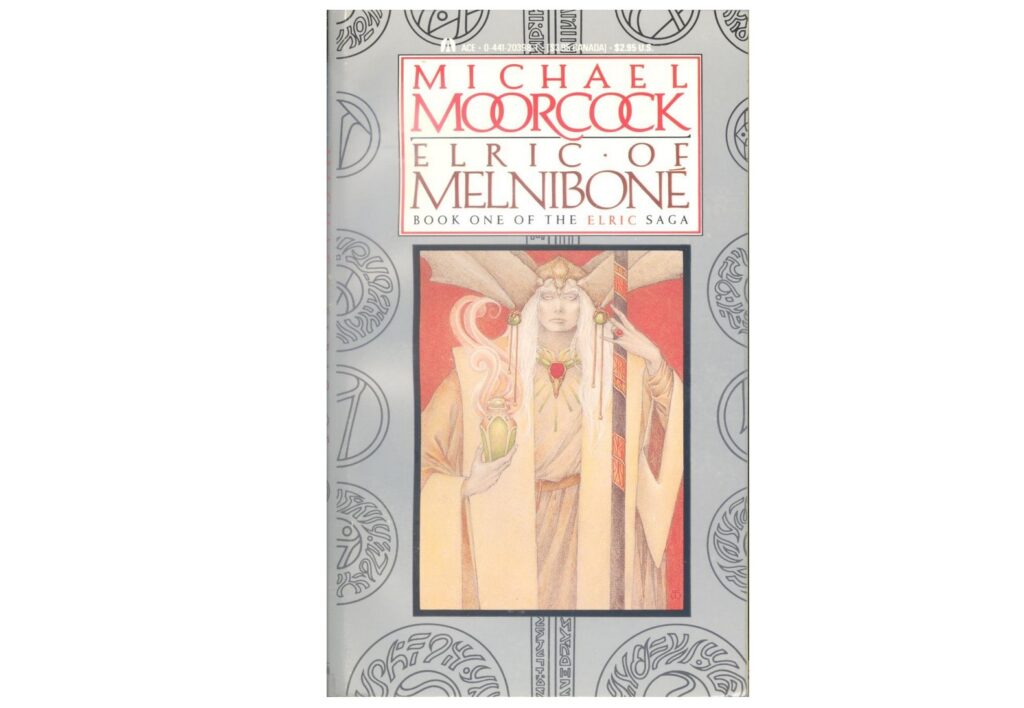
In 1961 a young writer named Michael Moorcock was asked by his editor to write a story in the style of Conan the Barbarian. The result was not what the editor expected, as Moorcock proceeded to create a character who was the antithesis of Conan in almost every way and would inspire his own legacy. Debuting in the story, The Dreaming City, readers were introduced to the last emperor of Melniboné, the bearer of the black sword Stormbringer, the white wolf, Elric of Melniboné, the doomed albino.
Moorcock wrote several Elric stories, which were collected in book form and then proceeded to write more Elric stories later, including a prequel novel set before the rest of the stories that has since become the first novel in the series retroactively. The novel Elric of Melniboné serves as an introduction to the character and sets up the events of later stories. It is here we see Elric as an emperor, something mentioned in the other stories but not something that is particularly a major driving point except in specific circumstances in later stories. Most of the later ( and technically earlier) stories have Elric as a traveling soldier of fortune, often accompanied by his companion Moonglum, but here the focus is on Melniboné itself and Elric’s conflict with his cousin Yyrkoon, something that was established as a major point in The Dreaming City.
One thing Elric of Melniboné does well is explain the world of the white wolf and how the forces within work. We see that Melniboné is an empire in name only and now a shadow of its former self, being Moorcock’s commentary and criticism of the British Empire and its actions, with its past brutal control of other nations that have since seized their freedom. Elric stands out immediately, both to the reader for his unique nature, and within the story for being unlike the other Melnibonéan people in that he wants more for their society and not just embracing mindless decadence and torture. And yes, Melniboné and its people were the inspiration for almost every depiction of Dark Elves in fantasy that would follow, whether the writers knew that or not.
We also see Elric interact with supernatural entities and call upon others in his initial quest and how this foreshadows what will play a role later in the series. It should be noted that Moorcock had already written and published what was the final chronological novel in the series, so it is interesting to see how he included details to help make the other installments have what feels like payoffs. That said, Elric of Melniboné feels different from the rest of the series, and while still a dark fantasy tale, has more of an epic fantasy feel to it.
One key moment shown is Elric’s first encounter with Stormbringer, his iconic black blade that will be his greatest strength and his greatest enemy throughout the series. It is subtle here, but we do get an idea that Elric does not realize what he is getting into with Stormbringer and the pain it will bring him, especially for those who are starting the series with this book. And make no mistake, Elric of Melniboné is a good book to start with and most collections of the Elric novel begin with it for a reason.
If you want to see the turning point in fantasy fiction where dark fantasy began to take hold and would radically change the genre, then look no further than the Elric Saga and Elric of Melniboné. We would also recommend the various comic book adaptations of the novel for their excellent interpretations of the story, be they the original Roy Thomas scripted comics or the recent French comic adaptations, all are available thanks to Titan Comics. Elric of Melniboné the book and the character are something truly special and have stood the test of time for a reason.