

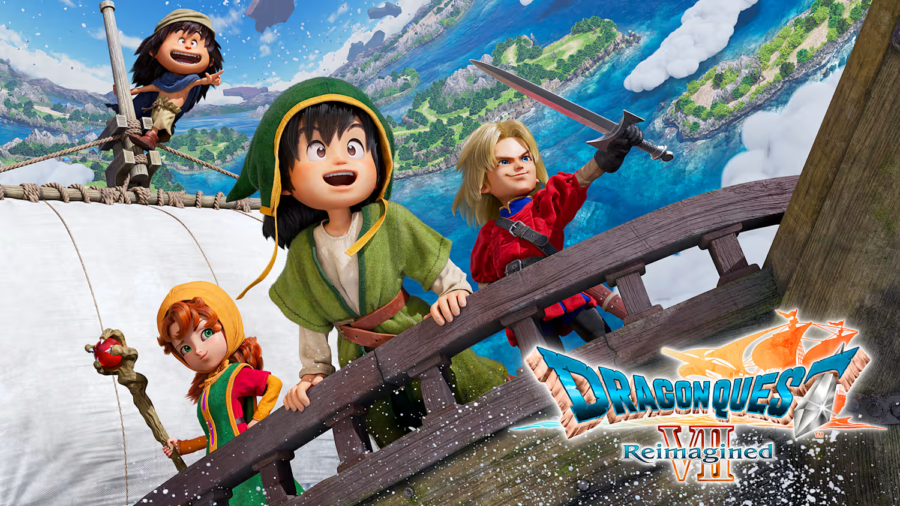
Dragon Quest is the original JRPG. It might not be the very first but it’s one of the most notable franchises in gaming history with actual release date holidays due to insane demand and an absolutely massive library of games and fan base. The Dragon Quest games are uniquely gorgeous too thanks to the wonderful art of the late Akira Toriyama. Over the last few years we’ve been treated to re-releases of the first 3 games in the series more than once, most recently with the HD releases of Dragon Quest I and II and Dragon Quest III (review here). Now it’s time to skip ahead to Dragon Quest VII Reimagined!

Why creator and publisher Square-Enix decided to skip Dragon Quest 4, 5, and 6 isn’t clear, but it’s not like any of the games in the series are bad so it really doesn’t matter. Dragon Quest VII was originally released in North America on PS1 as Dragon Warrior VII, the first game in the series to make it to a semblance of 3D. Later, the game was re-released on the 3DS as Dragon Quest VII: Fragments of the Forgotten Past. With that release as a starting point, we now finally have a definitive HD version of the game with Dragon Quest VII Reimagined.

While the core storyline of the game is well-documented, let’s get into a few specifics. You play an unnamed child growing up on the coast of the only island in the world. Your dad is a sailor, you hang out with the mayor’s daughter, and you’re best friends with the prince of the local castle. Seems like a pretty sweet life but you and your friends think there’s more to the world than the island you all live on. I’m sure you can see where this is going, right? Needless to say there are demons, gods, and magic involved in a complex plot of a game that will take you a good 75 hours of gameplay with an epic storyline that definitely takes a while to get going. We’re not going to ruin that story for you but once you get far enough, you’ll be collecting tablet fragments which allow you to travel to different places and change the world around you, so don’t worry about your tiny island being too small to explore!

Each new area brings new challenges, new enemies, and new fragments of a larger story that slowly weaves together to create a memorable experience that feels incredibly vintage and old-school. It’s the classic Dragon Quest experience and by far the longest game in the series. Naturally the mechanics have stayed fairly consistent too, so old DQ players will be almost immediately familiar with the controls and Square-Enix has done an excellent job of modernizing the menus and interfaces to make everything faster and easier to manage. Combat can be easily automated with the Tactics button so long as you pay attention to how powerful your party is and item management is a breeze with the new interface. You learn a teleportation spell called Zoom fairly quickly too and unless the story prevents it, you can zip all over the place very quickly for no magic points, allowing you to expedite your progress in the game, a welcome change from the PS1 version.

The thing that really makes Dragon Quest VII Reimagined special though is that your actions have consequences and because of the way the story is structured, you’ll get to see exactly what happens as a result of those actions. You might save someone one minute only to find out that your actions enabled someone else to be utterly terrible the next. The way this is approached broadens the perspective of players, forcing them into a macro understanding of the world of the game and creating an interesting contemplative background for the way we think about plots. The Dragon Quest series isn’t exactly known for its deep storylines and intense worldbuilding like the Trails games or Final Fantasy, but Dragon Quest VII is a bit different because we see growth, changes, and most importantly human flaws in the characters as we play. That’s a refreshing change for a very traditional JRPG.

Combat becomes interesting once you get far enough in the game for the job system to unlock. Every character has a set job to start and you slowly become more and more skilled at that job, gaining additional spells and attacks until it maxes out at level 8. Once you reach a certain point in the story, you are able to change your jobs and even add a second “moonlighting” job to your repertoire, letting you shift your skills, attacks, and abilities based on your job selection. At first, this is incredibly frustrating because you’ve powered all your characters up and changing jobs zeroes out your skills. You’ll quickly learn however that setting your tactics to “Consume no MP”, ensuring your gear is up to date, and automating combat will raise your job skills rapidly as each combat gives you 7 job points. Defeating an enemy in the overworld only gives you one however, so blazing through the combat with enemies that are underpowered vastly slows your job growth. It’s a trick that makes your entire party ridiculously overpowered as your job skills grow. You’ll even unlock new tiers of jobs once you get far enough and if you thought you were powerful before…

In addition to the bonuses from jobs, grinding through combat with Tactics handling most battles aside from bosses nets you a ton of gold and experience and your levels raise rapidly. While it’s a shame that the end battle data isn’t also automated, it’s still a pretty fast process and limits how tedious grinding can be, making Dragon Quest VII Reimagined a fair bit more fun than its original incarnation. It does pay to pay attention to the gear you have equipped though, as some of the monster hearts and items make a big difference depending on your job, weapon, and armor loadouts. While you aren’t going to be min/maxing the same way you might in a Trails game, Dragon Quest VII does a good job of making combat just a bit more interesting and some of the enemies have some pretty fun little surprises and tricks.

There are several interesting ways to zip around in Dragon Quest VII as well and lots of hidden things to find. As well as the Zoom spell that lets you go to any previously visited area, you can also obtain a ship and there’s an additional surprise way to travel (no spoilers!) for the dedicated explorer. Taking the time to do some extra exploring is important because there are areas and side quests that you will never find if you don’t go off the beaten path a bit. Lots of permanent buff items (seeds) are hidden everywhere and plenty of tablet fragments too, allowing you to add additional areas to explore as well as further powering up your party. This also helps Dragon Quest VII Reimagined feel like a deeper game that’s more alive in many ways.

Not only is this a long and involved game as JRPGs go, but it’s also a pretty one. One of the key selling points is the reworked visuals of the game. Unlike other recently redone Dragon Quest games, this is a fully 3D rework, not just a 2D/3D engine. The textures and visuals combined with Toriyama’s distinctive style create a gloriously superdeformed world that’s simply fun to spend time in. While the focus is clearly characters and creatures, a lot of time went into making each area distinctive in some way and adding a lot of fine detail to things like plants and the bricks of buildings. Cinemas are particularly spectacular and the game has a crisp AAA feel almost all of the time. Unfortunately for the sharp-eyed, there is also a weird glitch in the rendering system around your character. While it doesn’t happen all the time, when it activates there is a clearly square range box around your character where all of the background textures take an extra moment to load and the square around you appears slightly blurry as you move. This typically takes place in dungeon areas, not towns or the overworld, but it’s just disconcerting enough to be noticeable and slightly irritating, sucking you out of full immersion in the Dragon Quest world.

As you’d expect, the sound is also quite good in Dragon Quest VII Reimagined. There are plenty of tracks to draw from in the Dragon Quest library and the music is suitably heroic and moving. Again, there are a couple issues though. While there are plenty of tracks, this is a long game and you tend to get the same tracks in certain places over and over again, slowly becoming more and more repetitive as you play. The songs simply aren’t long enough and some of them don’t necessarily fit the storyline of the moment, creating a bit of musical dichotomy that can occasionally fell more frustrating than enjoyable. It’s not all the time but it’s certainly enough to mention.

The game has a ton of spoken dialogue as well and the voice actors take their roles seriously and do a great job. Not every single conversation is voiced, much like the Trails series, but all the important ones and a fair number of minor ones are. It’s sometimes surprising which portions of the dialogue are voiced but they’re generally quite interesting. Where things get a little odd however, is the script itself. Dragon Quest VII really wants you to feel like you’re going to strange and distant lands, which means that you’ll be reading and hearing very unique dialects. Well-travelled players will recognize these as various nationalities turned into caricatures, including French, German, British, Middle Eastern, and more. While it’s clever, it also seems a bit odd and might bother some players with the stereotypical dialogue. This is also reflected in the voice acting and each new area brings a new audio experience as well, which is neat. It can also come off a bit weird though, and in these days where everyone is bothered by everything, has a small potential to irritate or offend a minority of players.

At this point, you can see that there aren’t a lot of terrible flaws outside of the occasional odd video glitch and some repetitive music. However, Dragon Quest VII Reimagined has one more little tidbit that might not sit well with everyone. While we’re not going to get into specifics, there are a couple of different stories arcs within the game that have some fairly misogynistic undertones and some questionable behavior by a few of the male characters. While it’s understandable that at the time these scenes were originally written, they were considered appropriate, it’s a bit of a shame that there were no modifications for the reimagined game that shifted the nature of those plot points to something a bit more modern. This is definitely a minor quibble with the script because it’s likely that these weren’t scenes that were intentionally designed that way in the first place but it’s worth mentioning for a release in 2026.

Dragon Quest VII Reimagined is a spectacular game that has interesting combat for its age, an involved storyline where intertwined threads play out in unexpected ways, and a long and engrossing main story that makes you want to keep playing even though the game is noticeably longer than similar titles. The visuals and audio are excellent and while there are a few minor flaws and design issues that could be slightly improved, this is easily the best version of Dragon Quest VII ever released and a joy to play. At $60, you’re paying a AAA price but you’re getting what is unquestionably a AAA game and a memorable experience. If you’re at all a fan of traditional JRPGs, Dragon Quest VII Reimagined is more than worth your time and you’re going to end up exploring every inch of this gloriously remade world whether you played the original release or not. This is a must-have for Dragon Quest fans and RPG players alike and it runs extremely well on the Playstation 5 so don’t miss out!

This review is based on a digital copy of Dragon Quest VII Reimagined provided by the publisher. It was played on a Playstation 5 system and portably on the Playstation Portal where it played equally well. Dragon Quest VII Reimagined is also available for Nintendo Switch, Switch 2, Xbox Series X/S, and PC on Steam.

Nate Van Lindt has been a gamer since the days of yore (aka Commodore 64), and has played a bit of virtually everything out there. He's also an avid comic book collector, both vintage and current, and reads a fair amount of sci-fi and fantasy. On top of that, he watches a fair number of movies and TV shows as well. Oh, and he has a family, a full-time job, and lives somewhere in the urban wilds of Southwestern Ontario, Canada, foraging for old video cables and forgotten game soundtracks.